

Disclosure: This article contains paid links to one topical scalp serum. If you buy through those links, slimglowdr.com earns a commission at no extra cost to you. We only recommend products we believe are a reasonable fit, and the commission does not change our evidence assessment of any supplement or serum on this page.
Written and fact-checked by Dr. Kaneez Fatima, Pharm-D. Last updated: November 2026.
Maybe you noticed it in a photo first: your part looks wider than it used to. Or the shower drain clogs faster, or your ponytail holder suddenly needs an extra twist. For many women, these changes show up in their 40s or around menopause. They're common, they're often treatable, and they tend to send you straight into a supplement aisle full of gummies promising thicker hair in weeks.
The catch with picking the best hair growth supplements for women over 40 is that the right choice depends on why your hair is thinning. A supplement that corrects a real iron deficiency can make a difference. The same supplement taken by someone whose iron is already fine may do nothing, and in some cases it can cause harm.
So this guide works in the order a careful clinician would. We start with the common causes of midlife thinning and the blood tests worth asking about. Then we rank the popular oral supplements by the strength of their evidence and flag the safety issues. Finally, we cover topical scalp serums as a separate category, because something you apply to your scalp works differently from something you swallow.
Quick Answer
There's no single best hair growth supplement for women over 40. If blood work shows low iron (ferritin), vitamin D, or zinc, correcting that deficiency is the best-supported step. A few multi-ingredient formulas show modest results in small, brand-funded trials. Biotin rarely helps unless you're deficient. Give any supplement 3 to 6 months before judging it. Cosmetic scalp serums are a separate category from oral supplements; they are covered near the end, along with minoxidil, the best-supported topical.
Why Hair Thins After 40
Hair loss in women over 40 usually falls into one of three buckets: a gradual, hormone-influenced pattern; a sudden wave of shedding after some kind of shock to the body; or a medical or nutritional problem that shows up in your hair. Many women have more than one going on at once. The reason this matters is practical: each cause responds to a different fix, and only one of them responds well to supplements.
Female pattern hair loss and the drop in estrogen
According to the American Academy of Dermatology, female pattern hair loss (FPHL, also called androgenetic alopecia) is the most common cause of hair loss in women. It usually begins in midlife, and because it's more common after menopause, the AAD says hormones may also play a role. The early signs are the ones many women recognize: a widening part and a thinner ponytail.
What's happening at the follicle level is called miniaturization. In people with a genetic tendency, affected follicles produce progressively finer, shorter hairs with each growth cycle. Androgens such as DHT are thought to drive part of this. During perimenopause and menopause, the balance between estrogen and androgens shifts, and a 2022 press release from The North American Menopause Society (now The Menopause Society) noted that estrogen loss may accelerate FPHL because hair follicles carry estrogen receptors. The Society was clear that more research is needed on exactly how sex hormones contribute.
How common is it? A study in the journal Menopause found FPHL in 52.2% of 178 healthy postmenopausal women aged 50 to 65 at one clinic in Thailand. Most cases were mild, and the likelihood rose with age and time since menopause. That study covered women aged 50 to 65 after menopause at a single clinic, so it can't tell us how common FPHL is in your 40s, and one clinic's patients won't perfectly mirror US women. The broader takeaway still holds: hair thinning around and after menopause is common, not a personal failing.
Two practical points matter for anyone shopping for menopause hair loss supplements:
- FPHL is gradual and tends to progress without treatment. The AAD says treatment works best when started at the first sign of hair loss, so waiting a year to "see what happens" has a cost.
- Nutrients don't reverse miniaturization. If FPHL is your main issue and your labs are normal, a vitamin is unlikely to be the answer on its own. The evidence-backed tools for FPHL are covered in the topical and medical treatment sections below.
Telogen effluvium: shedding after stress, illness, or rapid weight loss
Every hair follicle cycles through phases. The anagen (growth) phase lasts for years, followed by a short transition called catagen and then the telogen (resting) phase, after which the old hair sheds. Telogen effluvium (TE) happens when a shock to the body pushes a large share of follicles into the resting phase at the same time. The shedding shows up later, typically a few months after the trigger (often around 2 to 4 months), which is why many women never connect the two.
[VISUAL PLACEHOLDER: Simple diagram of the hair growth cycle showing the anagen, catagen, and telogen phases, with an arrow from a trigger such as rapid weight loss to increased shedding "a few months later". Alt text: Diagram of the hair growth cycle showing how a trigger like rapid weight loss leads to shedding months later]
TE feels different from FPHL. Instead of a widening part, you notice, in the AAD's words, "a lot more hairs in your brush or on your pillow," spread across the whole scalp. Common triggers include illness, surgery, major stress, crash dieting, low protein intake, and rapid weight loss.
That last trigger matters for many women reading this site. Rapid weight loss, whether it comes from surgery, very-low-calorie dieting, or a GLP-1 medication, is linked to this kind of shedding, and the evidence comes from several directions:
- Bariatric surgery: a meta-analysis of hair shedding after rapid weight loss from surgery pooled 18 studies and estimated that 57% of patients experienced hair loss afterward. It was more common in women and in people with low zinc, folic acid, or ferritin, and it became less common with longer follow-up.
- GLP-1 medications: a large 2026 study of GLP-1 users with type 2 diabetes, published in the BMJ, linked starting a GLP-1 drug with a higher relative risk of hair loss than starting an SGLT-2 inhibitor (37% higher after adjustment). The absolute risk stayed low: 6.91 versus 5.04 cases per 1,000 person-years. The researchers couldn't tell whether the weight loss itself or the drug was responsible. Hair loss is also listed as a possible side effect on the prescribing information for some GLP-1 weight-loss medicines.
- Safety reports: an analysis of the FDA's adverse event reporting database found hair loss reported more often than expected with semaglutide and tirzepatide. Reports like these can flag a pattern, but they can't show how often it happens or prove the drug caused it.
If you're on a GLP-1 and notice shedding, tell your prescriber. Don't stop the medication on your own. The more useful response is usually to protect your protein and nutrient intake and check iron and zinc, which we cover below.
The good news about TE is that it usually resolves once the trigger passes. The AAD says most people see their hair regain its normal fullness within 6 to 9 months. That timeline creates a common trap: a woman starts a hair supplement at the peak of her shedding, her hair recovers on its own over the next few months, and the supplement gets the credit.
Thyroid problems, iron deficiency, and other medical causes
Some thinning is a symptom of something else, and fixing that "something else" is what brings the hair back.
- Thyroid disease. The AAD notes that a thyroid problem can cause thinning hair and that treating the thyroid disease can reverse the hair loss. Hypothyroidism is common in midlife women and also causes fatigue, weight gain, and feeling cold, so it's worth ruling out.
- Iron deficiency. Heavy or irregular periods, which many women experience during perimenopause, can steadily drain iron stores. Restrictive diets add to the problem.
- Low vitamin D, zinc, protein, or biotin. The AAD says that when you don't get enough biotin, iron, protein, or zinc, "you can have noticeable hair loss," and that hair can regrow once your body gets enough of the missing nutrient.
- Too much of certain nutrients. The same AAD page warns that large amounts of vitamin A or selenium are toxic and can cause hair loss. Over-supplementing is a real cause, not a theoretical one.
- Medications. Many prescription drugs list hair loss as a possible side effect. Classes commonly linked to shedding include anticoagulants (blood thinners), beta-blockers, oral retinoids, certain anticonvulsants, and antithyroid drugs, and starting or stopping hormonal contraceptives can also set off a shed. Shedding usually shows up 2 to 4 months after the change. If yours began after starting or switching a medicine, tell your prescriber or pharmacist, and don't stop a prescribed medicine on your own.
What to Check Before You Buy a Hair Supplement
This guide is general education, not medical advice. Hair loss has many causes, and a clinician can examine your scalp and order the right tests for your situation.
This is the step most supplement buyers skip, and it's the one that decides whether a supplement has any chance of helping.
Blood tests to ask your doctor about
When you raise thinning hair with your doctor, these are reasonable tests to ask about. Your clinician may add or skip some based on your history.
- Ferritin and an iron panel. Ferritin reflects your stored iron, and the research on ferritin and hair loss is genuinely mixed: some studies link low ferritin to shedding and others don't. A 2023 clinical guide in Cutis describes ferritin as a useful tool for ruling out underlying iron deficiency in women with diffuse hair loss. Some dermatologists use a ferritin of about 40 ng/mL as a cutoff for recommending iron, but a review of vitamins and minerals in hair loss states plainly that there's no consensus on a "normal" ferritin level for hair. Ask your doctor what your result means for you, and mention it if you've had heavy periods or feel unusually tired or breathless on stairs.
- TSH (thyroid-stimulating hormone). A first-line screen for thyroid problems, which are both common in midlife and reversible causes of thinning.
- Vitamin D (25-hydroxyvitamin D). Low levels are common and easy to correct.
- Vitamin B12. Low B12 is one of the anemia-related problems worth ruling out, especially if you eat few animal foods. Its direct link to hair regrowth is weaker than iron's.
- Zinc, in some cases. Worth discussing if you've had bariatric surgery, follow a very restrictive diet, or have lost weight quickly.
One more item belongs on the list even though it isn't a test: tell your doctor and the lab if you take biotin, including in hair, skin, and nail gummies or a multivitamin. Biotin can distort some lab results, as explained in the safety section.
[VISUAL PLACEHOLDER: Printable checklist graphic listing ferritin and iron panel, TSH, vitamin D (25-OH), B12, zinc (if relevant), and "tell your doctor if you take biotin.". Alt text: Checklist of blood tests to ask about for hair thinning after 40]
Red flags that mean see a doctor first
Some patterns call for a dermatologist before you spend anything on supplements. As general clinical guidance, book an appointment if you notice:
- Sudden hair loss, or loss in round or patchy areas rather than general thinning
- Scalp pain, burning, itching, scaling, or redness
- Loss of eyebrows, eyelashes, or body hair
- Signs of thyroid disease or anemia, such as unusual fatigue, feeling cold, a racing heart, or shortness of breath
- Shedding that hasn't eased after 6 months, or thinning that's clearly getting worse
Some of these patterns point to conditions, including scarring forms of hair loss, where early treatment protects follicles that can't recover later. A supplement can delay that diagnosis.
Before you buy anything, ask your doctor for the blood tests above. It's the cheapest step in this whole guide, and it tells you which of the supplements below are worth considering.
Do Hair Growth Supplements Actually Work?
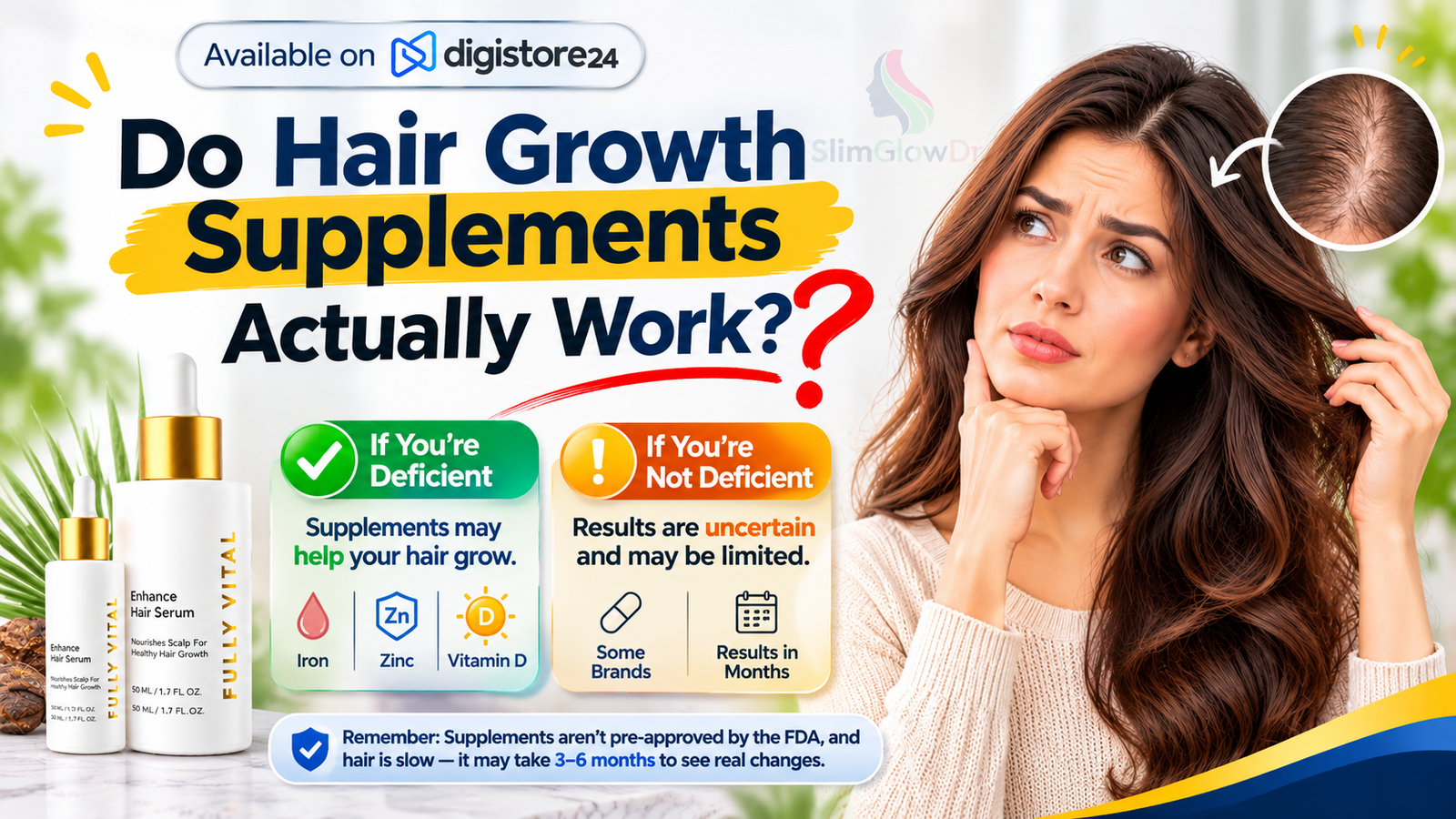
The short answer to whether vitamins for thinning hair work in women is: it depends almost entirely on whether you're deficient.
If you're deficient, correcting the deficiency has the clearest support. The AAD says hair can regrow once the body gets enough of a missing nutrient such as iron, protein, or zinc.
If you're not deficient, the picture is murkier. A systematic review of hair supplements in JAMA Dermatology examined 30 studies, 17 of them randomized controlled trials, in people with hair loss and no known deficiency. The highest-quality evidence suggested potential benefit for a handful of products, including Viviscal, Nutrafol, and an omega-3/6 formula with antioxidants. Evidence for vitamin D and B12 was lower quality. The authors also pointed out that the studies used inconsistent definitions and outcomes and that some were funded by supplement makers, and they encouraged readers to make supplement decisions together with a dermatologist.
Two more realities shape every recommendation below:
- Supplements aren't pre-approved. The FDA does not approve supplements before they're sold for safety or effectiveness. Manufacturers are responsible for that, so a confident label tells you little about what's inside the bottle or whether it works.
- Hair is slow. Because of the growth cycle, any real change takes months to show. In the trials cited below, changes were measured at about 3 months, and 6 months is a fairer test for visible density.
To keep things transparent, each option in the next section gets one of these grades, which describe evidence for hair outcomes unless stated otherwise:
- Strong: consistent results from multiple independent, well-designed trials. No oral hair supplement reaches this level for women over 40.
- Moderate: a clear rationale from authoritative medical bodies plus supporting data, usually for correcting a confirmed deficiency (not necessarily for regrowing hair).
- Limited: small trials, often funded by the manufacturer, or mostly associational data.
- Weak: case reports, tiny studies, animal or lab data, or anecdotes.
The Best Hair Growth Supplements for Women Over 40, Ranked by Evidence
The shortlist below runs from best-supported to least. The same ranking applies if you're looking at hair loss supplements for women over 50, because what matters is the cause of your thinning, not your exact age. Grades reflect our reading of the research cited in each section and should be confirmed with your own clinician.
[VISUAL PLACEHOLDER: HTML table. Alt text: Table ranking hair growth supplements for women over 40 by strength of evidence]
| Ingredient | Best for | Evidence grade for hair | Key caution |
|---|---|---|---|
| Iron | Confirmed low ferritin or iron deficiency | Limited for hair regrowth (Moderate only for correcting a deficiency) | Test first; adult upper limit 45 mg/day; overload risk |
| Vitamin D | Confirmed deficiency | Limited (mostly associational) | Upper limit 4,000 IU/day unless a clinician directs otherwise |
| Zinc | Confirmed deficiency | Limited (reviews conflict) | Upper limit 40 mg/day; long-term high doses can deplete copper |
| Protein | Low intake, rapid weight loss, GLP-1 use | Limited for hair (no hair-specific RCT); Moderate as a correctable cause | Needs depend on weight, activity, and kidney health |
| Collagen / marine protein | Curious readers with adequate basics | Weak (collagen); limited and brand-funded (marine protein) | Cost; check labels if you have a fish or shellfish allergy |
| Biotin | Rare true deficiency | Weak | Can interfere with lab tests |
| Multi-ingredient formulas (Nutrafol, Viviscal) | Self-perceived thinning without a deficiency | Limited (single small, brand-funded RCTs) | Cost; overlapping doses with other supplements |
| Omega-3/6 plus antioxidants | Optional add-on | Limited (one industry-linked trial) | Check with a clinician if you take a blood thinner |
| Saw palmetto | Not recommended for most | Weak | Proposed antiandrogen effect; avoid in pregnancy or breastfeeding |
| Ashwagandha | Not recommended for most | Weak / anecdotal | No adequate oral trial for hair in women |
| Tocotrienols | Not recommended for most | Weak | One tiny, industry-promoted trial |
Iron, if your ferritin is low
Verdict: take iron only if testing shows you're low, and only at the dose your clinician sets.
Who it's for: women whose blood work shows low ferritin or iron deficiency, which is especially common with heavy perimenopausal periods.
What the evidence says (Limited for hair regrowth; Moderate for correcting a deficiency): this is where research on iron, ferritin, and hair loss in women gets nuanced. A 2006 dermatology review found insufficient evidence to recommend iron supplements for hair loss in women who are iron deficient but not anemic. Yet the same Cleveland Clinic authors said they still screen for and correct iron deficiency in practice, because they believe hair-loss treatment works better once iron is restored, while acknowledging that view isn't strictly evidence-based. That's where the field stands: correcting a real deficiency is sensible, but iron is not a proven hair-growth treatment on its own.
Form and dose: follow your clinician's prescription. The adult Tolerable Upper Intake Level from NIH guidance on iron is 45 mg a day from all sources, though doctors sometimes prescribe more to treat a diagnosed deficiency under supervision.
Cautions: don't take iron "just in case." Without testing, you risk iron overload, and iron supplements commonly cause stomach upset and constipation. A practical approach is to ask when your ferritin should be rechecked, so you know whether the plan is working.If you take thyroid medication, see the timing note in the safety section below.
Vitamin D, if you are deficient
Verdict: correct a low level; if yours is normal, extra vitamin D isn't expected to help your hair.
Who it's for: women with a low 25-hydroxyvitamin D result.
What the evidence says (Limited): case-control studies generally find lower vitamin D levels in women with FPHL or chronic shedding than in women without hair loss, and one small study of women with FPHL found levels fell further as severity increased. Still, these studies are small and sometimes contradictory, and they show an association, not proof that vitamin D regrows hair. The review by Almohanna and colleagues suggests that supplementing people who are low can improve symptoms, while calling for larger trials.
Form and dose: NIH guidance on vitamin D lists 4,000 IU (100 mcg) a day as the adult upper limit for routine intake. Clinicians sometimes prescribe higher short-term doses to correct a deficiency, so follow your doctor's plan rather than self-dosing.
Cautions: more isn't better. If your level is already normal, extra vitamin D isn't expected to help your hair.
Zinc, for a confirmed deficiency only
Verdict: only for a confirmed or clearly likely shortfall, and add up zinc from every label first.
Who it's for: women with a confirmed low zinc level, or a clear risk such as bariatric surgery or a very restrictive diet.
What the evidence says (Limited): a Korean study of zinc levels found lower zinc in several hair-loss groups, including FPHL and TE, than in people without hair loss. But most zinc supplementation trials were done in alopecia areata, a different condition, and their results are inconsistent. One systematic review rated some zinc evidence more favorably, while other reviews find well-designed trials lacking. Taken together, zinc earns a place only when testing or your history points to a shortfall.
Cautions: the adult upper limit is 40 mg a day. Taking around 50 mg or more for a long period can interfere with copper absorption and lead to copper deficiency, which can cause anemia and nerve problems. Zinc also hides in multivitamins and hair formulas, so add up every label before taking a standalone dose.
Protein (and collagen): why dieting can show up in your hair
Verdict: fix protein intake first; it's the cheapest and safest step, especially during weight loss.
Hair is built mostly from protein, and the AAD lists too little protein as a cause of noticeable hair loss that can recover once intake is adequate. This is where weight loss and hair health meet. Aggressive calorie cutting, skipped meals, and the appetite suppression that comes with GLP-1 medications can all quietly push protein intake down, sometimes for months.
A practical approach is to build each meal around a protein source (eggs, Greek yogurt, fish, poultry, tofu, beans, or lentils) instead of trying to "make up" protein at dinner. If you're on a GLP-1 and only manage small portions, eat the protein portion of your plate first. Your exact target depends on your weight, activity, and kidney health, so it's worth learning how much protein you need while losing weight from your clinician or a dietitian.
Collagen (Weak for hair): collagen peptides are heavily marketed for hair, but we found no independent, hair-specific research in women. The only marine protein data come from the brand-funded Viviscal trial discussed below. Collagen can count toward your daily protein, but it isn't a complete protein and shouldn't replace meals built on whole-food sources. Rapid or GLP-1-driven weight loss affects more than hair, and protein and collagen come up again in our guide to loose skin after weight loss.
Biotin: popular, but rarely the answer
Verdict: skip it unless a clinician finds a true deficiency, and tell your lab if you take it.
Biotin is the ingredient most people associate with hair growth, and it's the one with the weakest case. So does biotin for hair growth work? For most women, probably not.
What the evidence says (Weak): a review of biotin for hair loss found 18 reported cases where biotin improved hair or nails, and every one of those patients had an underlying condition causing poor growth. The authors concluded that true biotin deficiency is uncommon and that there isn't enough evidence to support biotin for people with normal levels. The Almohanna review agrees, noting there are no evidence-based data showing that biotin supplements promote hair growth.
The bigger concern: high-dose biotin can interfere with certain blood tests, including thyroid tests, which are exactly the tests you may need to investigate thinning hair. Details are in the safety section.
Multi-ingredient formulas: Nutrafol Women's Balance vs Viviscal
Verdict: a reasonable but costly option for thinning without a deficiency, backed by small, brand-funded trials.
Nutrafol Women's Balance and Viviscal are the two names that come up most often when women compare hair supplements, so they deserve a straight comparison. Neither is an affiliate product, and we aren't endorsing either. Their trials showed the following.
Nutrafol Women's Balance (Limited). A placebo-controlled trial in menopausal women enrolled 70 women aged 40 to 65 with self-perceived thinning, across perimenopause, menopause, and postmenopause. Over 6 months, terminal and total hair counts rose significantly compared with placebo at 3 and 6 months, and the researchers reported a 32% reduction in shedding by day 180. A later 6-month extension in which everyone took the active product reported continued gains, but it had no placebo group. The important context: the lead author received a research grant from the manufacturer and the co-author was a company employee.
Viviscal (Limited). A 3-month trial of an extra-strength marine protein supplement randomized 60 women aged 21 to 65 with self-perceived thinning to the supplement or placebo. Terminal hair counts increased significantly versus placebo, shedding decreased, and no adverse events were reported. It was also funded by the manufacturer, lasted only 3 months, and included women well under 40.
How to choose between them: there's no head-to-head trial, so neither has been shown to be better. Both appear in the JAMA Dermatology review's list of products with potential effectiveness. Nutrafol's trial population is a closer match for women in midlife hormonal transition; Viviscal's trial was shorter and broader in age. Beyond that, the deciding factors are practical:
- Cost. Both typically cost more per month than single nutrients, so check current pricing before you commit. Commit only if you can sustain it for at least 6 months.
- Overlap. Multi-ingredient formulas often contain biotin, zinc, selenium, or vitamin A. Check the label against your multivitamin and any standalone supplements.
- Allergies. Viviscal's marine protein comes from fish, so check the label and ask a pharmacist if you have a fish or shellfish allergy.
- Deficiencies first. Neither replaces correcting low ferritin, vitamin D, or zinc.
Other popular ingredients: omega-3, saw palmetto, ashwagandha, tocotrienols
- Omega-3 (Limited). In a 6-month study of 120 women with hair loss, a supplement combining omega-3 and omega-6 fatty acids with antioxidants improved hair density on standardized photographs compared with no supplement. The authors were industry-affiliated, there was no placebo, and the formula combined several ingredients, so omega-3's own contribution can't be separated out.
- Saw palmetto (Weak). The NIH's integrative health center says the few small studies on saw palmetto for hair loss, mostly in men, are too limited to allow conclusions. It's thought to work by blocking an enzyme involved in androgen activity; see the safety section below before trying it.
- Ashwagandha (Weak / anecdotal). We found no adequately sized trial of oral ashwagandha for hair loss in women. The one placebo-controlled trial we located used a topical product in mostly male participants. There have been rare reports of liver injury linked to ashwagandha products.
- Tocotrienols (Weak). One small 8-month trial in about 38 volunteers reported more hairs with a vitamin E tocotrienol supplement than with placebo, but hair weight didn't change, the group included both men and women, and the ingredient's maker promoted the results.
Hair Supplement Safety for Women Over 40
Safety rarely gets much space on hair supplement lists. For women over 40, who are more likely to take other medications and to have regular blood work, it's one of the most important parts of the decision.
Biotin can skew lab results. In 2017, the FDA warned that biotin can interfere with lab tests (see this TCTMD summary of the FDA warning), causing falsely high or falsely low results on some hormone tests (including thyroid tests) and on troponin, a test used to diagnose heart attacks. The FDA reported one death after a falsely low troponin result in a patient taking high-dose biotin, and in a 2019 update it said some troponin tests were still affected. The agency also said there isn't enough information to know whether stopping biotin for a set number of hours before a test prevents the problem. Biotin is common in hair, skin, and nail gummies and in many multivitamins, so tell your doctor and the lab about every product you take.
Vitamin A and selenium can cause the hair loss you're trying to fix. The AAD warns that large amounts of either are toxic and can cause hair loss. NIH lists adult upper limits of 3,000 mcg RAE a day for preformed vitamin A and 400 mcg a day for selenium. In one outbreak, a contaminated supplement with excess selenium caused severe hair loss in most of the people affected.
Iron overload is a real risk without testing. Take iron only when testing shows you need it, and follow your clinician's dose.
Zinc can deplete copper. Long-term intake around 50 mg a day or more can lead to copper deficiency.
Saw palmetto and hormones. Its proposed antiandrogen effect hasn't been studied well in women, which is a reason to talk to a clinician first if you use HRT or have had a hormone-sensitive cancer. NCCIH also says it may be unsafe during pregnancy or breastfeeding.
More isn't better when you stack products. Here's a common scenario: a hair gummy, a daily multivitamin, and a standalone zinc tablet. Each label looks reasonable, but together they can push your total zinc, vitamin A, or selenium above the upper limit. Before adding anything, total up the amounts across all your labels.
Iron, calcium, and thyroid medication. Iron and calcium supplements can reduce how well your body absorbs levothyroxine, so the usual advice is to take them at least 4 hours apart from it. If you take thyroid medication, ask your pharmacist to help you set a dosing schedule before you start any mineral supplement.
Look for third-party testing. Because the FDA doesn't pre-approve supplements, an independent seal such as USP Verified or NSF Certified is the closest thing to a quality check. It means an outside lab confirmed the product contains what the label says and screened it for certain contaminants. A seal doesn't prove a product works for hair; it only makes an accurate label more likely.
Check with a clinician or pharmacist first if you are pregnant or breastfeeding, have a history of breast cancer, or take thyroid medication, a blood thinner, or HRT. A pharmacist can quickly screen for interactions, and that check is worth doing for any supplement you start after 40, not only hair products.
Topical Scalp Serums: A Separate Option (Not a Supplement)
This section covers products you apply to your scalp, not supplements you take by mouth. Women searching for a hair growth serum for thinning hair often see serums and supplements lumped together on the same "best of" lists, but they work in different places, are regulated differently, and have different evidence behind them.
How topical serums differ from oral supplements
An oral supplement works from the inside: it can only help if your body is short on something it provides. A topical product works at the scalp and follicle, regardless of your blood levels. That makes them complementary rather than competing. Correcting low ferritin addresses an internal shortfall; a topical product targets the follicles directly. A woman with both low iron and early FPHL may reasonably need both approaches.
[VISUAL PLACEHOLDER: Comparison table, rendered as HTML. Alt text: Comparison of oral hair supplements, topical hair serums, and minoxidil for women over 40]
| Oral supplements | Cosmetic topical serums | Topical minoxidil | |
|---|---|---|---|
| Where it acts | Whole body, via the bloodstream | Scalp and follicle | Scalp and follicle |
| Best suited for | Confirmed deficiencies; possibly some non-deficient thinning | Women wanting a non-prescription cosmetic option | Female pattern hair loss |
| Timeline to judge | 3 to 6 months | Often 3 to 6 months; varies by product | 6 to 12 months of continuous use (AAD) |
| Evidence base | Moderate for correcting deficiencies; limited otherwise | Mostly small, industry-linked ingredient studies, often in men | FDA-approved for women as a 2% solution and a 5% foam |
| Regulatory status | Dietary supplement; not pre-approved by the FDA | Cosmetic; not an FDA-approved treatment | FDA-approved OTC drug |
| Examples | Iron, vitamin D, zinc, multi-ingredient formulas | Rosemary oil, caffeine, peptide serums | Minoxidil foams and solutions |
What the evidence says about common serum ingredients
The benchmark for any topical product is minoxidil. According to the AAD, minoxidil is the only FDA-approved over-the-counter treatment for female pattern hair loss,.available for women as a 2% solution and a 5% foam (use a product labeled for women). The AAD advises using it continuously for about 6 to 12 months to judge results and notes that the benefit stops when you stop. Some women see a temporary increase in shedding in the first weeks, and minoxidil should be avoided if you're pregnant, planning a pregnancy, or breastfeeding. Cosmetic serums, by contrast, are not FDA-approved treatments for hair loss.
The popular serum ingredients compare as follows. One pattern stands out: most of these studies enrolled men, so results in women over 40 are largely untested.
- Rosemary oil (Limited). In a randomized trial of rosemary oil versus minoxidil, 100 men with androgenetic alopecia used one or the other for 6 months. Neither group improved at 3 months; both improved by 6 months, with no significant difference between them. The trial compared rosemary with the weaker 2% minoxidil rather than 5%, was single-blind, and had no placebo group. The fair summary for anyone interested in rosemary oil for hair growth: it performed similarly to 2% minoxidil in one small trial in men, which is promising but far from proof that it's "as good as minoxidil."
- Caffeine (Limited). In a trial of 210 men, a 0.2% caffeine liquid was found not inferior to 5% minoxidil on a lab measure of growing hairs after 6 months. The trial was open-label and the result is promoted by the caffeine product's maker.
- Redensyl (Limited to weak). The ingredient supplier's own placebo-controlled study in 26 men, as summarized in a 2025 review, reported roughly an 8% density gain over about 3 months. Other studies tested it in combinations, so its individual effect is unclear.
- Capixyl (Limited to weak). A supplier-linked study in 30 men reported an improved ratio of growing to resting hairs compared with placebo, and a small trial of a Capixyl-containing herbal blend reported results comparable to 3% minoxidil. A 2025 review of topical alternatives concluded that "more well-designed comparative studies are needed to ascertain the real-world benefits of these agents in hair loss."
- Topical melatonin (Limited). A pilot trial in 40 women with androgenetic or diffuse hair loss found that a 0.1% melatonin solution increased the share of growing hairs at some scalp sites over 6 months. It was small and old, but it's notable as the only topical-ingredient trial we found that enrolled women specifically.
- Copper peptides (Weak). The research is mostly lab and animal work, and human evidence for leave-on serums is very limited.
The scalp serum we link to, and what it can't do
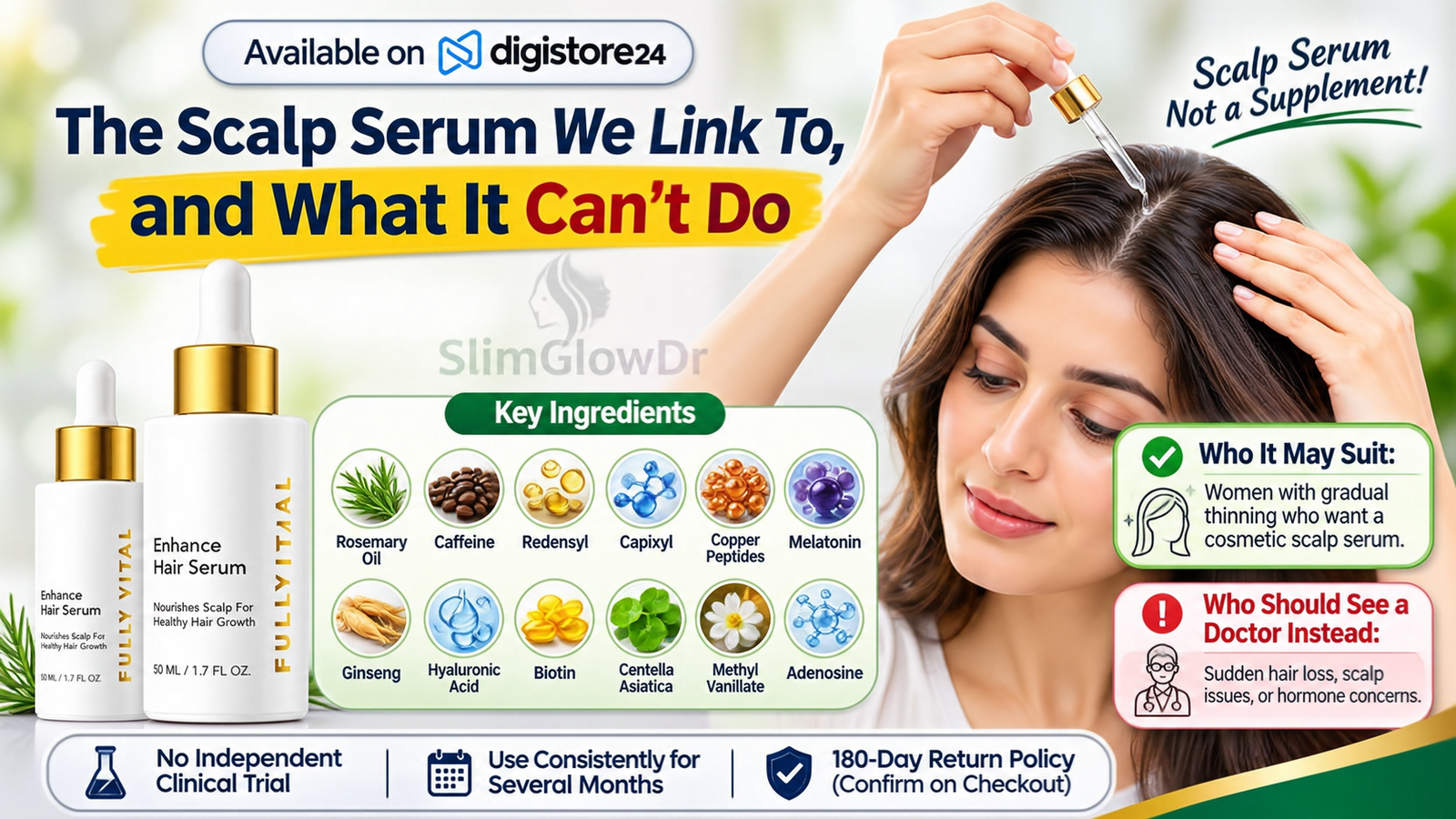
If your labs are sorted and you want to add something to your scalp routine without starting a medication,the scalp serum we link to is FullyVital Hair Growth Serum. To be clear about the category: it's a scalp serum applied with a dropper, not a supplement, and it doesn't belong in the oral ranking above.
What's in it. The sales page lists 13 named actives, several of which match the ingredients reviewed above: rosemary oil, caffeine, Redensyl, Capixyl, copper peptides, and melatonin, along with ginseng, hyaluronic acid, biotin, centella asiatica, methyl vanillate, adenosine, and methyl nicotinate. The evidence grades from the previous section apply: each of the better-studied ingredients has limited evidence, mostly from small, industry-linked studies in men. There's no good evidence that biotin applied to the scalp grows hair.
Who it may suit. Women with gradual thinning who want a cosmetic, non-prescription scalp product to use alongside correcting any deficiencies and protecting their protein intake. It may also appeal to women who've decided against minoxidil or can't use it.
Who should see a doctor instead. Anyone with the red flags listed earlier (sudden or patchy loss, scalp pain, scaling or redness, or eyebrow loss), and anyone who wants the treatment with the strongest evidence for FPHL, which remains minoxidil or a prescription option.
Practical details. Pricing and bundle offers change often, so we don't list them here. The vendor advertises a 180-day return for a refund or exchange, minus shipping and handling. Before you order, confirm the current price, whether the purchase is one-time or a subscription, and the refund terms on the checkout page. Plan on using it consistently for several months before judging it, the same as any hair product.
Honest limitations. We found no independent, published trial of the finished product. The manufacturer's site advertises high percentages of users seeing less shedding and new growth, but it gives no study design, sample size, or publication, so we don't treat those figures as evidence. Because none of the ingredient studies enrolled women over 40 at any real scale, there's no way to predict who will respond, and a cosmetic serum can't correct an iron, thyroid, or protein problem.
If you want a drug-free, scalp-applied option to use alongside the steps above, you can see the current price and 180-day refund terms for this scalp serum (paid link: we earn a commission if you buy).
Medical Treatments to Discuss With Your Doctor
Supplements and cosmetic serums aren't the only options, and for female pattern hair loss they aren't the strongest. These are worth raising with a dermatologist:
- Topical minoxidil. The FDA-approved over-the-counter option for FPHL, as covered above.
- Low-dose oral minoxidil. Some dermatologists discuss an oral form of minoxidil for hair loss. Whether it's appropriate is a prescription decision based on your health history. It's prescribed off-label (it isn't FDA-approved for hair loss) and can cause fluid retention, a faster heart rate, dizziness, and unwanted facial or body hair, so it needs prescriber oversight, especially if you have heart or blood-pressure conditions.
- Spironolactone. The AAD notes this prescription medication has been prescribed for decades to treat hair loss. Like other prescription hair-loss medicines, it isn't for women who are or may become pregnant.
- Hormone therapy (HRT). If you're in perimenopause or menopause, talk with your clinician about whether HRT is appropriate for your overall symptoms. That decision weighs many factors beyond hair.
- Other procedures. Laser devices and hair transplants are options for some women; the AAD says treatments such as platelet-rich plasma (PRP) need more study.
A Realistic 6-Month Hair Plan After 40
Here's how the pieces fit together in order:
- Take baseline photos. Photograph your part and crown in the same lighting every month, and note your part width. Memory is unreliable for slow changes.
- Get blood work. Ask about ferritin and iron, TSH, vitamin D, B12, and zinc if relevant, and tell the lab about any biotin.
- Correct confirmed deficiencies. Follow your clinician's dose and recheck schedule rather than buying a stack of products.
- Protect your protein intake, especially while losing weight or taking a GLP-1. Build every meal around a protein source.
- Optionally add a topical. Choose minoxidil for the strongest evidence, or a cosmetic serum if you'd rather not use a medication.
- Wait 3 to 6 months before judging. Compare your monthly photos, not the mirror. For minoxidil, allow 6 to 12 months.
- See a dermatologist if nothing has improved by 6 months or if any red flag appears.
Key Takeaways
- Hair thinning after 40 usually has a cause: hormonal shifts, telogen effluvium, or a nutrient or thyroid problem.
- Supplements help most when they correct a confirmed deficiency (iron/ferritin, vitamin D, zinc, protein).
- Biotin rarely helps without a deficiency and can skew lab results.
- Allow 3 to 6 months before judging any supplement or serum.
- Topical serums are a separate, scalp-applied option, not a supplement. Topical minoxidil is the only FDA-approved OTC treatment for female pattern hair loss.
- See a dermatologist for sudden or patchy loss or scalp symptoms.
Final Thoughts
The best hair growth supplements for women over 40 are the ones that fix what's actually wrong, and blood work, not a label, is what tells you which ones those are. Hair research in midlife women is still thin, so expect the evidence grades above to shift as larger, independent trials appear.
Start by finding the cause, correct what's low, choose evidence over marketing, and judge any change by your monthly photos. If you're losing weight, especially quickly or on a GLP-1, treat protein as part of your hair plan too.
A topical serum can be a reasonable add-on once those basics are covered. If that's where you are, you can review the scalp serum we recommend for women over 40.
Frequently Asked Questions
Do hair growth supplements actually work for women over 40?
They work best when they correct a real deficiency, such as low iron, vitamin D, zinc, or protein. For women with normal levels, a few multi-ingredient formulas have shown modest results in small trials, mostly funded by their makers, and biotin rarely helps. Get blood work first, then see the evidence-graded ranking above to decide what's worth trying.
Does menopause hair loss grow back?
It depends on the cause. Shedding from telogen effluvium usually recovers within 6 to 9 months once the trigger passes, and thinning from a thyroid or nutrient problem can improve once it's treated. Female pattern hair loss tends to progress without treatment, though treatments like minoxidil can slow it and may regrow some hair. Menopause hair loss supplements alone are unlikely to reverse it.
What vitamin deficiency causes hair loss in women?
Iron deficiency is the one most often discussed, particularly in women with heavy periods. The AAD also lists low biotin, protein, and zinc as causes of noticeable hair loss that can recover once corrected, and low vitamin D is associated with some types of hair loss. Ask your doctor about ferritin, vitamin D, B12, and zinc testing before supplementing.
How long do hair supplements take to work?
Plan on at least 3 months to notice less shedding and about 6 months to judge visible thickness. Hair grows slowly and new growth takes time to reach a length you can see. If you're correcting a deficiency, your clinician may recheck your levels along the way. Monthly photos are more reliable than day-to-day impressions.
Is Nutrafol or Viviscal better for women over 40?
Neither has been proven better, because no head-to-head trial exists. Nutrafol Women's Balance was tested in women aged 40 to 65 across menopause stages for 6 months; Viviscal was tested in women aged 21 to 65 for 3 months. Both trials were small and manufacturer-funded. Cost, ingredient overlap, and allergies are reasonable tiebreakers.
Can losing weight or taking a GLP-1 medication cause hair loss?
Yes, rapid weight loss is a recognized trigger for telogen effluvium, and studies link both bariatric surgery and GLP-1 medications to higher rates of hair shedding, though the absolute risk with GLP-1s appears low. Shedding is usually temporary. Protect your protein intake, ask about iron and zinc testing, and talk to your prescriber rather than stopping the medication yourself.
Is a hair serum better than a hair supplement?
They do different jobs, so one isn't simply better. A supplement can only help if your body is short on a nutrient, while a serum acts directly on the scalp. Topical minoxidil has the strongest evidence for female pattern hair loss; cosmetic serums rely on smaller ingredient studies. Many women reasonably combine deficiency correction with a topical.
Should I stop biotin before blood work?
Tell your doctor and the lab that you take biotin, including in hair, skin, and nail gummies or multivitamins, before any blood test. They can advise whether to pause it. The FDA has said there isn't enough information to set a reliable "stop for X hours" rule, so don't rely on a timeline from a label or forum.