

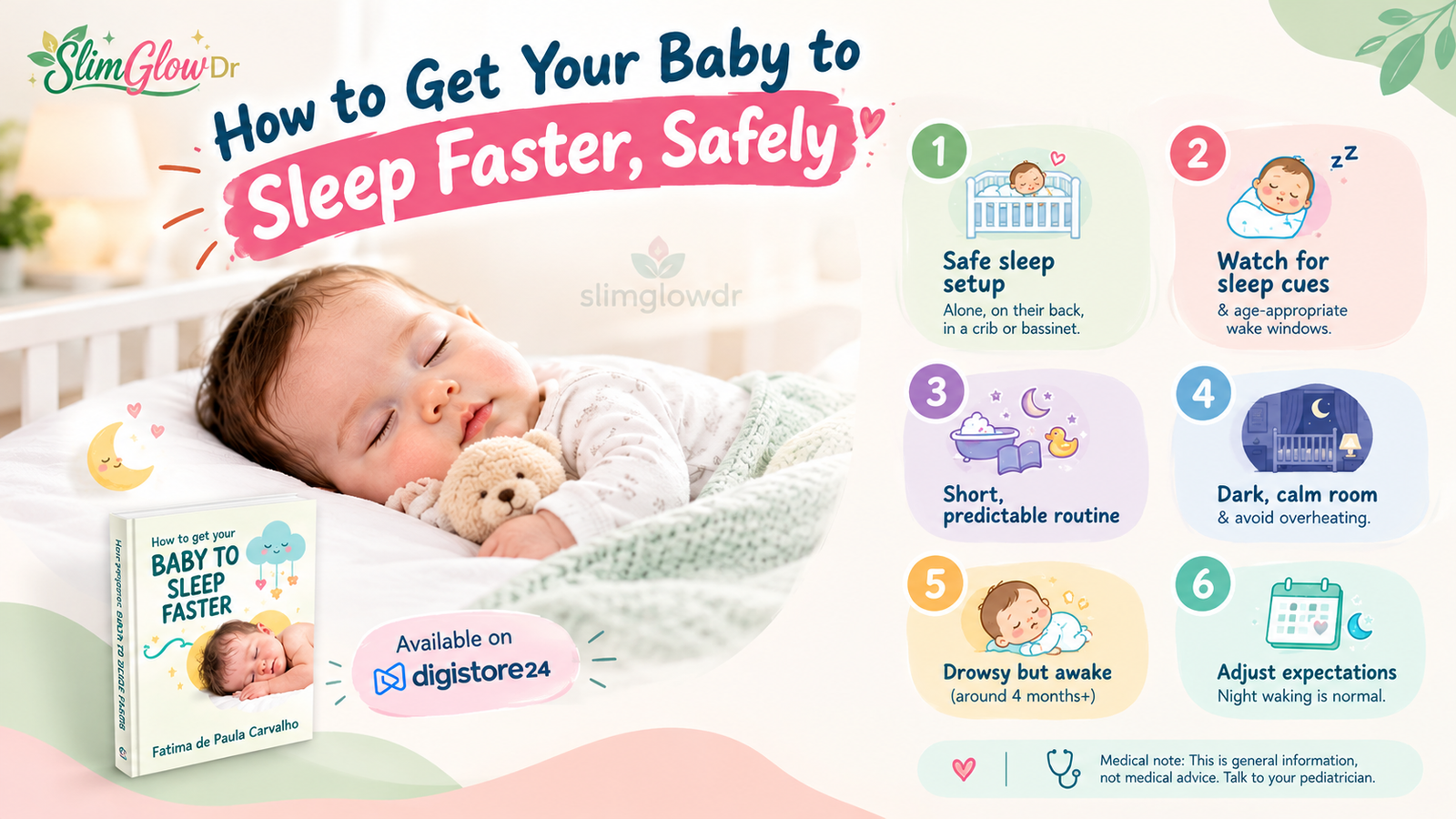
It's 9 p.m. You've fed, burped, rocked, and shushed, and your baby is still wide-eyed, or starts crying the second their back touches the mattress. If you've typed "how to get your baby to sleep faster" into your phone with one hand while bouncing with the other, this guide is for you.
No trick puts a baby to sleep on command. What you can usually do is shorten the battle. Babies tend to settle more easily when three things line up: a safe sleep space, good timing, and a short routine they can predict. This guide covers safe sleep first, then what's normal for your baby's age, what to try tonight from the newborn weeks to the first birthday, when to call your pediatrician, and how to protect your own sleep.
Written by Dr. Kaneez Fatima, Pharm-D | Health content creator, slimglowdr.com
Disclosure: This post contains an affiliate link. If you buy through one, slimglowdr.com may earn a commission at no extra cost to you. We say plainly what we have and haven't checked. You can read more in our affiliate disclosure.
Quick Answer: How Do You Get Your Baby to Sleep Faster?
- Use a safe sleep setup every time: alone, on their back, in a crib or bassinet.
- Watch for early sleep cues and age-appropriate wake windows so your baby isn't overtired.
- Keep a short, predictable bedtime routine.
- Make the room dark and calm, and avoid overheating.
- For babies who are ready (around 4 months and up), put them down drowsy but awake.
- Adjust expectations for their age, because night waking is normal.
Medical note: This article is general information, not medical advice. Talk to your pediatrician about your baby's sleep, and call them any time something feels off.
How we wrote this: This guide draws on the American Academy of Pediatrics (AAP), the CDC, the American Academy of Sleep Medicine (AASM), and peer-reviewed research linked throughout. We haven't tested the ebook mentioned below.
Safe Sleep Comes First: The ABCs Every Mom Should Know
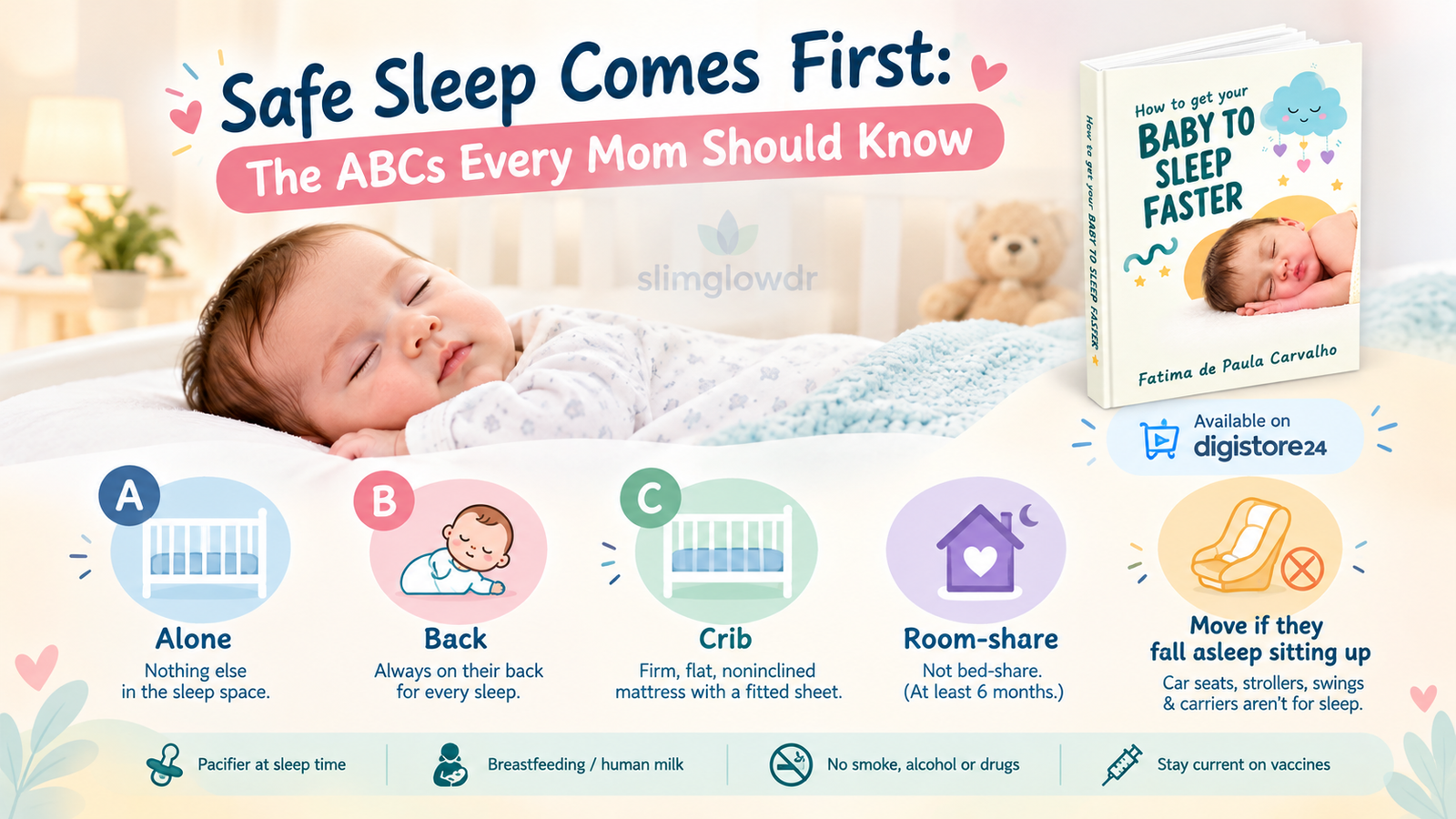
Before any soothing technique, the sleep space itself has to be safe. When you're exhausted, it's tempting to let a baby doze wherever they finally drop off, and that's exactly when these rules matter most.
According to the CDC, there were about 3,400 sudden unexpected infant deaths (SUID) in the United States in 2024, including 1,351 from sudden infant death syndrome (SIDS) and 947 from accidental suffocation and strangulation in bed. A 2026 CDC report on cases from 2020 to 2024 found unsafe sleep factors in at least 73% of the deaths reviewed, and about two-thirds happened between birth and 3 months. That's sobering, but it also means the basics below are among the most useful things you can do.
Start with the American Academy of Pediatrics' safe sleep recommendations, updated in 2022 and often summarized as the ABCs, plus two more rules:
- Alone: nothing else in the sleep space. No pillows, blankets, bumpers, or soft toys.
- Back: place your baby on their back for every sleep, naps included.
- Crib: use a crib, bassinet, or play yard with a firm, flat, noninclined mattress and a fitted sheet.
- Room-share, don't bed-share: the AAP recommends sleeping in the same room as your baby, but not the same bed, preferably for at least the first six months.
- Move them if they fall asleep sitting up: car seats, strollers, swings, infant carriers, and slings aren't recommended for routine sleep, particularly for babies under 4 months. If your baby nods off in one, move them to a flat, safe surface when you can.
The AAP also notes that offering a pacifier at sleep time, breastfeeding or feeding human milk, keeping baby away from smoke, alcohol, and drugs, and staying current on vaccines are all associated with lower risk.
[VISUAL PLACEHOLDER: Safe sleep checklist graphic with simple icons for Alone, Back, Crib, firm flat surface, nothing soft in the crib, and room-share without bed-sharing, showing a baby on their back in an empty crib; Alt text: Safe sleep checklist showing a baby sleeping alone on their back in an empty crib]
Every tip in the rest of this guide assumes this setup. If a technique only works when the baby is somewhere unsafe, it isn't worth the trade.
How Long Should It Take a Baby to Fall Asleep? (Realistic Expectations)
A lot of bedtime frustration comes from comparing your baby to a standard that doesn't exist.
What's normal for settling time and night waking
There's no official "normal" number of minutes for a baby to fall asleep, and settling time varies widely from baby to baby and night to night. If your baby is safe, fed, and generally content during the day, a bedtime that takes a while is common, not a sign you're doing something wrong.
Night waking is normal too. The AAP's healthy children site explains that newborns sleep about 16 to 17 hours a day, but often only 1 or 2 hours at a time, and that babies don't develop regular sleep cycles until around 4 months. It also notes that a 6-month-old waking during the night and going back to sleep after a few minutes is normal.
| Age | Total sleep per 24 hours (incl. naps) | What's normal at night |
|---|---|---|
| Newborn (0-3 months) | About 16-17 hours, in stretches of 1-2 hours (AAP guidance; no formal consensus range for this age) | Frequent waking to feed, around the clock |
| 4-12 months | 12-16 hours (AASM recommended hours of sleep by age, endorsed by the AAP) | Brief wakings are common; many babies still don't sleep 6-8 hours straight at 6 or even 12 months |
[VISUAL PLACEHOLDER: The table above, styled as a clean graphic; Alt text: Table of recommended baby sleep hours by age]
What "sleeping through the night" really means
It helps to start with what "sleeping through the night" actually means. Researchers usually mean 6 or 8 hours in a row, not 7 p.m. to 7 a.m. Even by that more modest standard, a 2018 Canadian study published in Pediatrics found that many babies still wake at night at 6 and 12 months. At 6 months, 38% of infants weren't sleeping 6 consecutive hours and 57% weren't sleeping 8. At 12 months, those figures were 28% and 43%.
The reassuring part: in that study, not sleeping through the night wasn't linked to differences in the babies' mental or motor development. It was based on mothers' reports from one cohort, so it isn't the final word, but it's a good reason to ease the pressure.
Can you really put a baby to sleep in 40 seconds?
You may have seen videos promising a sleeping baby in under a minute. Probably not, at least not reliably. Viral videos show one moment with one baby who was likely already very sleepy. They don't show the nights it didn't work. No research supports a fixed time-to-sleep for infants, and chasing that kind of promise tends to leave moms feeling like failures. A more realistic goal is a bedtime that gets a little calmer and a little shorter over a couple of weeks.
Timing Is Everything: Sleep Cues and Wake Windows
Timing is one thing moms can adjust. Put a baby down too early and they're not tired enough; too late and they can be wound up and harder to settle.
Early vs. late sleep cues
These cues come from common rules of thumb rather than clinical criteria, and every baby has their own version. Still, learning to spot your own baby's cues early is one of the most practical skills you can build.
| Early signs baby is tired (good time to start winding down) | Late cues (baby may already be overtired) |
|---|---|
| Staring off or "zoning out" | Arching back |
| Slowing down, less interest in toys or people | Crying that escalates quickly |
| Rubbing eyes or ears | Frantic or jerky movements |
| Yawning | Hard to soothe even when held |
For a few days, try jotting down the time you notice the first early cue. Patterns often show up faster on paper than in your sleep-deprived memory.
Why an overtired baby fights sleep
It's a common experience that an overtired baby won't sleep easily. Instead of drifting off, they fuss, cry harder, or seem oddly wired. The exact reasons aren't fully settled, but the practical lesson is consistent: starting the wind-down at the early cues usually goes better than waiting until your baby "seems really tired." If bedtime keeps turning into a meltdown, try starting the routine 15 to 20 minutes earlier for a few nights and see if anything changes.
Baby wake windows by age (approximate)
A wake window is the stretch of time a baby is awake between sleeps. The ranges below are widely shared rules of thumb. They are not medical recommendations from the AAP or any other medical body, and no clinical standard backs these exact numbers. Use them as a loose starting point and let your baby's cues have the final say.
| Age | Approximate wake window |
|---|---|
| 0-3 months | About 45-90 minutes |
| 3-6 months | About 1.5-2.5 hours |
| 6-9 months | About 2-3 hours |
| 9-12 months | About 2.5-4 hours |
Common rules of thumb, not medical standards. Every baby is different.
[VISUAL PLACEHOLDER: Approximate wake windows chart based on the table above, with the caption "Common rules of thumb, not medical recommendations. Every baby differs."; Alt text: Approximate baby wake windows by age chart]
Tips to Help Your Baby Fall Asleep Faster, by Age
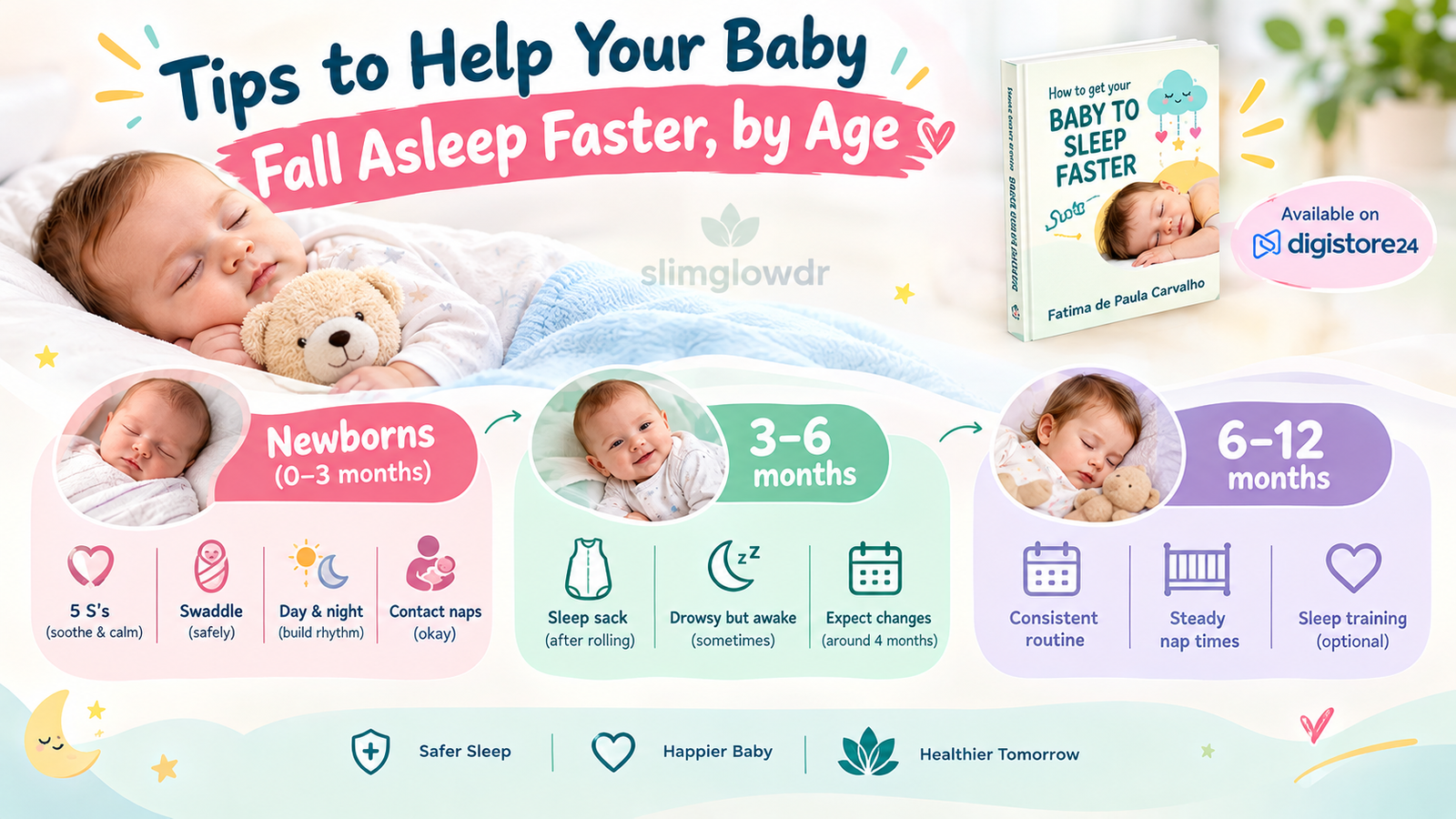
What works at 6 weeks can be unsafe or pointless at 6 months. Here's how to help your baby fall asleep faster at each stage.
Newborns (0-3 months)
The newborn stage is about soothing and survival, not independent sleep. The tips below focus on calming your baby and keeping things safe.
- Try the 5 S's in your arms. Pediatrician Dr. Harvey Karp, author of The Happiest Baby on the Block, popularized the 5 S's soothing approach: swaddle, side or stomach position, shush, swing (gentle rhythmic motion), and suck. Plenty of families find them calming. One important rule: the side or stomach position is only for soothing while you're holding your baby. Once they're calm, always lay them down on their back.
- Swaddle safely, if you swaddle at all. The AAP says there's no evidence that swaddling reduces SIDS risk, so think of it purely as a soothing tool. Always place a swaddled baby on their back, keep the hips loose so the legs can bend, and leave room for two or three fingers between the swaddle and baby's chest. Stop swaddling once your baby shows signs of rolling, which can happen as early as 2 months.
- Help with day-night confusion. Keep daytime feeds bright and social, and keep night feeds dim, quiet, and boring. Over time this nudges your baby's developing circadian rhythm in the right direction.
- Contact naps and feeding to sleep are fine. Keep contact naps supervised, with you awake. You aren't creating "bad habits" by meeting a newborn's needs. If you feel yourself nodding off while holding your baby, move them to their crib or bassinet. If you think you might doze off while feeding or holding your baby, it is safer to be in an adult bed with nothing soft nearby than on a sofa or armchair (see the sofa warning under What to Avoid).
3-6 months
This is when sleep starts to look a bit more organized, and when some new skills become possible.
- Switch from swaddle to sleep sack. Once rolling signs appear (see above), switch to a sleep sack with arms free.
- Practice drowsy but awake some of the time. The AAP's guidance suggests putting babies to bed drowsy rather than already asleep, and notes that babies around 4 months and older can begin learning to soothe themselves. You don't need to do this at every sleep. Some families start with bedtime only and keep naps flexible.
- Expect some turbulence around 4 months. Many moms notice sleep changes around this age, often called the "4-month sleep regression." It's not a formal medical term, but it lines up with the AAP's note that regular sleep cycles develop around 4 months. A rough patch here usually reflects development.
6-12 months
Older babies often respond well to consistency: a steady bedtime, the same routine each night, and predictable nap times. Nap schedules often change somewhere in this window, so expect some adjustment.
This is also when families start asking about sleep training. Some use structured methods such as graduated extinction (checking in at gradually longer intervals), the chair method (sitting near the crib and moving farther away over time), or bedtime fading (temporarily moving bedtime later to match when baby actually falls asleep, then shifting it earlier).
What does research on sleep training show? In a small 2016 randomized trial of 43 infants aged 6 to 16 months, graduated extinction and bedtime fading both shortened the time it took babies to fall asleep compared with a control group, with no differences in emotional or behavioral problems or attachment a year later. A larger trial that followed children to age 6 found no marked long-term harms or benefits on children's emotional health, the mom-child relationship, or maternal mental health.
That's reassuring if you choose to try it, but it doesn't mean you have to. Sleep training is a choice, not a requirement, and some families prefer gentler, more gradual approaches. Talk with your pediatrician first, especially to rule out medical causes of night waking.
Build a Bedtime Routine and Sleep Space That Do the Work
Most of these apply at every age, though the strongest research is on older babies, and small changes can add up.
A simple bedtime routine for baby
A bedtime routine for a baby doesn't need to be elaborate. What seems to matter is doing the same few steps in the same order each night. In a study on a consistent bedtime routine, mothers of babies 7 to 18 months old (206 mother-baby pairs in that group) followed a three-step routine: bath, massage, and a quiet activity like cuddling or a lullaby, with lights out within 30 minutes of the bath. Within two weeks, babies fell asleep faster and woke less often, their longest stretch of sleep rose from an average of 6.9 to 8.5 hours, and mothers' mood improved. The study started at 7 months and was funded by Johnson & Johnson, which also supplied the bath and massage products, so treat it as encouraging rather than conclusive, especially for younger babies.
A simple version you can start tonight:
- Bath or warm wipe-down
- Feed
- Book or song in a dim room
- Into the crib, lights out, white noise on (if you use it)
As a rough rule of thumb, aim for about 20 to 30 minutes from start to lights out.
[VISUAL PLACEHOLDER: Four-step routine graphic: bath, feed, book or song, lights out; Alt text: Four-step baby bedtime routine: bath, feed, book, lights out]
Dark, calm, and not too warm
A dark room helps signal nighttime, and blackout curtains can help with early sunrises and summer bedtimes. Temperature matters for safety as well as comfort: the AAP recommends avoiding overheating. Dress your baby in light layers or a sleep sack instead of piling on blankets, and watch for signs of overheating such as sweating, damp hair, flushed cheeks, heat rash, or rapid breathing.
Does white noise help?
Some moms find that steady white noise helps mask household sounds and becomes part of the "it's sleep time" signal. Volume matters, though. In a 2014 lab study, researchers tested 14 infant sleep machines at maximum volume, and all of them exceeded 50 decibels (the recommended limit for hospital nurseries) when measured about a foot away. Three exceeded 85 decibels. The study measured machine output rather than hearing damage in babies, but it's a good reason to be cautious.
To keep white noise at a safe volume, place the machine well away from the crib (the researchers suggested more than 200 centimeters, roughly 6.5 feet), never in the crib or on the rail, and use the lowest volume that does the job.
What to Avoid When You're Desperate for Sleep
When you're running on fumes, a quick fix can look very appealing. These are the ones to skip, along with what to do instead.
Pharmacist note: Check the active ingredients, not just the front of the box. Many "nighttime" or "PM" products contain an antihistamine such as diphenhydramine, and melatonin gummies come in kid-friendly flavors that make them easy to overdo. Infants are not small adults: their margin for error is narrow, so "natural" and "over the counter" do not mean safe for a baby.
- Melatonin, sleep supplements, and "natural" sleep aids. Don't give these to a baby unless your pediatrician specifically recommends it. The American Academy of Sleep Medicine advises treating melatonin like any other medication and talking to a pediatric professional first, partly because supplement contents can range from less than half to more than four times what the label says. See why sleep aids aren't recommended for babies for the full advisory.
- Antihistamines and cough or cold medicines. The FDA says children under 2 should not be given any cough and cold product that contains a decongestant or antihistamine because of the risk of serious side effects.
- Essential oils on or near your baby. Poison Control (US: 1-800-222-1222) warns that children's thin skin and immature livers may make them more vulnerable to toxic effects. Skip them unless your pediatrician says otherwise, and store them locked up.
- Falling asleep with your baby on a sofa or armchair. The AAP says the risk of sleep-related infant death is up to 67 times higher when sleeping with someone on a couch or soft armchair. The AAP's advice: if you're feeding at night and might doze off, an adult bed with nothing soft near the baby is less hazardous than a sofa. Put the baby back in their own sleep space as soon as you can.
- Inclined, weighted, or "positioning" products. The AAP says weighted swaddles, weighted clothing, and weighted objects on or near a baby aren't safe, and that sleep surfaces should be flat, not inclined. The FDA advises against infant sleep positioners and says it's not aware of evidence that any currently available baby product prevents SIDS.
- Cereal in the bottle. The CDC is clear that cereal in the bottle won't help baby sleep longer, and it could increase choking risk.
If you've done any of these out of sheer exhaustion, you're not a bad mom. The goal is simply to find safer ways through the hard nights.
When to Call Your Pediatrician
Sometimes a baby who won't settle is uncomfortable or unwell rather than just tired. Call your pediatrician if you notice:
- Loud, regular snoring, gasping, choking sounds, or pauses in breathing during sleep
- Signs of pain or reflux around feeds, such as frequent arching, crying during feeds, or vomiting
- Poor feeding, fewer wet diapers than usual, or concerns about weight gain
- Long stretches of inconsolable crying that nothing seems to ease
- A fever, or a sudden change in sleep that comes with other signs of illness
- Anything else that worries you
Pediatricians would much rather hear from you about something minor than have you wait on something that matters.
Want a Step-by-Step Guide? About the "How to Get Your Baby to Sleep Faster" Ebook
Everything above is free, and for many families it's enough. Some moms, though, prefer one structured read instead of piecing tips together at 2 a.m. If that's you, the "How to Get Your Baby to Sleep Faster" ebook sold through Digistore24 is one option.
Here's what the listing says, and what it doesn't:
- What it is: an English-language digital ebook aimed at new moms looking for better sleep routines and fewer nighttime disruptions.
- Approach: the listing says it focuses on relaxation techniques adapted to a baby's stage of development.
- Author: the listing says it was created by "a psychologist with over 11 years of experience." No name is given, and we haven't been able to verify that credential.
- Guarantee: Digistore24 lists a 60-day return guarantee if you're not satisfied.
- Price: around $19-20 at the time of writing. Check the current price at checkout.
- What we don't know: the author's name, the age range covered, and the table of contents aren't listed, and we haven't reviewed the full contents.
It may suit you if you want a single, organized guide to work through and like the idea of a relaxation-focused approach. It's probably not the right first step if you're worried about a medical issue (see the pediatrician section above) or you're hoping for a guaranteed fix. No guide can promise that.
Whatever guide you use, follow safe-sleep basics and check with your pediatrician. Keep using the AAP's ABCs above, and run any new method by your baby's doctor before you start.
Get the "How to Get Your Baby to Sleep Faster" ebook
Digital ebook. Digistore24 lists a 60-day return guarantee. Check the current price at checkout. Affiliate link: slimglowdr.com may earn a commission if you buy, at no extra cost to you.
Don't Forget Your Own Sleep, Mom
Most baby sleep guides stop at the baby. But you're the one doing the night shifts, and your rest affects how you feel, how you cope, and how much patience you have at 3 a.m.
Why your sleep matters too
Short-term, broken sleep can leave anyone foggy, irritable, and low on energy. Research in adults also suggests sleep loss can affect appetite. Those studies did not include new moms, so treat them as background, not a prediction for you. You can read more about how sleep affects appetite and energy.
Practical ways to protect your rest
- Nap when you realistically can. Not every nap, but even one daytime rest can take the edge off.
- Take turns on night duty. If you have a partner, splitting the night into shifts can give each of you one longer stretch of sleep.
- Say yes to help. If a friend or relative offers to hold the baby, take the dishes, or do a grocery run, let them.
- Keep a mini wind-down of your own. Ten minutes of dim light and no scrolling before you lie down can make it easier to fall asleep when you finally get the chance.
When exhaustion is more than tiredness
Feeling weepy or overwhelmed in the first couple of weeks after birth, often called the "baby blues," is common. But the National Institute of Mental Health notes that mood changes, anxiety, or unhappiness that are severe or last longer than two weeks may be signs of postpartum depression. Other signs include persistent sadness or anxiety, hopelessness, irritability, guilt, losing interest in things, trouble bonding with your baby, and difficulty sleeping even when the baby is asleep. In 2018 CDC survey data, about 1 in 8 new mothers reported postpartum depressive symptoms.
You don't have to wait until it feels "bad enough." Talk to your doctor, midwife, or OB, and know that if you're in the US, the National Maternal Mental Health Hotline is free, confidential, and available 24/7 by call or text at 1-833-TLC-MAMA (1-833-852-6262), in English and Spanish. If you ever have thoughts of harming yourself or your baby, call your local emergency number (911 in the US) or go to the nearest emergency room.If you're outside the US, your doctor or local emergency services can point you to support.
This week, pick one thing from the list above and try it. Small, protected pockets of rest add up, and you deserve them too. For more on looking after yourself, see taking care of your body after baby.
Conclusion
Learning how to get your baby to sleep faster is less about a secret trick than about stacking the odds in your favor. Some nights will still be long. That's normal, and it doesn't mean anything is wrong with you or your baby.
Settling usually gets easier with age and consistency, and it's always fine to ask for help, whether from your partner, your pediatrician, or a support line. If you'd like a structured read to go alongside these basics, the baby sleep ebook described above is an option. Either way, be kind to yourself tonight. You're doing better than you think. You can find more Motherhood articles
Frequently Asked Questions
Why does my baby fight sleep?
Often because they're overtired, overstimulated, or uncomfortable. Starting the wind-down at the first early cues, like staring off or slowing down, often makes bedtime smoother. Hunger, a wet diaper, teething, or illness can also play a part. If fighting sleep comes with breathing pauses, feeding problems, or crying nothing eases, check in with your pediatrician.
Should I put my baby down drowsy but awake?
It's worth trying from around 4 months. The AAP suggests putting babies to bed drowsy rather than fully asleep, which can help them learn to fall asleep in their own bed. It doesn't have to work every time, and you don't have to do it at every nap. For newborns, feeding or rocking to sleep is normal and fine.
Does white noise help babies sleep, and is it safe?
Some moms find steady white noise helps mask household sounds, though there's little research on whether it makes babies fall asleep faster. The main safety concern is volume: tests have found many sleep machines can get loud at close range. Keep the machine well away from the crib, never inside it, and use the lowest volume that works.
Is it safe to swaddle my baby, and when should I stop?
Swaddling can be a safe soothing tool if you follow a few rules: always place your baby on their back, keep the hips loose, and don't wrap too tightly around the chest. The AAP says swaddling doesn't reduce SIDS risk. Stop as soon as your baby shows any signs of trying to roll, which can happen as early as 2 months.
When is it safe to start sleep training?
Most research involves babies around 6 months and older, and studies so far haven't found long-term harm. It's a personal choice, not a requirement. Talk with your pediatrician first, both to choose an approach that fits your family and to rule out medical causes of waking.
When do babies start sleeping through the night?
Later than many moms expect. Researchers usually define "sleeping through the night" as 6 or 8 hours in a row, and one study found 38% of 6-month-olds weren't yet sleeping 6 straight hours. That wasn't linked to developmental problems. Brief night waking is normal through the first year.
What is the "How to Get Your Baby to Sleep Faster" ebook?
The listing describes a relaxation-focused guide for new moms; the author isn't named. Digistore24 lists a 60-day return guarantee. We haven't reviewed its contents, so we can't speak to the results. If you try it (affiliate link), keep following AAP safe-sleep basics alongside it.