


Disclosure: This article contains an affiliate link. If you buy through it, slimglowdr.com may earn a commission at no extra cost to you.
Written by Dr. Kaneez Fatima, Pharm-D, health content creator at slimglowdr.com. This guide is educational and does not replace advice from your doctor, midwife, or a licensed counselor.
[VISUAL PLACEHOLDER: Featured image of an expecting couple talking calmly at a kitchen table with a notebook between them, warm and non-clinical in tone. No product imagery. Alt text: Expecting couple planning together at the kitchen table to prepare their relationship for a baby]
The car seat is ordered, the name shortlist is on the fridge, and somewhere between the hospital tour and the baby shower a quieter worry has started to creep in: what happens to us when neither of us has slept properly in weeks? If you're searching for how to prepare your relationship for a baby, that worry is a good sign. It means you're thinking about the part of the transition that most birth-prep checklists skip.
Strain after a new baby is common, and it's been studied for decades. Researchers who follow couples through the transition to parenthood generally find that relationship satisfaction dips on average in the early years, while a sizeable share of couples stay stable or even improve. The pressure points are also fairly predictable: lost sleep, stress, an unclear split of chores and mental load, different ideas about parenting, and money.
That predictability works in your favor, because you can plan for most of it now. This guide covers the conversations worth having, a night-time sleep plan, a fair way to divide the work, a stress and conflict plan, simple shared habits, and money basics, plus clear signs it's time to bring in professional help.
Quick answer: To prepare your relationship for a baby, talk through your values and parenting expectations, make a realistic night-time sleep plan, agree on how chores and the mental load will be split, set up simple shared routines for meals and movement, build a basic budget, and decide now how you'll handle conflict and when you'll ask for help.
How we put this guide together: This guide draws on peer-reviewed research on the transition to parenthood and on guidance from sources including the CDC, NIH, the American Academy of Pediatrics, the US Department of Labor, and the Gottman Institute, checked in October 2026. We focus on the sleep, stress, and daily-habit side of preparing for a baby. We haven't tested the ebook mentioned near the end.
Why a New Baby Tests Even Strong Relationships
The research on the relationship after baby arrives is more reassuring than the scary headlines suggest, though it's honest about the dip. In an eight-year study of 218 couples, parents showed a sudden drop in relationship quality after the birth, small to medium in size and similar for mothers and fathers, while childless couples declined more gradually. A meta-analysis of studies on the transition to parenthood found small average declines from pregnancy to about 11 months after birth, but newlyweds without children declined by a similar amount over a comparable period. So studies agree satisfaction tends to dip in the early years; they disagree on how much of that is caused by the baby versus the normal course of a relationship.
You may have seen a "two-thirds of couples" figure online. The original source is narrower: in one Gottman-lab study of newlywed couples, about two-thirds of wives who became mothers reported a drop in marital satisfaction, compared with about half of wives who didn't have children (research on couples' relationship satisfaction after a first baby). It was a small sample, and it measured wives only.
Why the strain? New parent stress and relationship friction often trace back to two big drivers. Research in couples (not specifically new parents) suggests lack of sleep makes conflict more likely and less likely to get resolved, and new parents lose a lot of sleep. Unmet expectations matter too: when the reality of who does what doesn't match what someone hoped for, resentment can build.
The encouraging part is that preparation appears to help. In a randomized trial of 399 couples expecting their first child, those assigned to a nine-session couple-focused program did better than a control group on more than two-thirds of coparenting and parenting measures at 10 months postpartum (programs that help couples prepare for parenthood). That's one studied program, so it isn't a guarantee, but it supports the idea that working on the couple relationship ahead of time is worth the effort.
Conversations to Have Before Having a Baby
Most of the things to discuss with your partner before having a baby fall into a few buckets. You don't need to settle every question in one sitting. The goal is to surface the assumptions you each carry, so they don't show up for the first time at 2 a.m. with a crying baby between you.
Values, Expectations, and the Families You Grew Up In
Start with the family of origin. Ask each other what your parents did that you want to repeat, and what you'd rather leave behind. Those answers often explain reactions that would otherwise feel like they came out of nowhere, like one partner bristling when the other raises their voice, or insisting on a strict bedtime.
Then get specific about what "a good parent" looks like to each of you. Useful prompts:
- Will one of us stay home, go part-time, or will we both return to work? What childcare are we considering, and what happens if it falls through?
- Which religious, cultural, or family traditions matter to us, and which are we doing out of obligation?
- How do we each define "pulling our weight" at home once the baby is here?
Try not to treat these as one-time decisions. Plans made at 30 weeks pregnant often change once you meet your actual baby and see how recovery goes. Agree to revisit them at set points, such as two weeks after the birth and again before any return to work.
Parenting Style and Discipline: Agreeing on a Unified Front
A parenting styles discussion before baby can feel premature, since a newborn doesn't need discipline. It's still worth having, because the underlying values (how strict, how warm, how you'll respond to tantrums later) tend to shape smaller decisions from day one.
The American Academy of Pediatrics stresses clear and consistent rules, coordinated across caregivers, and notes that physical punishment such as spanking doesn't work well, while yelling and shaming have been found to be ineffective and harmful. Use that as common ground, then talk about where you naturally differ.
Many couples settle on one simple rule: disagree in private, present a unified front in public. If one partner makes a call the other doesn't like, back it in the moment and discuss it later. Over time, decide which issues need a joint decision and which either of you can handle alone.
Visitors, Grandparents, and Boundaries
The first weeks at home can fill up quickly with well-meaning visitors. Decide together:
- Who visits, when, and for how long (for example, short visits only, or no visitors for the first week)
- What helpful visitors can do, such as bringing a meal or folding laundry rather than holding the baby while you host
- Who communicates the boundaries. A common approach is that each partner handles their own family, which keeps either of you from becoming the "bad guy" with the in-laws.
[VISUAL PLACEHOLDER: Table titled "Before-Baby Conversation Checklist." Alt text: Checklist table of conversations to have before having a baby, covering values, parenting style, money, sleep, chores, and conflict]
| Topic | Questions to Ask Each Other | Decided? |
|---|---|---|
| Values and traditions | Which traditions do we want to keep or start? What did our families do that we want to repeat or avoid? | ☐ |
| Parenting style and discipline | How strict or flexible do we want to be? How will we handle disagreements about rules? | ☐ |
| Work and childcare | Who returns to work, and when? What's our backup childcare plan? | ☐ |
| Visitors and grandparents | Who visits in the first weeks? Who sets boundaries with each family? | ☐ |
| Money and leave | What leave can each of us take? What does our budget look like with a baby? | ☐ |
| Sleep and nights | How will we split night wakings? How will each of us get protected sleep? | ☐ |
| Chores and mental load | Who owns which tasks from start to finish? When do we check in? | ☐ |
| How we'll handle conflict | What's our signal for "I need a break"? How do we reconnect after an argument? | ☐ |
A simple place to start: pick one topic from the checklist above and talk it through with your partner this week. Later in this article, we also look at one structured guide some couples use to work through these conversations.
Make a Sleep Plan Together Before the Baby Arrives

Sleep is one of the most underrated relationship issues in early parenthood. In a large German panel study, sleep hit its lowest point in the first three months after birth. After a first baby, at that low point, mothers averaged about 62 minutes less sleep per night than before pregnancy and fathers about 13 minutes less, and new parents' sleep can take years to fully recover. Those are averages, but they show two things: the loss is real, and it often falls unevenly.
A sleep plan won't eliminate night wakings. What it can do is replace "whoever wakes up first" with a system that protects each adult's rest. Two common approaches:
- Split-night shifts: One partner covers the early part of the night, the other covers the later part, so each gets one longer block of sleep.
- Alternating nights: One partner is "on duty" for the whole night while the other sleeps elsewhere with earplugs, then you swap.
Feeding method shapes the plan, and there's no right answer here. If one parent is nursing, the other can take on diaper changes, settling the baby, bringing the baby to the feeding parent, and an early-morning shift so the nursing parent can sleep afterward. If you're bottle-feeding with formula or expressed milk, splitting nights more evenly is often easier.
A few more agreements worth making now:
- No big decisions or big arguments at 3 a.m. If something's bothering you during a night shift, park it until you've both slept. Exhausted brains are bad at conflict resolution.
- Use naps and help. If a relative or friend offers help, a two-hour nap may do more for you than a tidy kitchen.
- Plan to adjust. Treat the first version as a draft, and review it after the first week or two. This is one of the most useful fourth trimester relationship tips: the plan exists to serve you, not the other way around.
[VISUAL PLACEHOLDER: Table showing an example newborn night-shift plan. Alt text: Example newborn night-shift schedule showing how two partners can split night wakings to protect sleep]
| Example approach | Partner A on duty | Partner B on duty | Protected sleep |
|---|---|---|---|
| Split-night shifts | 9 p.m. to 2 a.m. | 2 a.m. to 7 a.m. | Each partner aims for one longer block of up to about 5 hours |
| Alternating nights | Monday, Wednesday, Friday | Tuesday, Thursday, Saturday | Off-duty partner sleeps in another room with earplugs |
This is an example, not a prescription. Adjust times to your baby and your work schedules. Safety note: follow the safe sleep guidelines for babies from the NIH Safe to Sleep campaign. Place your baby on their back, in their own sleep space (crib, bassinet, or portable play yard) with only a fitted sheet. If you're feeding at night, put the baby back in their own sleep space before you doze; falling asleep with a baby on a sofa or armchair is risky. Ask your pediatrician if you have questions about your baby's sleep.
Dividing Household Chores and the Mental Load After Baby
Dividing household chores after baby involves more than splitting the visible jobs like laundry and dishes. There's also the invisible labor of keeping a household running. In interviews with 35 couples, sociologist Allison Daminger described this cognitive work as four steps: anticipating what's needed, identifying options, deciding, and monitoring whether it got done. It's often invisible even to the person doing it.
Expectations may matter as much as the split itself. In one study of expectant couples, mothers whose hopes about their partner's childcare involvement weren't met after the birth reported lower satisfaction and less collaborative coparenting (how unmet expectations about childcare affect couples). The actual division of labor was only weakly linked to how well couples coparented, which suggests the gap between expectation and reality is what stings. That's a strong argument for agreeing on the split before the baby arrives.
A practical framework:
- List everything. Include baby tasks, household tasks, and admin, such as feeding supplies, laundry, pediatric appointments, meals, and bills.
- Assign an owner for each task, end to end. Owning a task means noticing when it needs doing, planning it, doing it, and following up. "Just tell me what to do" sounds helpful, but it leaves the planning with one partner.
- Check in weekly. Spend 15 minutes reviewing what's working and what's slipping. Recovery, feeding, and work schedules will change the balance, so expect to reassign things.
[VISUAL PLACEHOLDER: Table splitting chores and mental load. Alt text: Table splitting household chores and mental load between partners after a new baby arrives]
| Task | Visible work | Invisible work (anticipate, plan, decide, monitor) | Owner | Check-in date |
|---|---|---|---|---|
| Feeding supplies | Washing bottles or pump parts, restocking | Noticing supplies are low, choosing what to buy | ||
| Laundry | Washing, drying, folding | Tracking when baby clothes are outgrown | ||
| Pediatric appointments | Attending visits | Booking, tracking vaccine schedule, preparing questions | ||
| Meals | Cooking, cleanup | Planning the week, keeping the grocery list current | ||
| Household bills | Paying bills | Tracking due dates, reviewing new baby-related costs |
Build a Shared Stress and Conflict Plan
Disagreements are part of life with a newborn. The goal is to argue in a way that doesn't leave lasting damage, and the easiest time to agree on how is now, while you're both rested.
Agree on a break signal. The Gottman Institute describes "flooding," when a heated argument triggers a racing heart, stress hormones, and a fight-or-flight response. Its guidance on taking a break is that a pause should last at least 20 minutes, because that's roughly how long the body needs to calm down. Pick a neutral phrase like "I need a pause," and pair it with a return time so the break doesn't feel like stonewalling.
Practice repair. The Gottman Institute calls the small words or gestures that ease tension "repair attempts," and notes that awkward ones can still work when there's underlying goodwill (how couples repair after arguments). A touch on the arm, "I'm sorry I snapped, I'm wiped out," or a joke you both recognize all count.
Hold a short daily check-in, starting now. In the Gottman-lab study mentioned earlier, couples who stayed more satisfied after the baby tended to express fondness for each other, stay aware of what was going on in each other's lives, and approach problems as something they could solve together. Ten minutes a day asking "How are you actually doing?" builds that habit while you're rested, so it's already in place when the baby comes.
Give each person a stress outlet. New parent stress hits both partners, and each of you needs a few minutes alone to reset, such as a short walk, focused breathing, a shower without interruptions, or music with headphones. Schedule these so neither of you has to ask permission.
Lower the bar on non-essentials. Decide now what can slide for a few months: a perfectly clean house, replying to messages, elaborate dinners. Fewer standards means fewer things to argue about.
Set Up Simple Healthy Habits as a Couple Now
Healthy routines are often the first thing to disappear in the newborn weeks, and running on takeout and broken sleep tends to make everyone shorter-tempered. Setting up a few simple habits before the due date gives you something to fall back on when you're too tired to plan.
- Batch cook before the birth. Spend a few weekends in the third trimester making freezer meals you both like, such as soups, stews, or casseroles. Label them with contents and dates.
- Set a shared grocery routine. Agree on one running grocery list and a regular order or pickup day so food planning doesn't sit in one person's head.
- Say yes to meal help. If friends offer to organize a meal train, accept, and tell them about any dietary needs up front.
- Stock the night-feed station. Keep water and simple snacks within reach of wherever night feeds happen, for whoever is on duty.
- Plan gentle movement together, later. A short walk with the stroller can become a shared ritual once the birthing parent's healthcare provider says it's okay. Let your OB-GYN or midwife guide when and how to resume any activity.
Keep expectations realistic. These habits are about having fewer decisions to make and a little more energy on hard days. For anything specific to nutrition or exercise during pregnancy or recovery, follow your healthcare provider's advice.
Financial Planning Before Having a Baby
Money is a common source of conflict for couples, and a baby adds new costs while often reducing income for a while. Financial planning before having a baby is mostly about getting on the same page early.
Estimate costs by category. The most recent USDA estimate is from 2015: a middle-income married-couple family was projected to spend about $233,610 raising a child born that year through age 17. That figure is dated and covers all of childhood, not the first year, so it's most useful for the breakdown. Housing (29%), food (18%), and child care and education (16%) made up the largest shares, followed by transportation (15%) and health care (9%) (how much it costs to raise a child, USDA 2015 estimate). Use those categories to build your own estimate, and price out first-year items like childcare, diapers, and delivery costs under your insurance.
Understand your leave options. In the US, the Family and Medical Leave Act provides eligible employees up to 12 workweeks of unpaid, job-protected leave to bond with a new child (parental leave rules). Not everyone qualifies: you generally need to work for a covered employer, have been there at least 12 months, have worked at least 1,250 hours in the past year, and work at a location with at least 50 employees within 75 miles. Check your employer's policy and any state paid-leave program, then map out what each partner's income will look like during leave.
Work out your leave gap. Multiply the number of unpaid or partially paid weeks each of you expects to take by the take-home pay you'll lose, then add the first-year costs you priced above. That total is a practical savings target, and having it set aside makes surprises like a longer leave or an unexpected medical bill much less stressful.
It also helps to decide how money works between you: shared versus individual accounts, who pays which bills, and how you'll make bigger purchases, especially if one partner's income drops. While you're at it, check how and when to add the baby to your health plan, and review life insurance, beneficiaries, and whether you need a will or a guardian named. For advice specific to your situation, talk with a qualified financial professional.
Keeping Your Relationship Strong in the Fourth Trimester
The fourth trimester, the first few months after birth, is when the planning above gets tested. If you're wondering how to keep your marriage strong after having a baby (or your partnership, if you're not married), small, consistent habits tend to matter more than grand gestures. Keep the daily check-in going even on rough days, and add a few more:
- Say thank you out loud. Noticing the invisible work, like "Thanks for booking the pediatrician," builds the fondness that research links to couples who weather the transition well.
- Make date nights realistic. A takeout dinner on the couch after the baby's down counts. So does a 20-minute walk while a grandparent watches the baby.
- Offer affection without pressure. Hugs, hand-holding, and sitting close keep physical connection alive while bodies recover and energy is low.
- Talk openly about intimacy. Desire and readiness often differ between partners after a birth. When to resume sex depends on the birthing parent's recovery and their healthcare provider's guidance, so let that conversation happen without a deadline.
When to Get Professional Help
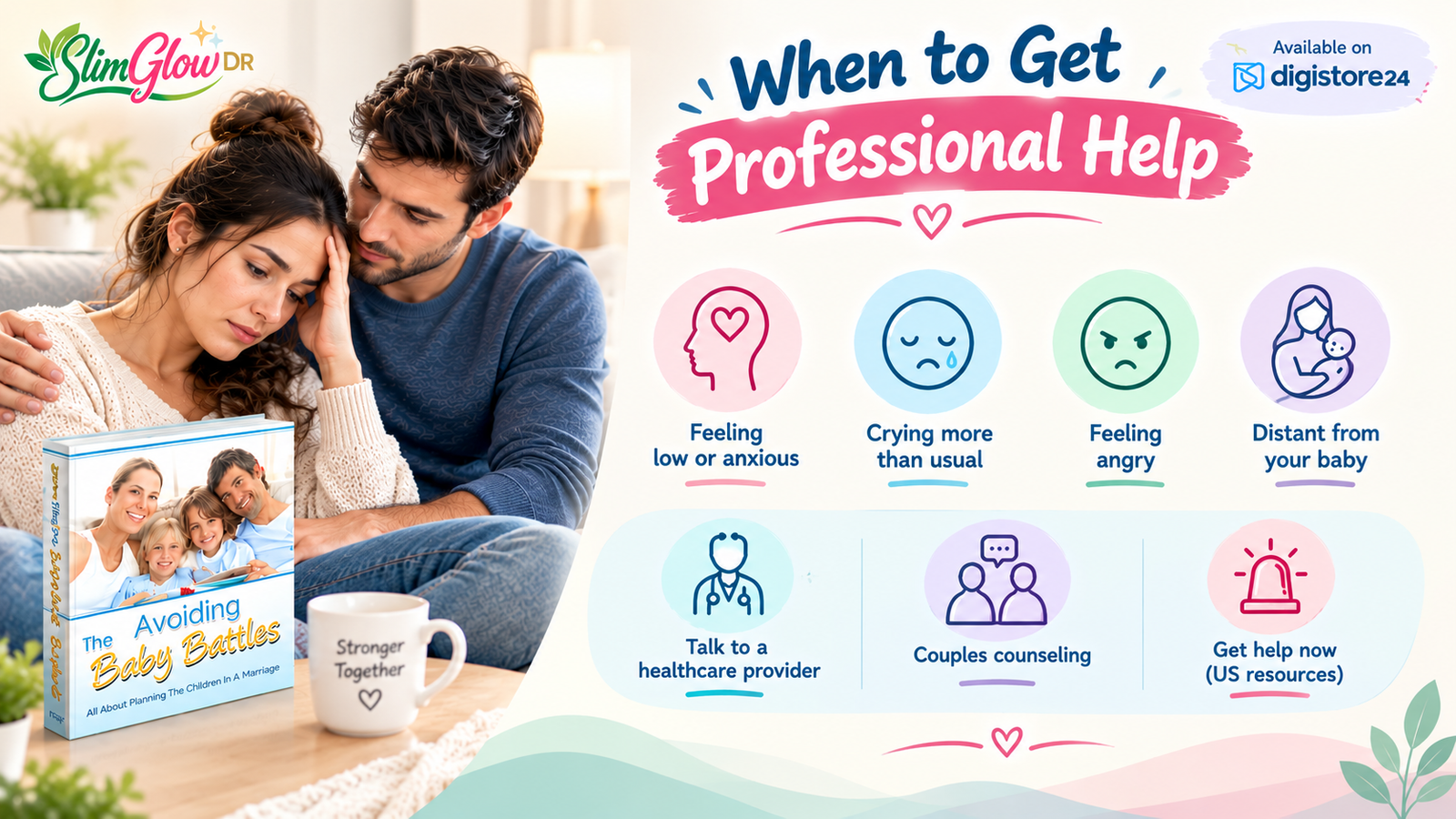
Some struggles go beyond normal exhaustion, and they can affect either parent. According to CDC data from 2018, about 1 in 8 women with a recent birth reported symptoms of postpartum depression. Partners can be affected too: a meta-analysis estimated that about 1 in 10 fathers experience depression during pregnancy or after the birth (postpartum depression in partners).
The CDC lists signs of postpartum depression that can include crying more than usual, feeling angry, feeling distant from the baby, or doubting your ability to care for the baby. Feeling anxious can be part of the picture too. Unlike the short-lived "baby blues," postpartum depression is more intense and lasts longer.
If you notice these signs in yourself or your partner, the first step is to talk with a healthcare provider, who can refer you to a mental health professional. Depression is treatable, and most people get better with treatment.
If you or your partner ever have thoughts of harming yourself or the baby, are seeing or hearing things that aren't there, or seem confused or unable to sleep at all, treat it as an emergency: call 911 or go to the nearest emergency room right away, and don't leave that person alone with the baby. These can be signs of postpartum psychosis, a rare but serious condition.
Couples counseling is also a normal, proactive option, including before the birth. Consider it if the same arguments keep repeating, if one of you feels consistently unheard, or if you simply want a structured space to work through the conversations above.
If you need support now (US resources):
- Emergency: Call 911 if you or someone else is in immediate danger.
- 988 Suicide & Crisis Lifeline: Call or text 988, or chat online, available 24/7.
- National Maternal Mental Health Hotline: Call or text 1-833-TLC-MAMA (1-833-852-6262). It's free, confidential, and available 24/7 for pregnant and new mothers and their loved ones, in English and Spanish.
- Postpartum Support International HelpLine (not a crisis line): Call 1-800-944-4773 or text "Help" to that number for non-urgent support.
Outside the US, contact your local emergency services or your healthcare provider.
Want a Structured Guide? A Look at "Avoiding The Baby Battles"
Everything above is free to use, and plenty of couples will be fine working through the checklist on their own. Some prefer a structured guide that walks them through the conversations in order. One option is the Avoiding The Baby Battles ebook.
We haven't reviewed the full ebook ourselves, so the details here come from the seller's sales page. It's a digital PDF from Prime Parents Club, described by the seller as a guide to help expecting and future parents "prepare emotionally, mentally, and practically for a new baby" and protect their relationship. According to the sales page, it covers four areas:
- Planning Beyond the Crib: home preparation, organizing pediatric care, and family budgeting
- Crucial Conversations: discussing values, timing, and responsibilities
- Unified Discipline: setting consistent rules between parents
- Financial Resilience: delivery costs, medical checkups, and educational funding strategies
Check the sales page for the current price and refund terms before you buy. The sales page doesn't list an author or credentials.
Who it might suit: couples who want a workbook-style framework for the conversations, discipline, and money topics covered earlier in this guide.
Who it may not suit: anyone looking for help with sleep, stress, health habits, or mental health, since the sales page doesn't say it covers those. It isn't a substitute for medical advice or couples counseling.
See what's inside Avoiding The Baby Battles
Affiliate link: slimglowdr.com may earn a commission if you buy through this link, at no extra cost to you.
Key Takeaways
- Strain on a relationship after a baby is common and mostly comes from predictable pressures, and many couples stay stable or improve.
- Talk through values, parenting style, and boundaries before the birth.
- Make a night-time sleep plan that protects both partners, and follow safe-sleep guidance.
- Split chores and the mental load with clear, end-to-end ownership and weekly check-ins.
- Set up simple shared routines (meals, walks, check-ins) and a budget now.
- Get professional help early if either parent struggles with mood, anxiety, or ongoing conflict.
Conclusion
Preparing your relationship for a baby won't make the newborn months easy, but it can make them feel less like a series of surprises. The relationship after baby arrives is shaped by things you can plan for now.
You don't need to cover everything this weekend. Pick one conversation from the checklist and have it this week, then another next week. If either of you starts to struggle with mood, anxiety, or conflict that won't settle, reaching out for help is a normal and smart part of the plan.
And if you'd like a structured prompt to work through some of these topics together, the Avoiding The Baby Battles guide described above is one optional resource.
This article is for general information only and isn't a substitute for advice from a doctor, midwife, mental health professional, or financial advisor. If you have concerns about your health, your baby's health, or your mood, contact a qualified healthcare provider.
Last updated: October 13, 2026
Frequently Asked Questions
What should couples talk about before having a baby?
The most useful conversations to have before having a baby cover values and traditions, parenting style and discipline, work and childcare plans, visitor and grandparent boundaries, money and parental leave, night-time sleep, the division of chores and mental load, and how you'll handle conflict. You don't have to settle everything at once. Agree on the basics, then plan to revisit decisions after the birth.
Why do couples fight more after having a baby?
Lost sleep and stress are big drivers. Research in couples suggests poor sleep makes conflict more likely and harder to resolve, and new parents lose a lot of sleep, especially in the first three months. Unmet expectations about who does what, along with new money pressures and less time together, can turn small frustrations into recurring arguments.
Is it normal for relationship satisfaction to drop after a baby?
Yes, a dip is common on average, usually small to moderate, and many couples stay stable or improve. A meta-analysis found small average declines through roughly the first 11 months, and also found that childless newlyweds declined by a similar amount over a comparable period. So some of the dip may reflect the normal course of a relationship rather than the baby alone.
How do you split night feeds and chores fairly with a newborn?
When dividing household chores after baby, start by listing every task and giving each one an owner who handles it from planning through follow-up. For nights, try split shifts or alternating nights so each adult gets a longer block of sleep, and adapt the plan to how the baby is fed. Check in weekly and reassign tasks as recovery, feeding, and work schedules change.
How can we protect our sleep as new parents?
Make a shared night plan before the birth, protect one longer sleep block for each adult, use naps and offers of help, and avoid big decisions or arguments in the middle of the night. Always follow safe-sleep guidance: put the baby on their back in their own sleep space, and return the baby to that space before you doze off after a night feed.
When should we see a couples counselor?
Any time it would help, including before the baby arrives. Consider it if the same arguments keep repeating, if either of you feels unheard, or if you want support working through big decisions. If either parent shows signs of depression or anxiety, such as persistent sadness, anger, or feeling distant from the baby, talk to a healthcare provider as well.
Is "Avoiding The Baby Battles" worth it?
It depends on whether you want a structured guide. We haven't reviewed the full ebook, but according to its sales page, it covers home planning, values conversations, unified discipline, and family finances.You can check its current price and refund terms on the Avoiding The Baby Battles sales page (affiliate link; we may earn a commission at no cost to you). It doesn't claim to cover sleep, stress, or mental health.