

Affiliate disclosure: This article contains an affiliate link. If you buy through it, Slim Glow Dr may earn a commission at no extra cost to you. Free official resources are listed first, and the paid resource is entirely optional.
Medical disclaimer: This guide is for education only. It is not a substitute for evaluation by your child's pediatrician or a developmental professional.
Last updated: October 8, 2026
Written by Dr. Kaneez Fatima, Pharm-D, using CDC, AAP, ASHA and federal IDEA sources.
[VISUAL PLACEHOLDER: Hero photo of a mother sitting on the floor stacking blocks with her toddler in a bright, relaxed home setting; no clinical imagery and no distressed child. Alt text: Mother playing with her toddler on the floor while watching for developmental milestones]
Maybe it came up at a family dinner: "She's almost two and still isn't saying much, is she?" Or maybe you noticed it on your own, watching your toddler at the playground next to children the same age. Now you're reading about the signs of developmental delay in toddlers and trying to work out whether this is something to watch or something to act on.
Paying attention like this is part of good parenting, and asking the question early is the sensible move. Every child develops at their own pace. Still, the milestone checklists that pediatricians and moms use were redesigned in 2022 so that a missed milestone is a clearer signal to talk to someone, rather than a reason to keep waiting.
This guide covers what to look for at each age from 12 months to 3 years, the handful of red flags that mean you should call your pediatrician promptly, and the exact next steps, including how to request an evaluation yourself without a doctor's referral.The Early Intervention steps describe the US system. If you're outside the US, the milestone lists still apply, so ask your doctor what local services exist.
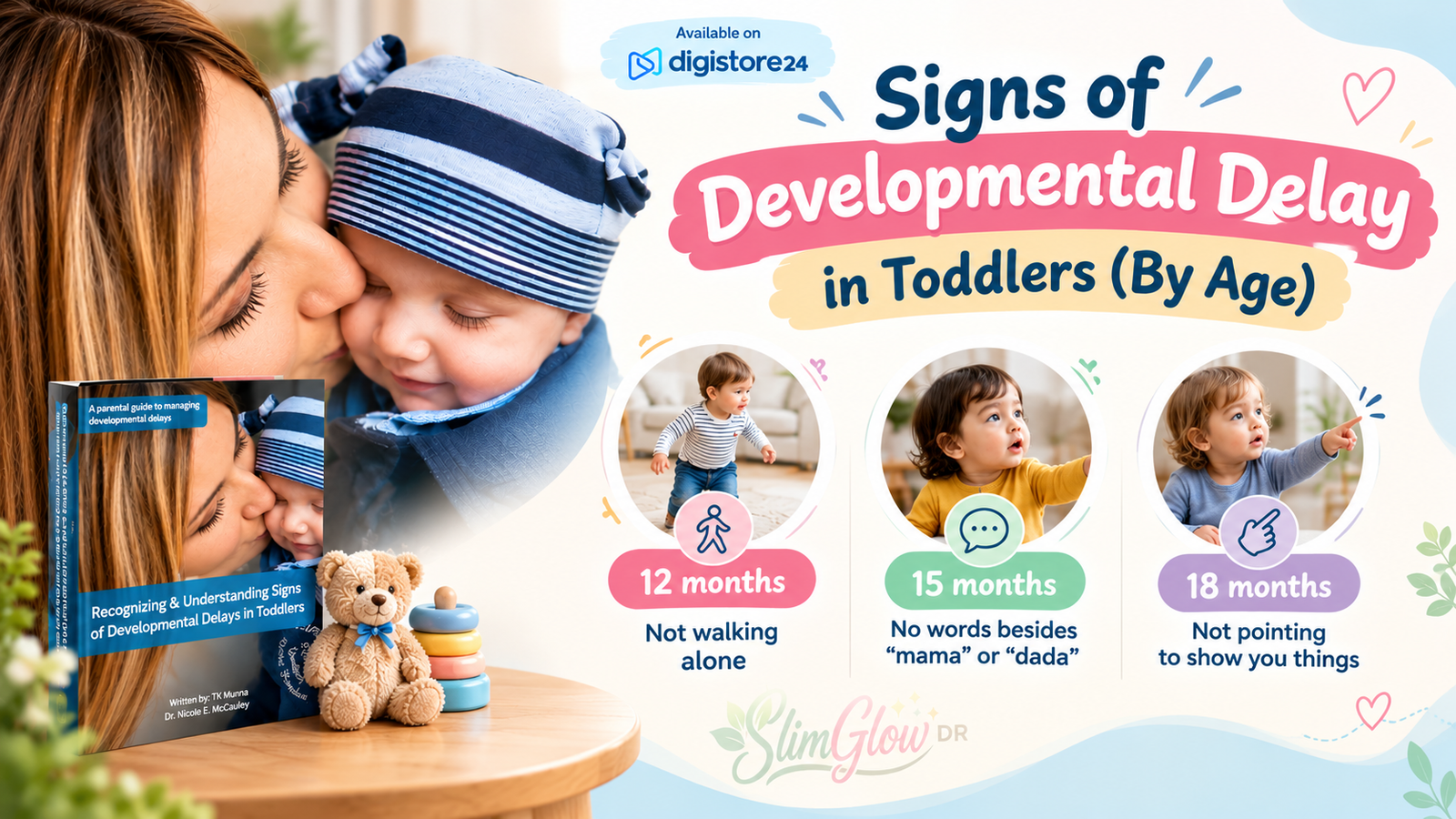
Quick answer: Common signs of developmental delay in toddlers include not walking alone by 18 months, no words besides "mama" or "dada" by 15 months, not pointing to show you things by 18 months, not responding to their name, no two-word phrases by age 2, and losing skills they once had. If you notice any of these, ask your pediatrician about developmental screening or contact Early Intervention directly.
What Is a Developmental Delay in Toddlers?
A developmental delay means a child hasn't yet reached skills that most children their age have reached. Clinicians usually look across several areas, or domains:
- Gross motor: sitting, standing, walking, climbing, running
- Fine motor: picking up small objects, scribbling, turning pages
- Speech and language: both receptive language (what your child understands) and expressive language (what they say or gesture)
- Social-emotional: eye contact, sharing attention, playing with others, showing affection
- Cognitive (thinking and problem-solving): pretend play, following directions, figuring out how things work
- Self-help or adaptive skills: feeding, drinking from a cup, helping with dressing
The CDC's checklists group these into four headings (Social/Emotional, Language/Communication, Cognitive, and Movement/Physical), with self-help skills like feeding and dressing sitting under Movement/Physical.
A delay can be isolated, affecting one area such as speech, or it can affect several. When a young child has significant delays in two or more domains, clinicians may use the term global developmental delay. The commonly used clinical definition applies to children under 5, and it's a description that typically prompts a fuller medical workup, not a final answer about why the delay is happening.
If you spot gaps in more than one area on the age lists below, mention all of them to your pediatrician, not just the one that worries you most.
It also helps to know you're far from alone. According to the CDC's overview of developmental disabilities, about 1 in 6 children aged 3 through 17 has one or more developmental disabilities. That figure uses a broad definition (it includes conditions such as ADHD and learning disabilities) and doesn't describe toddlers specifically, but it shows how common developmental concerns are.
One important framing point: a delay describes where a child is right now. It isn't a diagnosis or a prediction. Even formal screening questionnaires, the CDC notes, "do not provide conclusive evidence of developmental delays and do not result in diagnoses." They tell you whether a closer look is warranted.
Signs of Developmental Delay by Age
The lists below come from the current CDC developmental milestones for toddlers. Each item is something most children do by that age. Read them as prompts, not a pass/fail test: if your child isn't doing one of these yet, talk to your pediatrician. If your baby was born early, use their corrected age (see the section on premature babies below).
By 12 Months
Talk to your pediatrician if, by about 12 months, your child isn't yet:
- Playing games with you, like pat-a-cake
- Waving "bye-bye"
- Calling you "mama," "dada," or another special name
- Understanding "no" (pausing briefly or stopping when you say it)
- Putting something in a container, like a block in a cup
- Looking for things they saw you hide, like a toy under a blanket
- Pulling up to stand or walking while holding on to furniture
- Picking up small things, like bits of food, between thumb and pointer finger
Note that walking alone isn't on the 12-month list. Cruising along furniture is the milestone here.
By 15 Months
Talk to your pediatrician if, by about 15 months, your child isn't yet:
- Taking a few steps on their own
- Trying to say one or two words besides "mama" or "dada," like "ba" for ball
- Pointing to ask for something or to get help
- Looking at a familiar object when you name it
- Following directions given with both a gesture and words
- Showing you an object they like, clapping when excited, or showing affection
- Stacking at least two small objects, like blocks
- Using fingers to feed themselves some food
The CDC's 15-month page adds a direct message for parents: "Don't wait."
By 18 Months
Talk to your pediatrician if, by about 18 months, your child isn't yet:
- Walking without holding on to anyone or anything
- Trying to say three or more words besides "mama" or "dada"
- Pointing to show you something interesting
- Following a one-step direction without gestures, like handing you a toy when you say "Give it to me"
- Looking at a few pages in a book with you
- Playing with toys in a simple way, like pushing a toy car
- Scribbling, trying to use a spoon, or climbing on and off a couch without help
Late walking (a possible motor delay) and very few words (a possible speech delay) are both worth raising at this visit. Eighteen months is also when the AAP recommends both developmental and autism screening, so it's a natural time to bring your notes.
By 2 Years (24 Months)
Talk to your pediatrician if, by about 2 years, your child isn't yet:
- Saying at least two words together, like "More milk"
- Pointing to things in a book when you ask, like "Where is the bear?"
- Pointing to at least two body parts when asked
- Using gestures beyond waving and pointing, like blowing a kiss or nodding yes
- Noticing when others are hurt or upset
- Looking at your face to see how to react in a new situation
- Kicking a ball, running, or walking (not climbing) up a few stairs
- Eating with a spoon
If your child isn't combining two words by 2, that's one of the classic late talker signs speech-language professionals look for (see the comparison below).
By 30 Months
Talk to your pediatrician if, by about 30 months, your child isn't yet:
- Saying about 50 words
- Combining two or more words with one action word, like "Doggie run"
- Using words like "I," "me," or "we"
- Using things to pretend, like feeding a block to a doll
- Showing simple problem-solving skills, like standing on a small stool to reach something
- Following two-step instructions, like "Put the toy down and close the door"
- Playing next to other children and sometimes with them
- Jumping off the ground with both feet or turning book pages one at a time
By 3 Years
Talk to your pediatrician if, by about 3 years, your child isn't yet:
- Having a conversation with at least two back-and-forth exchanges
- Asking "who," "what," "where," or "why" questions
- Talking well enough for others to understand most of the time
- Saying their first name when asked
- Saying what action is happening in a picture or book, like "running" or "eating"
- Calming down within about 10 minutes after you leave, like at childcare drop-off
- Noticing other children and joining them to play
- Drawing a circle when you show them how
- Stringing items together, like large beads or macaroni, or using a fork
Toddler Developmental Milestones Checklist at a Glance
Caption: Toddler developmental milestones checklist: signs of developmental delay by age (12-36 months)
| Age | Movement | Language & Communication | Social & Play | Talk to your pediatrician if your child isn't yet... |
|---|---|---|---|---|
| 12 months | Pulls up to stand; walks holding furniture | Waves "bye-bye"; says "mama"/"dada" or similar | Plays pat-a-cake | Cruising, waving, or using a name for a parent |
| 15 months | Takes a few steps alone | Tries 1-2 words besides "mama"/"dada"; points to ask | Shows you objects; shows affection | Taking steps, trying words, or pointing to ask |
| 18 months | Walks without holding on | Tries 3+ words besides "mama"/"dada" | Points to show you something interesting | Walking alone, using 3+ words, or pointing to show |
| 24 months | Kicks a ball; runs | Says two words together | Notices when others are upset | Using two-word phrases |
| 30 months | Jumps with both feet | Says about 50 words; uses an action word | Plays next to other children; pretend play | Using about 50 words or pretending |
| 36 months | Strings large beads; uses a fork | Back-and-forth conversation; mostly understandable | Joins other children in play | Holding a simple conversation or playing with peers |
Based on the CDC/AAP 2022 checklists. Use corrected age for babies born early. At any age, losing skills a child once had is a reason to call promptly.
Red Flags That Mean You Should Call Your Pediatrician Now
Knowing when to worry about toddler development mostly comes down to separating two kinds of concern. Some signs deserve a prompt phone call rather than waiting for the next scheduled visit.
Call your pediatrician promptly if:
- Your child loses skills they once had. This includes words, babbling, gestures, social engagement, or walking. Every CDC checklist names loss of skills as a reason to act, and it's the strongest "don't wait" signal on this list.
- Your child doesn't respond to sounds or to their name. The CDC lists not responding to name by 9 months among early signs of autism, and it can also point to a hearing problem.
- Your child uses few or no gestures (like waving) by 12 months, or isn't pointing by the ages on the checklists above.
- Your child makes very little eye contact or rarely shares attention with you, such as looking where you point or bringing things to show you.
- You notice unusual stiffness or floppiness, or your child uses one side of the body much more than the other. These aren't on the CDC toddler checklists, but as a general rule they're worth raising with your pediatrician soon rather than saving for a routine visit.
- Your gut tells you something is wrong, even if the checklist looks fine. The CDC explicitly includes "you have other concerns" as a reason to act early.
Raise it at the next well-child visit, or call sooner if you'd rather not wait:
- Your child is just short of the age on a checklist and the skill is clearly emerging, for example, a 17-month-old taking a few wobbly independent steps.
- A skill shows up some days and not others, and it's not yet listed for your child's age.
- Someone else (a grandparent, a daycare teacher) has raised a concern you haven't seen yourself. Write down exactly what they noticed and bring it.
If a listed milestone is still missing at the checklist age, treat it as a reason to talk to your pediatrician now rather than waiting for it to resolve on its own.
Emergency: Call emergency services (911 in the US) or go to the nearest emergency room if your child has a seizure, suddenly becomes unresponsive, or has trouble breathing. Those are medical emergencies, not developmental concerns.
Why Milestone Checklists Changed in 2022, and Why It Matters
If you used a milestone list with an older child, you may notice that today's lists look different. In 2022, the CDC and the American Academy of Pediatrics (AAP) revised the "Learn the Signs. Act Early." checklists. The updated milestones, published in Pediatrics in 2022, now include only skills that most children (75% or more) would be expected to reach by each well-child visit age.
The working group also added checklists for the 15- and 30-month visits, and applying the new criteria removed or replaced a large share of the previous milestones. One stated goal was to clarify when most children can be expected to reach a milestone, specifically to discourage a "wait-and-see" approach.
Here's what that means for you in practice. Each CDC milestone checklist now says: "If your child is not meeting one or more milestones, has lost skills he or she once had, or you have other concerns, act early." Because roughly three out of four children already have a listed skill by that age, a missing one is worth a conversation with your pediatrician, even if your child seems fine otherwise.
There's a tradeoff worth understanding. Using a 75% threshold places some skills at later ages than many moms expect. Independent walking, for example, now appears on the 18-month checklist rather than at 12 months. That later age doesn't mean you should relax about it; it means that if your child hasn't reached it by then, the signal to act is clearer.
To keep track between visits, the CDC's free Milestone Tracker app (iOS and Android) covers ages 2 months to 5 years, adjusts for premature birth, and can create a summary to share with your child's doctor. The CDC is clear that the app is a monitoring aid and is "not a substitute for the use of validated, standardized developmental screening tools."
Late Talker, Developmental Delay, or Autism? How They Differ
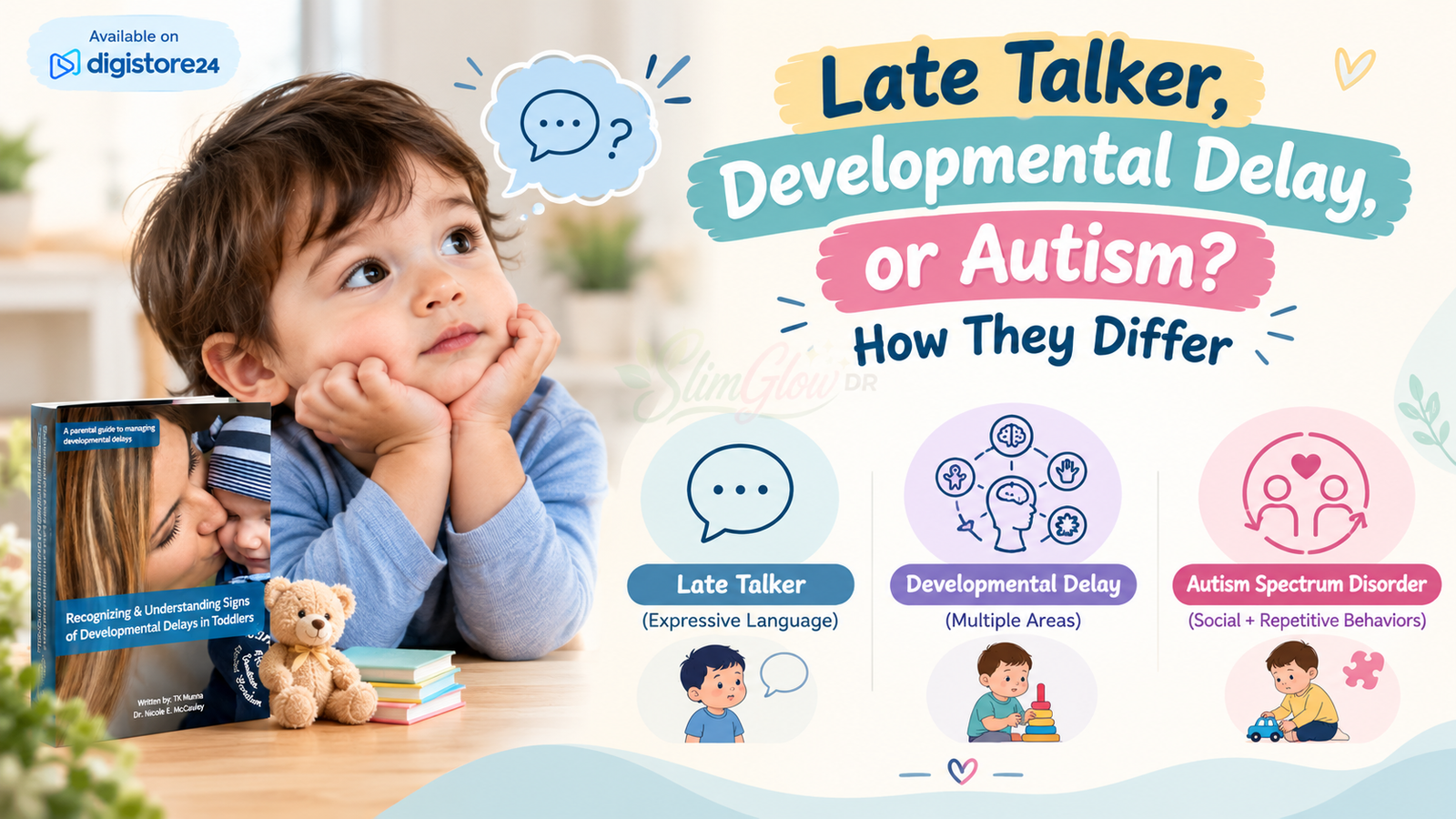
Parents searching for speech delay in toddlers often end up reading about autism too, and the overlap can be confusing. These are related but distinct ideas, and they can occur together.
ASHA describes late language emergence (the clinical term for "late talkers") as fewer than 50 words and no two-word combinations by 24 months. It affects roughly 10-20% of 2-year-olds, and the delay is mainly in expressive language. Developmental delay is broader and can affect one or more domains. Autism spectrum disorder, which the CDC describes as "a developmental disability caused by differences in the brain," is defined by differences in social communication alongside restricted or repetitive behaviors, and it can coexist with other delays.
| Late Talker | Developmental Delay | Autism Spectrum Disorder | |
|---|---|---|---|
| What's affected | Mainly expressive language (words and phrases) | One or more domains: motor, language, social, thinking, self-help | Social communication, plus restricted or repetitive behaviors |
| Typical social and play skills | Often typical | Depends on which domains are affected | Often different, such as limited shared attention or pretend play |
| Common early signs | Few words; no two-word phrases by 2 years | Missing milestones in one or several areas | Not responding to name; few gestures; not pointing to show; lining up toys and getting upset when the order changes; repeating words or phrases |
| Who evaluates | Pediatrician, speech-language pathologist, audiologist | Pediatrician, Early Intervention team, specialists as needed | Pediatrician, developmental-behavioral pediatrician or other autism specialists |
| Screening tool | Developmental screening such as the ASQ; hearing check | Developmental screening such as the ASQ | Autism screening such as the M-CHAT-R/F |
Caption: Late talker vs. developmental delay vs. autism: key differences. Only qualified professionals can diagnose, and these categories can overlap.
The CDC lists other early signs of autism, including not sharing interests by 15 months, not noticing when others are hurt or upset by 2 years, and avoiding eye contact. It also stresses that children with autism "may not have all or any of the behaviors listed." The AAP also recommends autism-specific screening for every child at 18 and 24 months, regardless of whether parents have concerns. When it comes to developmental delay vs. autism, a checklist alone can't tell you the answer. A professional evaluation can.
Raising a bilingual toddler? Growing up with two languages does not cause a language delay. Count the words your child uses across all of their languages, and tell your pediatrician which languages are spoken at home. If your child seems behind in every language they hear, that's worth raising.
Premature Babies and Corrected Age
If your baby was born early, comparing them against the checklist for their birth age can create worry that isn't warranted. Pediatricians typically use corrected age instead.
To calculate it, start with your baby's age in weeks since birth, then subtract the number of weeks they were born early (40 weeks minus their gestational age at birth). For example, a 12-month-old born at 32 weeks arrived 8 weeks early, so their corrected age is about 10 months. That child would be compared against 10-month expectations, not 12-month ones.
According to the AAP's guidance on using your baby's corrected age, this adjustment applies during the first 2 years. Practices vary on details, such as how early a baby needs to be born for the adjustment to apply, so ask your pediatrician which age to use. The CDC Milestone Tracker app can adjust for prematurity automatically.
Corrected age isn't a reason to relax monitoring. Premature birth and low birth weight are recognized risk factors for developmental disabilities, so regular screening matters more for preemies, not less. There's also encouraging research here: a Cochrane review of early intervention programs for preterm infants found they improved cognitive and motor outcomes during infancy, with cognitive benefits lasting into the preschool years, although those gains weren't sustained at school age.
What Causes Developmental Delays?
Often, no single cause is found. The CDC notes that most developmental disabilities are thought to result from a complex mix of factors. The known risk factors for developmental delays include:
- Genetic and chromosomal conditions, such as Down syndrome or fragile X syndrome
- Premature birth, low birth weight, and multiple birth (twins or more)
- Complications during birth
- Infections during pregnancy (such as CMV) or very early in a baby's life
- Exposure to alcohol or smoking during pregnancy
- Exposure to high levels of environmental toxins, such as lead
- Hearing loss, which can affect speech and language development
Notice what isn't on that list. Everyday parenting choices, like going back to work or how many books you read, aren't among the known risk factors. If you're carrying guilt, it's worth setting it down. Your job now is to get your child a good evaluation, and you're already doing that by reading this.
What to Do If You're Worried: Step-by-Step Next Steps
[VISUAL PLACEHOLDER: Numbered callout box titled "Worried? Your next 4 steps": 1) Write down what you're seeing. 2) Ask your pediatrician for a developmental screening. 3) Contact Early Intervention (under 3) or your school district (3 and older). 4) Book a hearing check if speech is the concern. Alt text: Four next steps if you notice signs of developmental delay in your toddler: track, screen, contact Early Intervention, check hearing]
If something on these lists sounds familiar, you don't have to wait for the next check-up. These steps can run in parallel, so you don't need to finish one before starting the next.
Write Down What You're Seeing
Specifics make appointments far more productive than "I'm a bit worried about her talking." Before you call, note:
- Which milestones your child hasn't reached, using the CDC checklist or app for their age
- Concrete examples, such as "says 'ba' and 'mama' only" or "doesn't look when we call his name from across the room"
- When you first noticed, and whether anything has been lost
- Short phone videos of the behavior, which help when a child acts differently in the exam room
A simple note you can copy and fill in:
Child's age (corrected, if born early): ____
Milestones not yet reached (from the CDC list): ____
What I see, with an example: ____
When I first noticed; anything lost? ____
Talk to Your Pediatrician and Ask About Developmental Screening
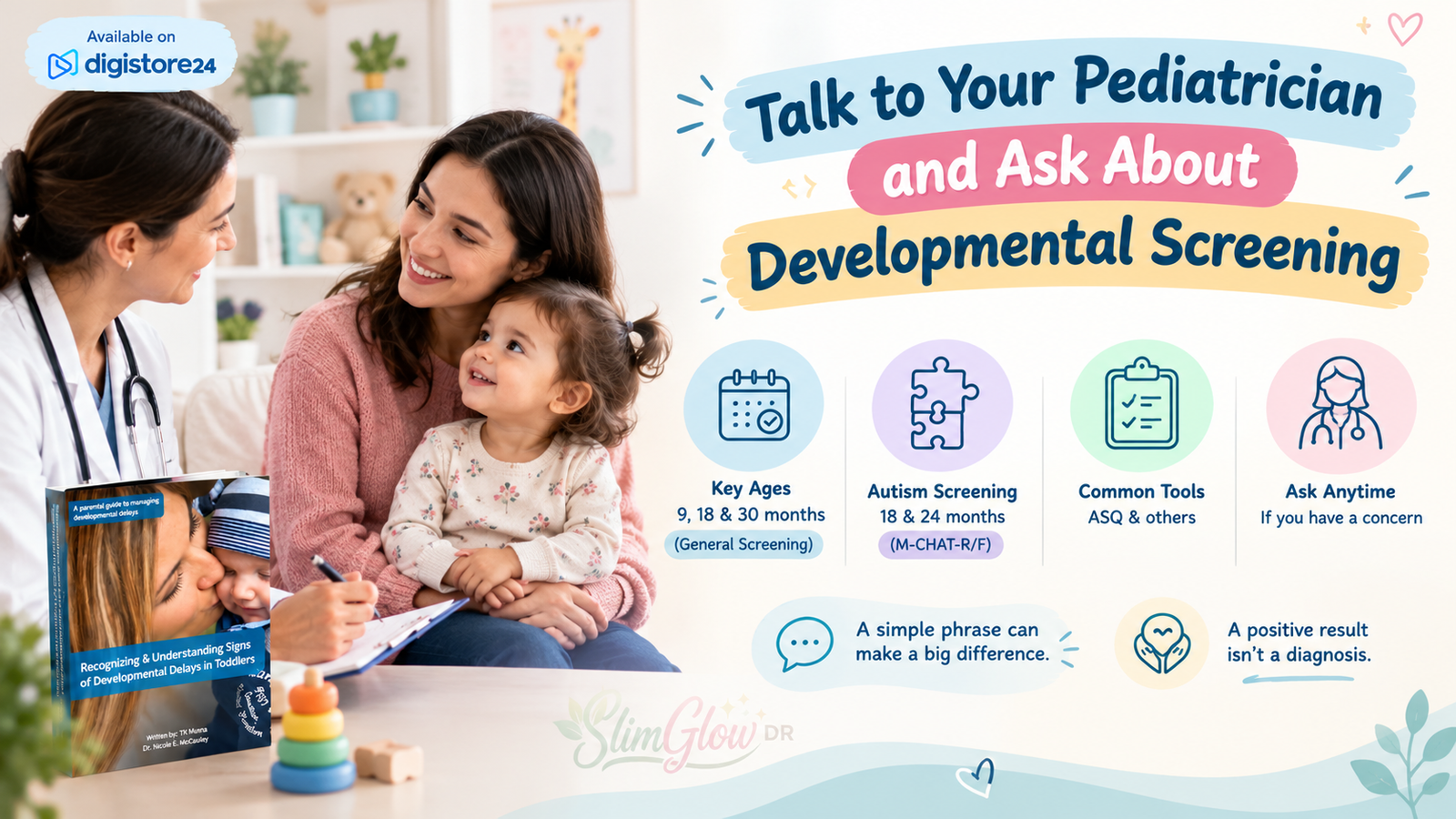
Pediatricians monitor development at every well-child visit, which is called developmental surveillance. On top of that, the AAP recommends developmental screening with a standardized questionnaire at 9, 18, and 30 months, and autism-specific screening at 18 and 24 months. Common tools include the ASQ (Ages and Stages Questionnaires) and, for autism, a questionnaire such as the M-CHAT-R/F, though practices may use others.
If you have a concern between those ages, you can ask for developmental screening at any visit. A helpful phrase: "I'd like a developmental screening, not just a check-in. Here's what I've noticed." A positive screening result isn't a diagnosis; it means your child should have a more thorough assessment.
Contact Early Intervention Directly (You Don't Need a Referral)
This is the step many parents don't know about. Under Part C of the Individuals with Disabilities Education Act (IDEA), every state runs an Early Intervention program for children from birth to age 3. According to the CDC's Early Intervention guidance, "A doctor's referral is not necessary." You can find your state's Early Intervention program and call yourself. The CDC suggests saying: "I have concerns about my child's development and I would like to have my child evaluated."
On cost, under the federal Early Intervention rules, evaluations and service coordination through Early Intervention are provided at no cost to families. Depending on your state, some ongoing services may be free or offered on a sliding fee scale, but an inability to pay can't be used to delay or deny services. Eligibility for early intervention for toddlers depends on the results of the evaluation.Whether your child qualifies for services depends on the results of the evaluation.
Under federal rules, the evaluation, assessments, and first planning meeting (the Individualized Family Service Plan, or IFSP) must be completed within 45 days of the program receiving the referral, (see ASHA's summary of the Part C timeline). though scheduling can vary in practice.
If your child is 3 or older, contact your local public elementary school, even if your child doesn't attend it, and ask for an evaluation for preschool special education services under IDEA Part B.
Get a Hearing Check If Speech Is the Concern
Hearing affects how children learn to talk. As the NIDCD explains, a hearing test is often part of the evaluation because a hearing problem can affect speech and language development. ASHA also recommends a hearing screening when assessing late talkers. If speech is your main worry, ask your pediatrician about a referral to a pediatric audiologist, ideally at the same time you request screening.
What Happens at an Evaluation
Early Intervention evaluations are multidisciplinary, so more than one specialist usually looks at your child. Depending on your concerns, the team may include a developmental-behavioral pediatrician, a speech-language pathologist, an occupational therapist, a physical therapist, or an audiologist.
Expect a mix of play-based observation, structured activities, and lots of questions for you about your child's daily life. You know your child best, so bring your notes and videos. If your child is having an off day, say so.
The outcome may be that your child doesn't qualify for services, qualifies in one area, or is referred for further medical evaluation. Any of those results gives you clearer information than you had before.
Supporting Your Toddler's Development at Home
While you're waiting for appointments, everyday interaction still matters. These suggestions come from the CDC's "what you can do" tips on its checklist pages (except the screen-time point, which comes from the AAP). They support development for all children and work alongside professional evaluation, not in place of it.
- Get down to eye level and talk. Face your child when you speak, and narrate what you're doing together ("You're putting the cup in the bag").
- Build on their words. If your child says "banana," try "You want more banana." This shows the next step without pressure.
- Read together every day. Point at pictures and use simple words. One or two books at bedtime is a good routine at age 2.
- Play back and forth. Roll balls, push toy cars, do puzzles and blocks, and encourage pretend play, like feeding a doll.
- Make time for movement. Floor play and outdoor time give children room to practice climbing, running, and kicking.
- Be thoughtful about screens. The AAP advises avoiding screens other than video calls with loved ones before 18 months, choosing only high-quality programming you watch together at 18 to 24 months, and keeping it to about 1 hour a day from ages 2 to 5. Limiting your own phone use during play also helps you respond to your child's words and gestures.
These habits won't replace speech therapy or other support if your child needs it. Diets, supplements, and "natural remedies" aren't recommended treatments for developmental delay, so if someone suggests one, check with your pediatrician before trying it.
A pharmacist's note on supplements: No vitamin, supplement, or "brain booster" has been shown to treat developmental delay, and products marketed that way can be unsafe for toddlers, for example through doses that are too high or ingredients that interact with medicines. Before giving your child anything beyond what their pediatrician recommended, ask your pediatrician or pharmacist, and bring every product your child takes (including vitamins and herbal remedies) to the evaluation. If your child takes a prescribed medicine, don't stop it on your own.
Taking Care of Yourself as a Mom Through the Uncertainty
The time between noticing something and getting answers can be hard. Many mothers describe a mix of worry, guilt, and second-guessing, along with the exhausting job of researching late at night. All of that is normal, and none of it means you've done something wrong.
You may also hear "they'll grow out of it" from relatives with the best intentions. A calm reply can help: "The checklists were updated a few years ago so that a missed milestone means it's worth asking. Getting it checked is low-risk, and if everything's fine, we'll know sooner."A 2022 American Family Physician editorial said the revision can help clinicians and families "avoid a wait-and-see approach by clarifying when to act," which gives you solid ground to stand on.
A few practical ways to lighten the load:
- Share the tasks. If you have a partner, split the calls: one of you books the pediatrician and the other calls Early Intervention.
- Lean on your service coordinator. If your child is referred to Early Intervention, you'll typically be assigned one, and part of their role is helping families navigate the process.
- Find other parents. Local parent groups, including those connected to Early Intervention programs, can offer practical advice from people a few steps ahead of you.
- Protect your own sleep and health. If worry is affecting your mood or sleep for weeks, mention it to your own doctor too.
Helpful Resources for Parents
Free resources (start here):
- CDC's milestone checklists: printable, age-by-age lists from 2 months to 5 years, with tips for each age.
- CDC's free Milestone Tracker app: track milestones, adjust for prematurity, and share a summary with your child's doctor.
- Find your state's Early Intervention program: names, websites, and phone numbers for every state, DC, and the territories.
Optional paid resource:
Some parents like having one guide to read through at their own pace. The Recognizing and Understanding the Signs of Developmental Delay in Toddlers ebook is a $19.99 downloadable PDF that, according to its publisher, aims to help parents and caregivers identify early warning signs, understand key milestones, and take timely, informed action. Slim Glow Dr hasn't independently reviewed its contents.
See the toddler developmental-delay guide. Please note that this link opens the publisher's online store, which lists several products, rather than going straight to the ebook. Look for the toddler developmental-delay guide there. It's sold through Digistore24, so check their terms at checkout.
This ebook is an educational read only. It isn't a screening tool and can't diagnose anything, and it doesn't replace a conversation with your pediatrician, developmental screening, or an Early Intervention evaluation. If you're short on time or budget, the free CDC resources above cover the essentials. If you do want the extra reading, the publisher's store with the toddler developmental-delay ebook is where to find it.
Key Takeaways
- Since 2022, CDC/AAP milestones reflect what about 75% of children can do by each age, so a missed milestone is a reason to talk to your pediatrician.
- Watch all areas of development: movement, language, social skills, thinking, and self-help.
- Losing skills your child already had is a red flag. Call your pediatrician promptly.
- You can ask for a developmental screening at any visit and contact Early Intervention yourself, without a referral.
- If speech is the concern, get your child's hearing checked.
- Everyday parenting choices aren't on the list of known causes, and acting early can make a real difference.
Conclusion
You know your child better than any checklist does, and noticing that something seems off is worth taking seriously. The signs of developmental delay in toddlers covered here aren't meant to make you anxious. They're meant to help you decide when to ask questions. A missed milestone is a reason to check in, not a reason to panic.
Asking early costs very little: either you get peace of mind, or your child starts getting support sooner, which the CDC says can make a real difference.
Your next step: if something on this list sounds familiar, don't wait for the next check-up. Call your pediatrician this week to ask for a developmental screening, or contact your state's Early Intervention program directly.
Sources
- CDC. "Learn the Signs. Act Early." Developmental milestones (12 months, 15 months, 18 months, 2 years, 30 months, 3 years). https://www.cdc.gov/act-early/milestones/index.html
- Zubler JM, Wiggins LD, Macias MM, et al. "Evidence-Informed Milestones for Developmental Surveillance Tools." Pediatrics. 2022;149(3):e2021052138. https://stacks.cdc.gov/view/cdc/122643
- Zubler J, Whitaker T. "CDC's Revised Developmental Milestone Checklists." American Family Physician. October 2022. https://www.aafp.org/pubs/afp/issues/2022/1000/editorial-cdc-developmental-milestone-checklist.html
- CDC. Milestone Tracker app. https://www.cdc.gov/act-early/milestones-app/index.html
- CDC. Clinical Screening for Autism Spectrum Disorder. https://www.cdc.gov/autism/hcp/diagnosis/screening.html
- Lipkin PH, Macias MM. "Promoting Optimal Development: Identifying Infants and Young Children With Developmental Disorders Through Developmental Surveillance and Screening." Pediatrics. 2020;145(1).
- Hyman SL, Levy SE, Myers SM. "Identification, Evaluation, and Management of Children With Autism Spectrum Disorder." Pediatrics. 2020;145(1):e20193447.
- CDC. Signs and Symptoms of Autism Spectrum Disorder. https://www.cdc.gov/autism/signs-symptoms/index.html
- CDC. Early Intervention. https://www.cdc.gov/act-early/early-intervention/index.html
- CDC. Early Intervention contact information by state. https://www.cdc.gov/act-early/early-intervention/contact-information-by-state.html
- 34 CFR 303.521, Agreements and fees under IDEA Part C. https://www.law.cornell.edu/cfr/text/34/303.521
- ASHA. IDEA Part C: Referral Timelines and Requirements. https://www.asha.org/advocacy/idea/idea-part-c-issue-brief-referral-timelines/
- ASHA Practice Portal. Late Language Emergence. https://www.asha.org/practice-portal/clinical-topics/late-language-emergence/
- NIDCD (NIH). Speech and Language Developmental Milestones. https://www.nidcd.nih.gov/health/speech-and-language
- CDC. Developmental Disability Basics. https://www.cdc.gov/child-development/about/developmental-disability-basics.html
- AAP / HealthyChildren.org. Corrected Age for Preemies. https://www.healthychildren.org/English/ages-stages/baby/preemie/Pages/Corrected-Age-For-Preemies.aspx
- Moeschler JB, Shevell M; AAP Committee on Genetics. "Comprehensive Evaluation of the Child With Intellectual Disability or Global Developmental Delays." Pediatrics. 2014;134(3):e903-e918.
- Spittle A, Orton J, Anderson PJ, Boyd R, Doyle LW. "Early developmental intervention programmes provided post hospital discharge to prevent motor and cognitive impairment in preterm infants." Cochrane Database of Systematic Reviews. 2015;(11):CD005495. https://pmc.ncbi.nlm.nih.gov/articles/PMC8612699
Frequently Asked Questions
What are the first signs of developmental delay in a toddler?
Early signs often show up in communication and movement. Examples include not pointing to ask for things by 15 months, no words besides "mama" or "dada" by 15 months, and not walking alone by 18 months. Not responding to their name and losing skills they once had are also important signs. If you notice any of these, talk to your pediatrician.
How do I know if my toddler is a late bloomer or developmentally delayed?
You can't reliably tell on your own, and that's fine, because you don't need to. Under the 2022 CDC/AAP checklists, each milestone is something at least 75% of children do by that age. If your child is missing one, ask your pediatrician for a developmental screening. Screening helps sort typical variation from delay that would benefit from support.
At what age should I worry if my toddler isn't talking?
Based on the CDC checklists, talk to your pediatrician if your child has no words besides "mama" or "dada" by 15 months, fewer than three words by 18 months, or no two-word phrases like "more milk" by 2 years. Losing words at any age is a reason to call promptly. A hearing check is often part of the evaluation.
Is developmental delay the same as autism?
No. Developmental delay means a child is behind in one or more areas, such as movement or language. Autism is a distinct developmental condition involving differences in social communication along with restricted or repetitive behaviors. A child can have one, both, or neither. The AAP recommends autism screening at 18 and 24 months, and only a qualified professional can diagnose autism.
Can a toddler catch up from a developmental delay?
Many children make significant progress, especially with early support, but outcomes vary and no one can promise a child will fully catch up. For children whose only concern is late talking (late language emergence), ASHA reports that roughly 50-70% catch up by late preschool or school age, while some continue to have language difficulties. That number doesn't apply to every kind of developmental delay. Your child's evaluation team can give you a more personal picture.
Do I need a doctor's referral for Early Intervention?
No. The CDC states that a doctor's referral is not necessary. For children under 3, you can contact your state's Early Intervention program directly and ask for an evaluation, which is provided at no cost to families. For children 3 and older, contact your local public elementary school to ask about a preschool special education evaluation.
Should I wait and see, or get my toddler evaluated?
If your child is missing a milestone on the CDC checklist, has lost skills, or you simply have a strong concern, getting evaluated is the safer choice. The 2022 checklist revision was designed partly to discourage a wait-and-see approach. An evaluation carries little downside, and if support is needed, starting early gives your child more time to benefit.
Do premature babies have developmental delays?
Premature birth is a known risk factor for developmental delays, though many preemies develop typically. During the first 2 years, use your baby's corrected age (age minus weeks born early) when checking milestones, so you're comparing them fairly. Ask your pediatrician which age to use, and keep up with regular developmental screening.