
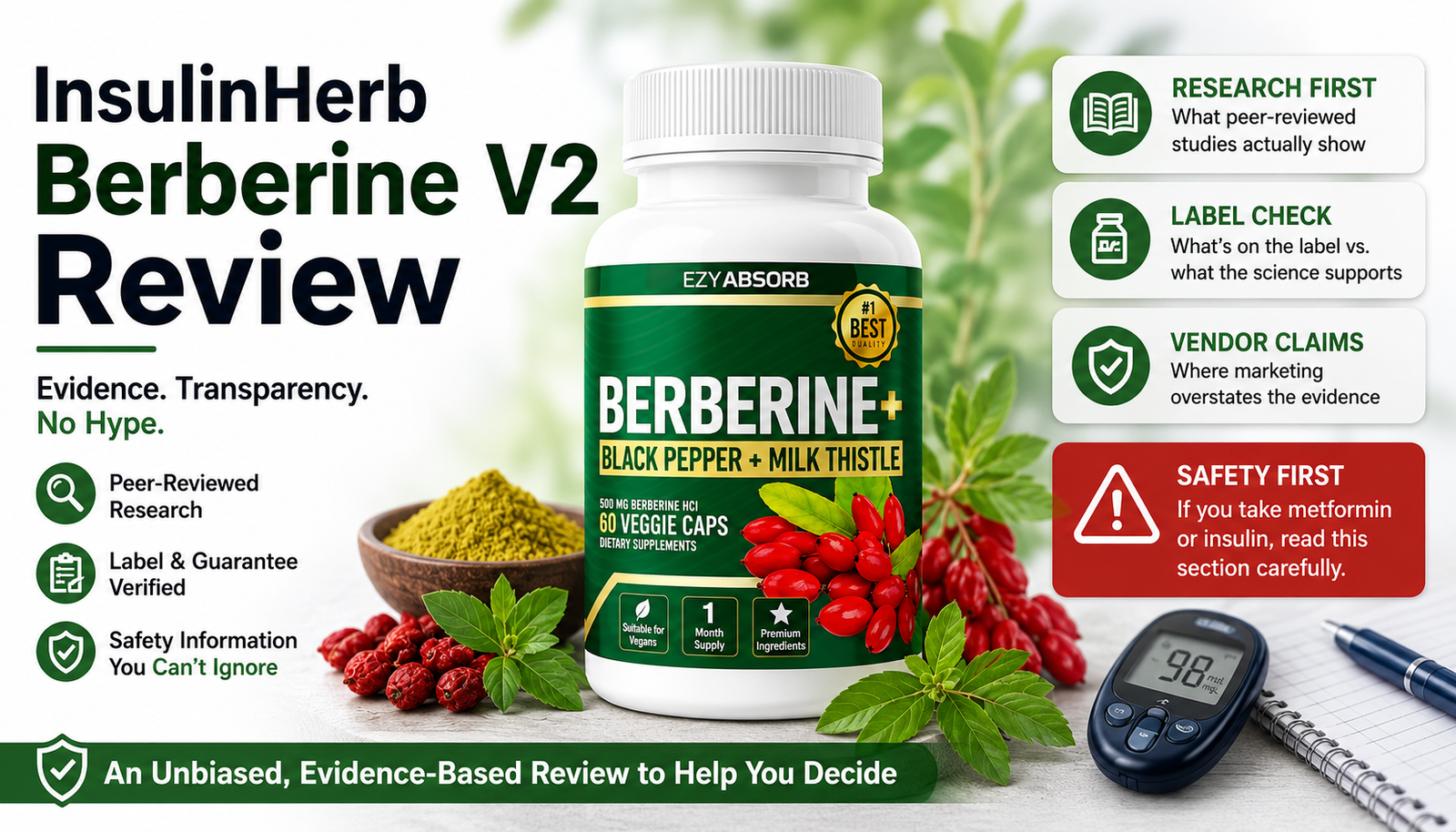
If you're reading this, you've probably already seen InsulinHerb Berberine V2 somewhere: an ad, a social post, or one of the other review sites currently ranking for this exact search. You're not looking for a definition of berberine. You want to know if this specific product is real, whether it actually does what the marketing claims, and, if you're already managing blood sugar with medication, whether it's safe to try.
This InsulinHerb Berberine V2 review is built to answer that directly. Unlike most of the pages currently ranking for this term, we're not going to stack testimonials and call it evidence. We pulled the peer-reviewed research on berberine, checked the product's own label and guarantee terms against what's actually published on the official page, and flagged the places where the vendor's own marketing overstates what the science supports. If you take metformin or insulin, the safety section below is not optional reading.
Quick Answer
InsulinHerb Berberine V2 is a real, purchasable supplement (500mg berberine HCl plus milk thistle per capsule), backed by a 90-day money-back guarantee. Berberine has peer-reviewed evidence for modestly supporting blood sugar and insulin sensitivity, but it's not a diabetes cure or a metformin substitute. If you take metformin, insulin, or another blood-sugar medication, talk to your doctor before combining it with berberine: the interaction carries a real hypoglycemia risk. Keep reading for dosage, side effects, and the full safety picture.
Quick Verdict callout box: real product (verified pricing, $39.90/$99.90, 90-day money-back guarantee); real evidence (berberine plus milk thistle backed by peer-reviewed research on blood sugar and insulin sensitivity); not a cure (does not reverse diabetes and is not a metformin replacement); medication caution (talk to your doctor before combining with metformin or insulin) — Alt text: Quick verdict summary box for InsulinHerb Berberine V2 review, covering legitimacy, evidence, and safety caution.
What Is InsulinHerb Berberine V2?
The Company and Product Overview
InsulinHerb Berberine V2 is manufactured and sold by a company that operates under the name Ezyabsorb, according to the vendor's own affiliate-recruitment materials (the retail product page itself does not separately name the manufacturer). The company describes its team as including Joel Chue, referred to on its affiliate page as a "7-time ClickBank Platinum Marketer," and Dr. Helen Okoye, described there as an "American Public Health Physician" who was "recently onboarded to improve product quality and credibility." These are the company's own self-descriptions; we did not independently verify Dr. Okoye's credentials through a licensing database, so treat that detail as a company claim rather than an independently confirmed fact.
The product itself is a one-time purchase, not a subscription. There's no recurring billing model on the checkout page, which is worth noting given how many supplement funnels quietly enroll buyers in auto-ship programs.
Key Ingredients (Berberine HCl from Phellodendron amurense + Milk Thistle/Silymarin)
Each capsule contains 500mg of berberine HCl, sourced from Phellodendron amurense, commonly known as cork tree bark, one of the traditional plant sources of this isoquinoline alkaloid. The formula also includes milk thistle, standardized around its active compound silymarin, though the product page does not disclose the exact milk-thistle dosage. That's a label-transparency gap worth knowing about rather than a dealbreaker.
The berberine-plus-milk-thistle combination is actually the more interesting detail here, because it's not just a filler pairing. As we cover in the research section below, this specific combination has its own dedicated clinical evidence, separate from berberine alone.
Like every product in this category, InsulinHerb Berberine V2 is a dietary supplement, not an FDA-approved drug. It is not FDA-regulated to treat, cure, or prevent disease, and the official product page carries standard disclaimer language to that effect.
How Does Berberine Actually Work for Blood Sugar and Weight?
The AMPK Pathway, Explained Simply
Berberine's main mechanism runs through an enzyme called AMPK (AMP-activated protein kinase), sometimes described as a cellular "metabolic master switch." When AMPK is activated, it shifts cells toward burning glucose and fat for energy and away from storing it, and it also tends to reduce how much glucose the liver produces through a process called gluconeogenesis. There's also emerging interest in berberine's effect on gut microbiota composition, which may play a secondary role in its metabolic effects, though this piece of the mechanism is less established than the AMPK pathway itself.
What This Means for Insulin Resistance and Glucose Metabolism
In practical terms, activating AMPK is one of the reasons berberine shows up consistently in research on insulin resistance: cells that respond better to insulin need less of it to move glucose out of the bloodstream, which is the underlying goal for anyone with prediabetes, type 2 diabetes, or PCOS-related insulin resistance.
Here's where we need to correct something you may have already read elsewhere. Berberine has been nicknamed "nature's Ozempic" across a lot of the marketing and review content in this space, including some of the sites currently ranking for this exact search. That comparison doesn't hold up. GLP-1 medications like Ozempic work by mimicking a gut hormone that regulates appetite and digestion through an entirely different receptor system. Berberine's AMPK-driven mechanism is a different pathway altogether. As UCLA Health explains in a piece specifically addressing this comparison, there is no conclusive evidence that berberine's effects come anywhere close to what GLP-1 drugs achieve, and researchers are calling for more rigorous, gold-standard trials before anyone draws that line. If a review site tells you berberine is a natural Ozempic alternative, that's marketing language outrunning the science.
What Does the Research Say? (Evidence, Not Hype)
Fasting Blood Glucose and A1C Findings
This is where InsulinHerb's specific formulation actually has something the thin competitor sites don't cite: real, peer-reviewed data on the berberine-plus-milk-thistle combination it uses, not just berberine in general.
Multiple systematic reviews of randomized controlled trials in people with type 2 diabetes have found that berberine produces a statistically significant reduction in HbA1c compared with placebo or control, with pooled effect sizes in the range of roughly half a percentage point to just under one full point, depending on which meta-analysis you look at. The same body of clinical research on berberine and blood sugar also shows a consistent reduction in fasting plasma glucose and improvement in fasting insulin and HOMA-IR, a standard marker of insulin resistance.
Those numbers come with real caveats. Most of the underlying trials were conducted in Asian populations, ran for only 8 to 13 weeks, and several were flagged with unclear or high risk of bias. This is not a single definitive number you can bank on; it's a consistent direction across imperfect but well-conducted peer-reviewed research.
More directly relevant to InsulinHerb's actual product: a meta-analysis of five randomized, double-blind, placebo-controlled trials on the specific berberine plus milk thistle combination, covering nearly 500 participants, found statistically significant improvements in total cholesterol, triglycerides, HDL, LDL, and fasting plasma glucose. The researchers behind that analysis believe silymarin likely works by improving berberine's bioavailability rather than independently driving the metabolic change, which may allow for a lower effective berberine dose with fewer gastrointestinal side effects. That's a plausible, evidence-supported rationale for why InsulinHerb pairs the two ingredients rather than selling berberine alone.
For women managing PCOS-related insulin resistance specifically, a meta-analysis of 12 randomized trials covering more than 1,500 participants found berberine reduced fasting glucose and fasting insulin compared with placebo. When compared head-to-head with metformin in a smaller subset of that research, berberine showed no significant difference in fasting glucose reduction, but did show better lipid-lowering and a greater reduction in waist circumference. We'll come back to why that "comparable, not superior" framing matters in the metformin comparison section below.
Weight Loss: What's Realistic (and What Isn't)
If you're hoping berberine will produce dramatic, rapid weight loss, the honest answer is that the research doesn't support that expectation, and any review claiming otherwise is overselling it.
Meta-analyses looking at obesity-related outcomes have found average reductions in the range of roughly two kilograms (about 4 to 5 pounds) in body weight, modest BMI reductions, and waist circumference changes generally in the one-to-three-centimeter range across different studies. Some effects on weight and BMI appear more consistently at doses above 1 gram per day sustained for eight weeks or longer, which lines up with InsulinHerb's recommended 1,000 to 1,500mg daily protocol.
NIH's guidance on berberine and weight loss is worth reading directly if you want the unvarnished government-health-agency take: the National Center for Complementary and Integrative Health describes the evidence as mixed, notes that many of the included studies carried a high risk of bias, and does not endorse the idea that berberine rivals prescription weight-loss medications. That's the accurate framing. A few pounds and a modest reduction in waist circumference over several weeks is a realistic, evidence-supported expectation. A dramatic transformation is not.
InsulinHerb Berberine V2 Ingredients and Label Facts
Here's the full label breakdown, verified directly against the official product page:
- Berberine HCl: 500mg per capsule, sourced from Phellodendron amurense (cork tree bark)
- Milk thistle/silymarin: included per capsule; exact milligram amount not disclosed on the label
- Recommended protocol: 1,000 to 1,500mg of berberine per day, taken as one capsule two to three times daily
- Bottle size: 60 capsules, roughly a one-month supply at the recommended dose
- Regulatory status: dietary supplement, not FDA-approved to diagnose, treat, cure, or prevent disease
That last point isn't a knock against the product specifically; it's true of every supplement in this category under current FDA dietary supplement disclaimer requirements. Any product claiming otherwise should raise your suspicion, not your confidence.
Is InsulinHerb Berberine Legit or a Scam?
Short answer: it's a real, functioning product with a legitimate purchase and refund process, sold through a mainstream affiliate platform (Digistore24) with a verifiable product ID. That's different from saying every claim made about it in the wild is accurate, so let's separate the two.
Company Transparency and Guarantee
The product carries a 90-day, empty-bottle, 100% money-back guarantee, confirmed on both the official product page and the Digistore24 checkout page, along with free shipping and consistent pricing across both listings. That's a reader-friendly guarantee window; 90 days gives you enough time to actually judge whether it's doing anything for you, rather than the 14 to 30 day windows common elsewhere in this category.
What we did not find, after directly reviewing the official product page, is any claim of GMP (Good Manufacturing Practice) certification or third-party lab testing. Some of the other sites ranking for this term assert GMP certification as though it's confirmed. We looked, and as of this review, the vendor's own page simply doesn't make that claim, so we're not going to repeat it as fact. If third-party testing matters to you, and for a supplement you're taking daily alongside diabetes medication, it should; that's a reasonable question to put directly to the company before you buy, not something to assume.
What Real Reviews and Complaints Say
The official product page itself features customer testimonials, as most direct-response supplement pages do. We want to flag something here rather than gloss over it: one testimonial on that page claims the person "hasn't had to take metformin for a year because it works better." We're not repeating or endorsing that claim anywhere in this review, and you shouldn't take it as evidence either. No supplement should be presented as a reason to stop prescribed diabetes medication, and a single customer's unverified account isn't clinical proof of anything.
A second testimonial on the same page describes a large, rapid overnight drop in blood sugar readings. That kind of swing looks less like a clean success story and more like a description of a possible hypoglycemic event, which is exactly the risk our safety section below covers. If anything, that testimonial is a case study in why medical supervision matters, not a reason to feel reassured.
This is the core differentiation this review is built around: we're willing to point out where the vendor's own marketing overreaches, because an honest verdict is more useful to you than a persuasive one.
Side Effects and Safety: Read This Before You Buy
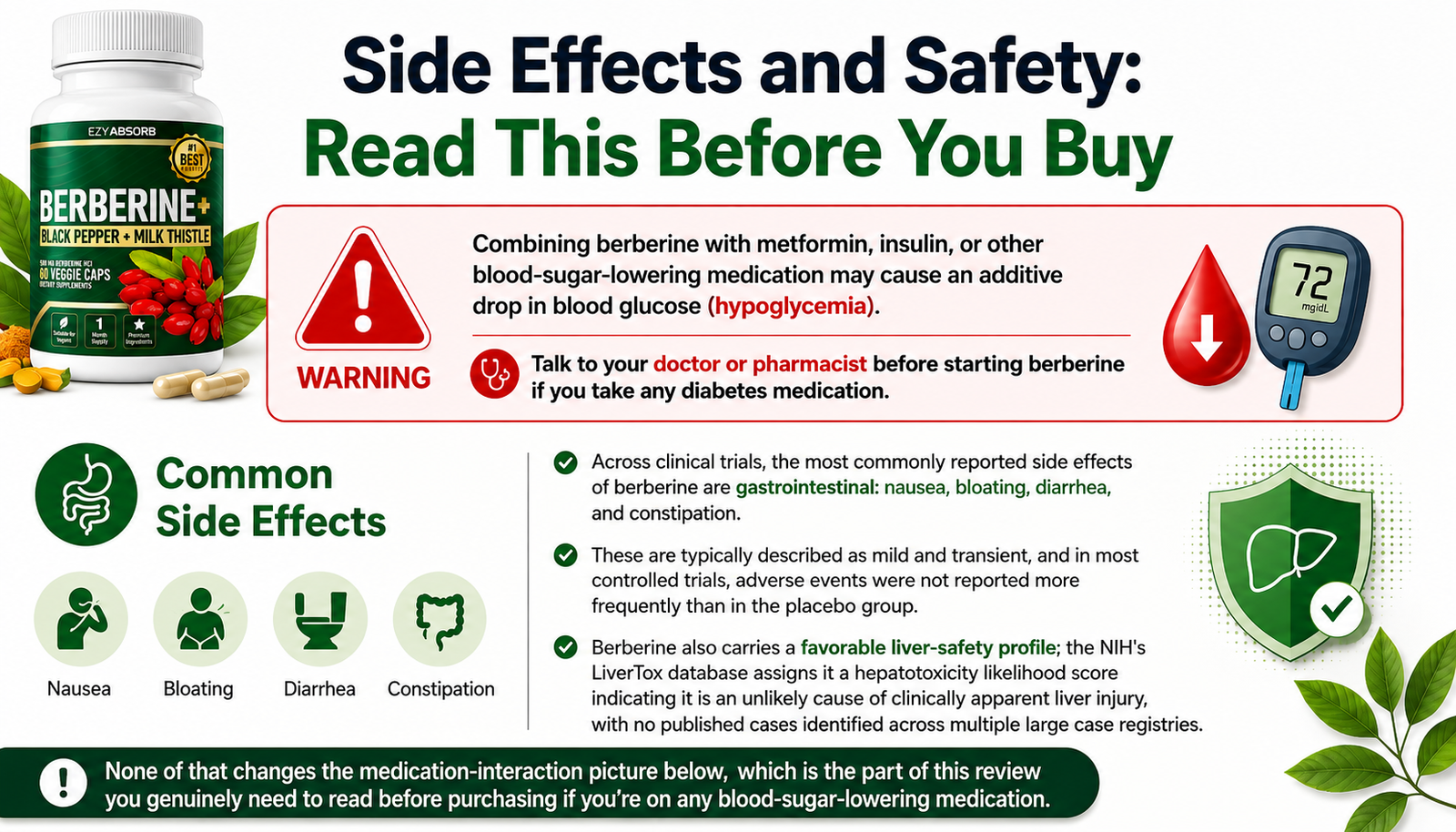
Safety warning callout box: Combining berberine with metformin, insulin, or other blood-sugar-lowering medication may cause an additive drop in blood glucose (hypoglycemia). Talk to your doctor or pharmacist before starting berberine if you take any diabetes medication. — Alt text: Warning: berberine and diabetes medication interaction safety notice.
Common Side Effects
Across clinical trials, the most commonly reported side effects of berberine are gastrointestinal: nausea, bloating, diarrhea, and constipation. These are typically described as mild and transient, and in most controlled trials, adverse events were not reported more frequently than in the placebo group. Berberine also carries a favorable liver-safety profile; the NIH's LiverTox database assigns it a hepatotoxicity likelihood score indicating it is an unlikely cause of clinically apparent liver injury, with no published cases identified across multiple large case registries.
None of that changes the medication-interaction picture below, which is the part of this review you genuinely need to read before purchasing if you're on any blood-sugar-lowering medication.
Medication Interactions: Metformin, Insulin, and Hypoglycemia Risk
If you take metformin, insulin, or any other medication that lowers blood sugar, talk to your doctor before starting berberine. This is not boilerplate caution; it's the single most important thing in this entire review.
Clinical drug-interaction references, including those compiled by patient.info and similar independent pharmacology resources, consistently describe the risk of low blood sugar when combining berberine with diabetes medication as a moderate-severity, additive interaction.
The concern is straightforward: berberine and drugs like metformin or insulin lower blood glucose through different but overlapping mechanisms, and berberine also affects some of the same liver and kidney transporters that process metformin. Stack those effects together without monitoring, and blood sugar can drop further and faster than either medication alone would produce, especially if you're also fasting or exercising.
To be fair to the full picture, we should note an important countervailing data point: at least one peer-reviewed meta-analysis of actual clinical trials did not find a significant increase in total adverse events or hypoglycemia when berberine was combined with oral hypoglycemic medications. In other words, the large spikes in observed hypoglycemia that the pharmacological risk would predict weren't consistently showing up in the short, small trials conducted so far. That's a real, honest nuance, but it doesn't cancel out the underlying concern: the pharmacological mechanism for an additive blood-sugar-lowering effect is well-established, the trial evidence to date is limited and short-term, and individual responses vary.
The vendor's own FAQ, notably, states that berberine "can be taken on top of metformin" without mentioning this risk at all. We're not deferring to that framing. If you're on medication, this is a conversation for your doctor or pharmacist, not a decision to make solely from a product FAQ.
On metformin or insulin? Talk to your doctor first, then come back and check pricing further down this page once you've got the green light.
Berberine also isn't recommended during pregnancy or breastfeeding, and it's been flagged for a specific infant bilirubin risk (kernicterus) in that context, along with a known interaction with cyclosporine. If you're pregnant, nursing, or on other prescription medications, run this by your doctor before starting, full stop.
Berberine vs. Metformin: What's the Real Difference?
This is probably the question that brought you here if you're already on metformin, so let's be direct about it: berberine is not a replacement for metformin, and it does not outperform it as a glycemic-control treatment.
What the research actually supports is more nuanced. A peer-reviewed meta-analysis examining this exact comparison found that berberine alone does not outperform metformin or other oral hypoglycemic drugs for glycemic control. The same body of research found that combining berberine with metformin, under medical supervision, improved glucose and insulin resistance markers more than metformin alone.
One small early trial comparing berberine directly against metformin in newly diagnosed type 2 diabetes patients found broadly comparable reductions in fasting glucose and HbA1c over three months. That was a single, small study, though, so we're deliberately not treating it as a generalizable statistic.
The accurate takeaway: in some limited research contexts, berberine has produced glucose reductions in a similar range to metformin. That is meaningfully different from "berberine works better than metformin," a claim you may have seen on this exact product's own page in a customer testimonial.
We are not repeating that claim here because it isn't supported by the broader clinical evidence, and because acting on it could mean discontinuing a medication your doctor prescribed for a real reason. If you and your physician decide to explore berberine as an addition to your current treatment plan, that's a legitimate conversation to have. Deciding to swap metformin for a supplement on your own, based on one product's testimonial, is not.
Dosage: How to Take InsulinHerb Berberine V2
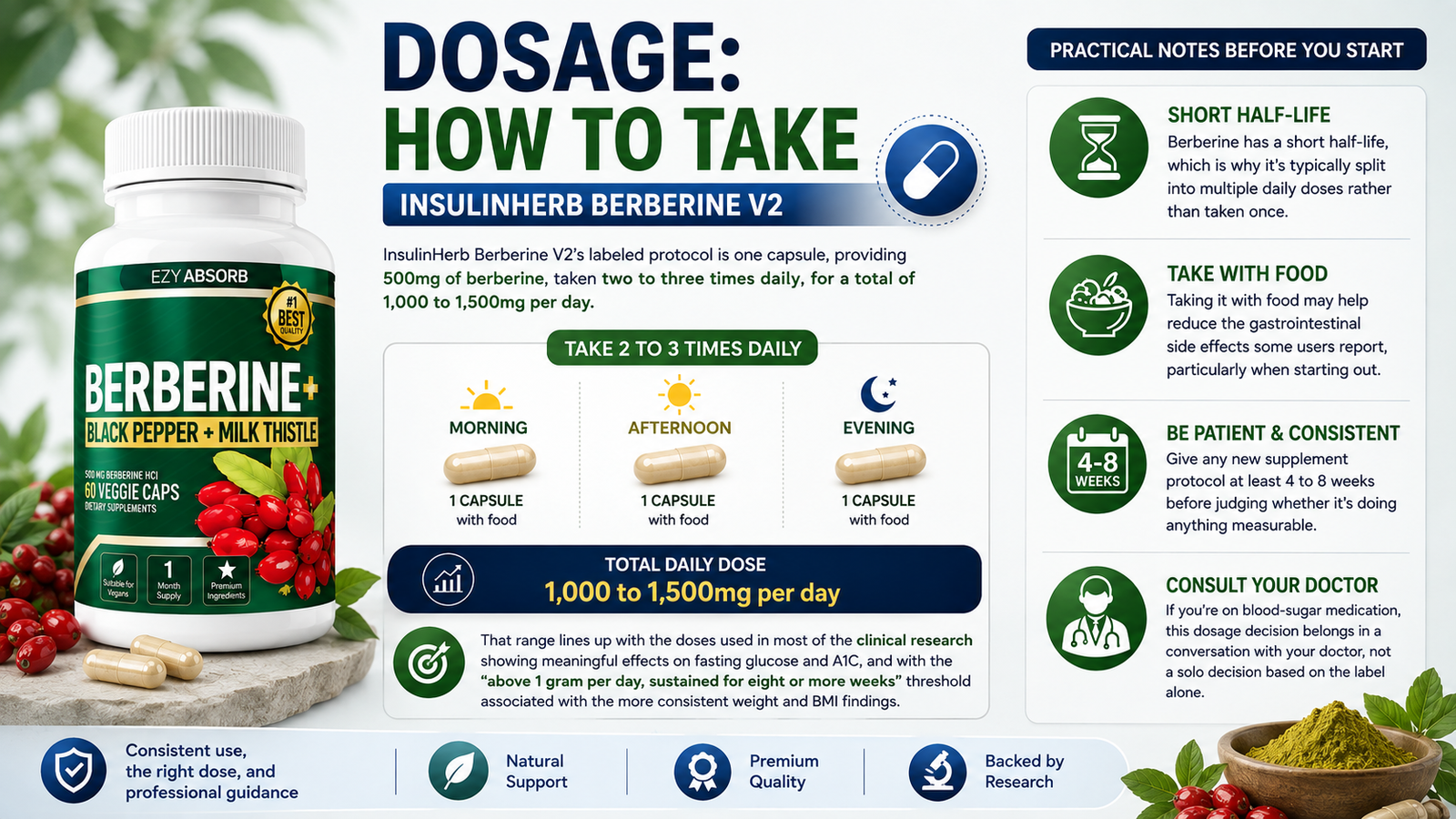
InsulinHerb Berberine V2's labeled protocol is one capsule, providing 500mg of berberine, taken two to three times daily, for a total of 1,000 to 1,500mg per day. That range lines up with the doses used in most of the clinical research showing meaningful effects on fasting glucose and A1C, and with the "above 1 gram per day, sustained for eight or more weeks" threshold associated with the more consistent weight and BMI findings.
A few practical notes worth knowing before you start:
- Berberine has a short half-life, which is part of why it's typically split into multiple daily doses rather than taken once
- Taking it with food may help reduce the gastrointestinal side effects some users report, particularly when starting out
- As a general rule of thumb, give any new supplement protocol at least four to eight weeks before judging whether it's doing anything measurable, since that's roughly the timeframe used in most of the clinical trials referenced above
- If you're on blood-sugar medication, this dosage decision belongs in a conversation with your doctor, not a solo decision based on the label alone
Pricing, Guarantee, and Where to Buy It Safely
InsulinHerb Berberine V2 is priced at $39.90 for a single bottle (a one-month supply) or $99.90 for a three-bottle value pack, with free shipping on both options. We independently confirmed both prices on the official product page and the Digistore24 checkout page, so this pricing is accurate as of this review.
Every purchase is backed by a 90-day, empty-bottle, 100% money-back guarantee, which means you have roughly three months to actually test whether it works for you before deciding to keep it. It's a one-time purchase with no subscription or recurring billing built into the product.
Check current pricing and availability: Check Current Pricing and Availability →
(This is our affiliate link. If you purchase through it, Slim Glow Dr may earn a commission at no extra cost to you.)
If you're on metformin, insulin, or another blood-sugar medication, please read the safety section above and talk to your doctor before buying, not after.
Pros and Cons: The Honest Verdict
Pros:
- Real, peer-reviewed evidence base for berberine's effect on fasting glucose, A1C, and insulin sensitivity via the AMPK pathway
- The specific berberine-plus-milk-thistle combination has its own dedicated clinical research, not just generic berberine studies
- Transparent 90-day money-back guarantee, verified across both the vendor and Digistore24 checkout pages
- One-time purchase with no hidden subscription or auto-ship enrollment
- Favorable liver-safety profile, with GI side effects that are typically mild and transient
Cons:
- No GMP certification or third-party lab-testing claim found anywhere on the official product page
- Milk thistle dosage per capsule is not disclosed
- Real hypoglycemia risk if combined with metformin or insulin without medical supervision
- One customer testimonial on the product's own page makes an unsupported "better than metformin" claim we do not endorse
- Weight-loss and glucose effects are modest, not dramatic, and not a substitute for diet, exercise, or prescribed medication
How InsulinHerb Compares to Other Berberine Supplements
If you're weighing berberine supplements in 2026, the details below matter more than any single marketing claim.
| Product | Formula | Daily Protocol | Price | Guarantee | Third-Party Testing |
|---|---|---|---|---|---|
| InsulinHerb Berberine V2 | 500mg berberine HCl + milk thistle (amount undisclosed) | 1,000-1,500mg/day (1 cap, 2-3x daily) | $39.90/bottle or $99.90 for 3 | 90-day money-back | Not claimed on product page |
| Double Wood Berberine | 500mg berberine HCl, single-ingredient | Typically 1 capsule/day | $19.95/bottle (2-month supply) | 30-day money-back | ISO/IEC 17025-accredited lab, cGMP facility |
| Thorne Berberine-500 | Berberine, single-ingredient | Per label | Around $44/30 servings | Per Thorne's standard policy | NSF Certified |
The comparison here isn't about crowning a single "best" product; it's about seeing what you're trading off. Double Wood is meaningfully cheaper and backs its quality claims with accredited third-party testing, but it's berberine alone, without the bioavailability-supporting milk thistle pairing. Thorne carries NSF certification, a recognized third-party quality standard, at a higher per-bottle price point. InsulinHerb sits in the middle on price and offers the longest guarantee window of the three, along with the milk-thistle combination that has its own dedicated research, but it's the only one of the three that doesn't make a third-party testing claim. Independent testing matters more in this category than most buyers realize, since supplement quality and labeled potency can vary meaningfully across manufacturers in this space. That's exactly why a documented third-party testing claim, or the honest absence of one, belongs in your buying decision rather than being an afterthought.
The Bottom Line
InsulinHerb Berberine V2 is a legitimate, purchasable supplement with a real ingredient list, a transparent guarantee, and a mechanism backed by credible, peer-reviewed research, including research on its specific berberine-plus-milk-thistle formulation. The realistic benefits – modest improvements in fasting glucose, A1C, and a few pounds of weight change over several weeks – are worth something for the right person, particularly someone managing prediabetes, mild insulin resistance, or PCOS-related blood sugar issues who is not already relying on it to replace a prescribed treatment plan.
What it is not: a cure for diabetes, a substitute for metformin or insulin, or a risk-free addition to an existing medication regimen. If you take blood-sugar medication, the conversation with your doctor comes first. If you don't, and you're looking for a well-documented, transparently guaranteed berberine option to support diet and exercise, InsulinHerb Berberine V2 is a reasonable one to evaluate.
Check current pricing and availability: Check Current Pricing and Availability →
(Affiliate link; Slim Glow Dr may earn a commission at no extra cost to you if you purchase.)
Key Takeaways
- InsulinHerb Berberine V2 is a real, purchasable supplement (500mg berberine plus milk thistle) sold via Digistore24, backed by a 90-day money-back guarantee.
- Berberine has real, peer-reviewed evidence for modestly supporting blood sugar and insulin sensitivity via the AMPK pathway, but effect sizes are modest, not dramatic, and it is not a cure for diabetes or a replacement for prescribed medication.
- Anyone taking metformin, insulin, or other blood-sugar-lowering medication must talk to a doctor before starting berberine because of a real hypoglycemia-interaction risk.
- This review is an independent, medically cautious evaluation and contains affiliate links (FTC disclosure); Slim Glow Dr may earn a commission if you purchase through them.
Frequently Asked Questions
Is InsulinHerb Berberine V2 legit or a scam?
It's a legitimate, purchasable product with verified pricing, a documented 90-day money-back guarantee, and an accurately labeled ingredient list, confirmed independently against the official product page and Digistore24 checkout. It is not a scam, though it also doesn't currently claim GMP certification or third-party lab testing, which is worth factoring into your decision.
Does berberine really lower blood sugar?
Yes, according to multiple peer-reviewed meta-analyses of randomized controlled trials, berberine produces statistically significant reductions in fasting blood glucose, HbA1c, and insulin resistance markers compared with placebo, primarily through activating the AMPK pathway. The effect sizes are moderate, and trial quality varies, so treat it as a supportive tool rather than a guaranteed fix.
Can berberine cure or reverse type 2 diabetes?
No. No dietary supplement, including berberine, cures or reverses type 2 diabetes. Berberine may modestly support blood sugar and insulin sensitivity as part of a broader plan that includes diet, exercise, and, when needed, prescribed medication, but it does not replace medical treatment or reverse a diagnosed condition.
Can you take berberine with metformin or insulin?
Only under medical supervision. Combining berberine with metformin or insulin can produce an additive blood-sugar-lowering effect and raise the risk of hypoglycemia. Talk to your doctor or pharmacist before combining them, and don't stop or adjust prescribed medication based on a supplement alone.
What are the side effects of berberine?
The most common side effects are gastrointestinal, including nausea, bloating, diarrhea, and constipation, usually mild and temporary. Berberine also carries a favorable liver-safety profile in available data. The more significant concern isn't a standalone side effect but the medication-interaction risk covered above.
How long does it take for berberine to start working?
Most clinical trials showing measurable effects on fasting glucose and A1C ran for 8 to 13 weeks, so as a general rule of thumb, give it at least four to eight weeks of consistent use before evaluating results.
Does berberine actually help with weight loss?
Modestly. Meta-analyses show average weight reductions in the range of a few pounds and small waist-circumference changes over several weeks, particularly at daily doses above 1 gram sustained for eight or more weeks. It is not associated with dramatic or rapid weight loss in the clinical literature.
How much berberine should you take per day?
Most clinical research and InsulinHerb's own label point to 1,000 to 1,500mg per day, typically split into two to three doses of 500mg each. Confirm any dosage plan with your doctor if you're on other medications.
Is InsulinHerb Berberine V2 worth the money?
For someone without a medication interaction concern who wants a well-documented berberine-plus-milk-thistle formula backed by a verified 90-day guarantee, it's a reasonable option within its category. It is not worth buying as a substitute for prescribed diabetes treatment, and the guarantee window gives you a low-risk way to judge it for yourself.