
Last updated: October 15, 2026. Written by Dr.Kaneez Fatima.
You've probably seen the pitch: a five-step bedtime routine that promises to have you asleep in 10 minutes by calming a stress-hormone surge the sales page calls the "Midnight Cortisol Spike." If you've spent too many nights staring at the ceiling, or waking at 3 AM and doing mental math about how many hours are left, that promise is hard to ignore. This sleep hacking method review looks at what the program actually contains, which parts sleep research supports, which parts it doesn't, and what you'll really pay before you decide.
To be clear about which product we mean: this is the Sleep Hacking Method sold through Digistore24 by Better Daily Guide and attributed to a creator the sales page names as "Dr. Marcus Rivera." It isn't Keith Barry's sleep book, Life Extension's sleep hacking protocol, or the general "sleep hacks" lists that crowd search results.
Affiliate disclosure: If you buy through the links in this review, Slim Glow Dr earns a commission at no extra cost to you. That doesn't change our assessment, and we've included the downsides and a section on who should skip this program.
This article is for general information only and isn't medical advice. Talk to your doctor or pharmacist before changing any sleep routine or medication.
We'll check the vendor's claims against published sleep research, clear up the confusion about the price, and help you work out whether it's a fit for you, a free technique is enough, or it's time to talk to a doctor.
[VISUAL PLACEHOLDER: Quick-verdict summary box rendered as a styled text box directly after the introduction. Alt text: "Sleep Hacking Method review quick verdict summary"]
| Quick Verdict | |
|---|---|
| Product | Sleep Hacking Method (also sold as "Sleep Hacking" and "Sleep Hacking System") |
| Format | Digital PDF guide plus four bonus guides (vendor-stated) |
| Seller | Digistore24 GmbH, on behalf of Better Daily Guide |
| Price | $27 one-time via the sales-page buttons; $105 on the bare order form (both seen Sept 27, 2026; confirm at checkout) |
| Refund | 60-day guarantee shown on the Digistore24 order form |
| Best for | Healthy adults with occasional trouble falling asleep who want a structured, drug-free routine |
| Not for | Chronic insomnia, suspected sleep apnea, or anyone hoping to replace prescribed sleep medication |
| Verdict | Worth considering with caveats; the claims outrun the evidence |
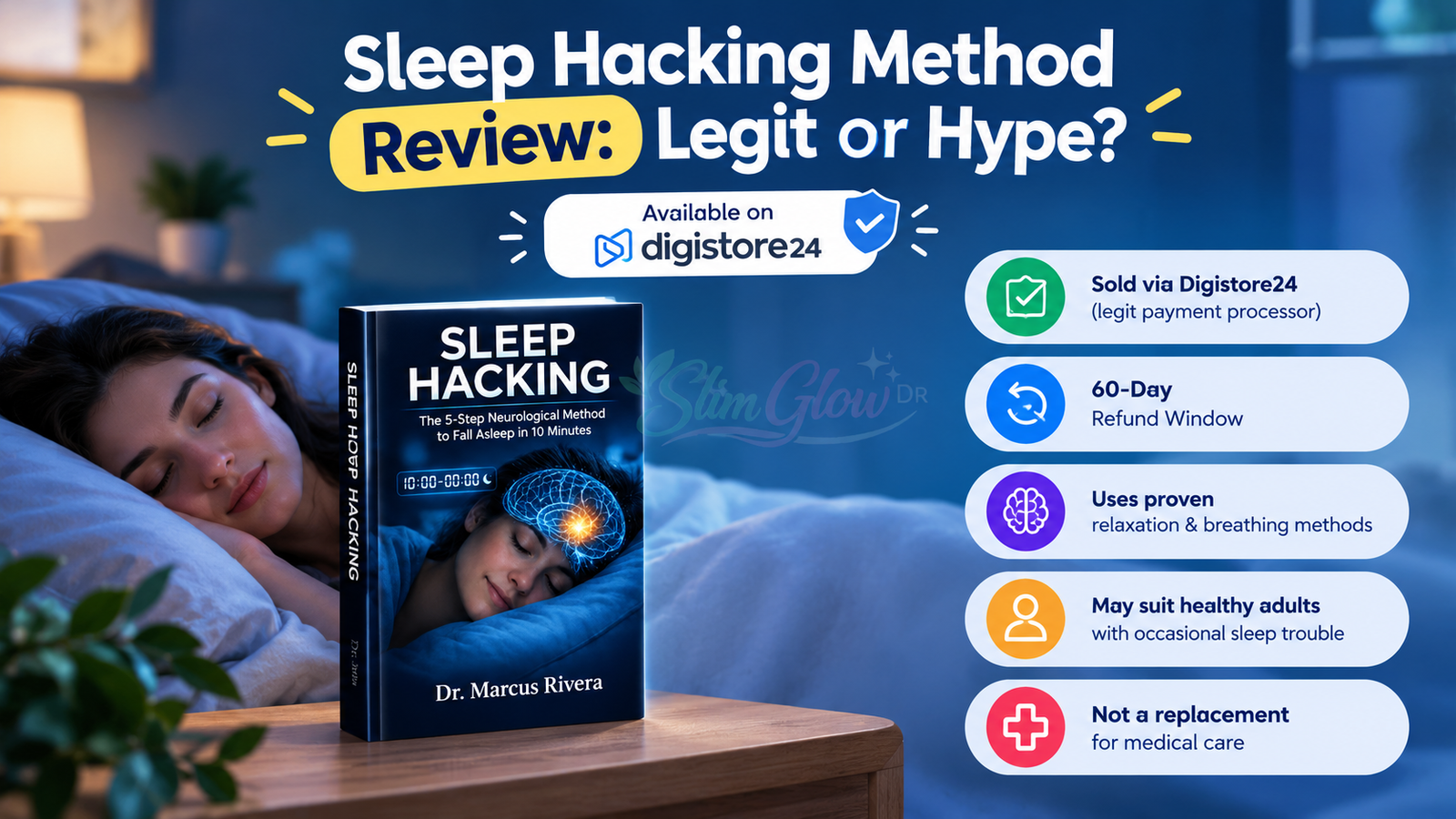
Quick answer: is the Sleep Hacking Method legit? It appears to be a real digital guide sold through Digistore24, a legitimate payment processor, with a 60-day refund window shown on the checkout page. Its techniques appear to overlap with relaxation and breathing approaches that have some research support, but its 10-minute promise, headline statistics, and author credentials can't be independently verified. It may suit healthy adults with occasional trouble falling asleep. It's no substitute for medical care for chronic insomnia or a suspected sleep disorder.
See the Sleep Hacking Method (check the current price at checkout)
What Is the Sleep Hacking Method?
According to its sales page, the Sleep Hacking Method is a digital guide that teaches a five-step bedtime routine designed to help you fall asleep in about 10 minutes. The vendor, Better Daily Guide, also calls it "Sleep Hacking" and the "Sleep Hacking System," and the Digistore24 order form lists it as "Sleep Hacking: The 5-Step Method to Fall Asleep in 10 Mins." If you searched under any of those names, it's the same product.
The sale itself is handled by Digistore24 GmbH, a German payment and reselling platform that acts as the seller of record. In practice, that means your order, payment, and any refund go through Digistore24 rather than directly through the vendor.
What You Get
The sales page says you receive instant access to a 156-page PDF (the main guide) and four bonus guides:
- 7-Day Digital Detox for Deep Sleep
- Anxiety Detox Guide for a Quiet Mind
- Perfect Sleep Environment Checklist
- 7-Day Energy Restoration Plan
The vendor values the bonuses at $68 combined. That figure is the vendor's own, and there's no independent market for these guides, so treat it as marketing rather than a measure of worth. Because we didn't purchase the program, we can't confirm the actual page count of the PDF or how the material is laid out.
Who Is "Dr. Marcus Rivera"?
The sales page names Dr. Marcus Rivera as the program's creator. We searched for independently verifiable information about this person's credentials, such as a medical license, institutional affiliation, or published sleep research, and couldn't find any that connects to this product. That doesn't mean the person doesn't exist. It means we can't confirm that the creator is a physician or sleep scientist, so we don't rely on the name as evidence for any claim in this review.
The practical takeaway is simple: judge the techniques on their own merits and on published research, not on the title attached to them. The same goes for the sales page's short, first-name testimonials, which we couldn't independently verify either.
How We Approached This Sleep Hacking Method Review
We did not buy or use the Sleep Hacking Method. This review is based on the public sales page, the vendor's affiliate materials, the Digistore24 order form (viewed September 27, 2026), Digistore24's official buyer information, and published sleep research. It isn't a personal test, so you won't find any "I tried step two and slept in eight minutes" stories here.
Our standard was straightforward: every vendor claim is attributed to the vendor, then compared with peer-reviewed studies and clinical guidance from bodies such as the American Academy of Sleep Medicine (AASM), the American College of Physicians (ACP), and the National Institutes of Health. Where the evidence is thin or mixed, we say so rather than rounding up or down. You can learn more about how we review products and research [MISSING: internal destination URL supplied by upstream package].
The 5 Steps, Checked Against Sleep Science
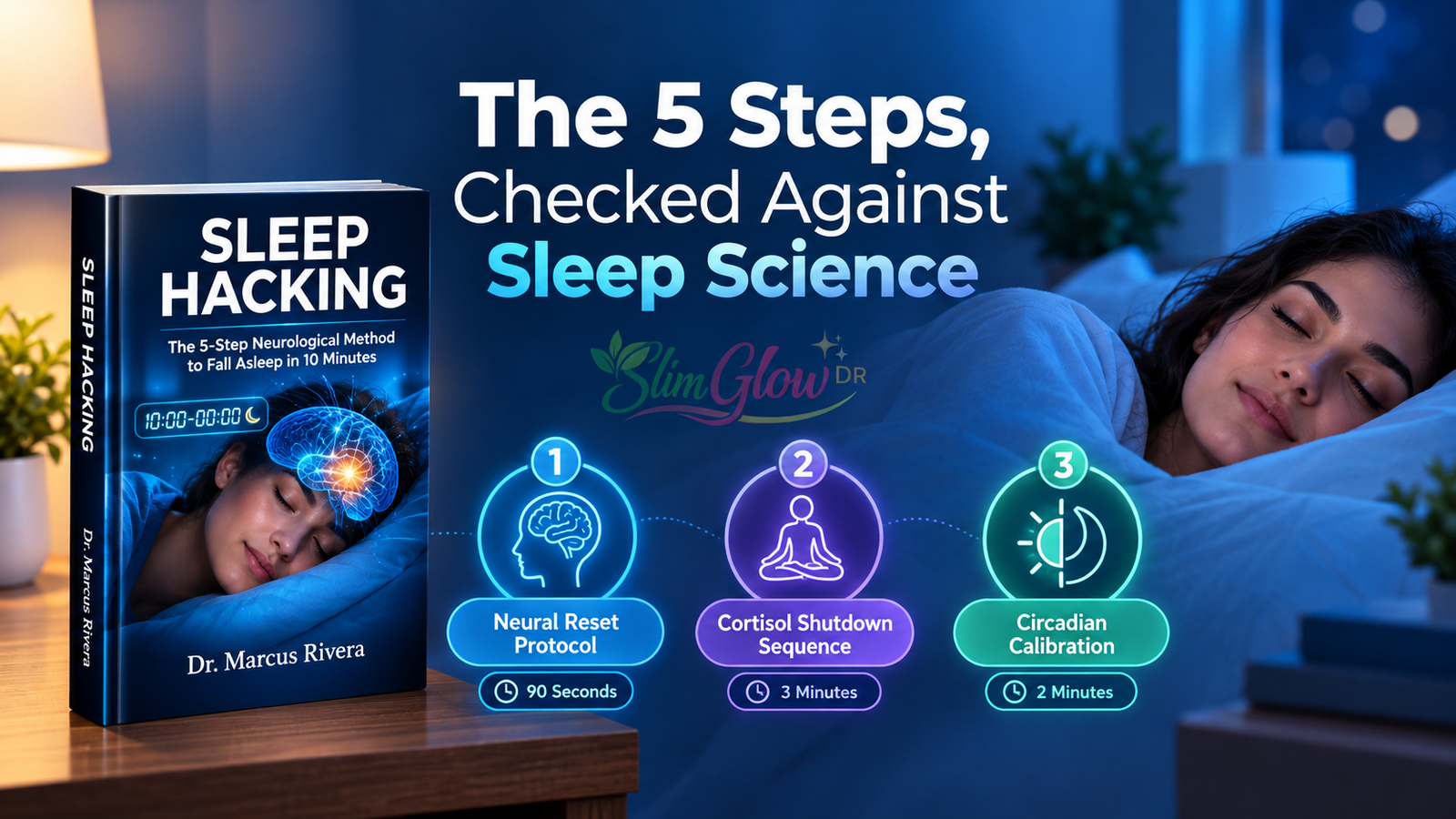
The 5 steps, as named on the sales page, takes about nine and a half minutes in total, by the vendor's timings. We haven't seen the paid instructions, so the comparisons below are based on the step names and public descriptions, matched against the closest techniques that researchers have actually studied.
Neural Reset Protocol (90 Seconds)
The vendor presents this first step as a way to reset an overactive nervous system. "Neural reset" is the vendor's own framing, not a clinical term. The closest recognized techniques are body scans and progressive muscle relaxation (PMR), where you tense and release muscle groups in sequence.
PMR has reasonable support. A 2026 meta-analysis in Frontiers in Public Health pooled 14 randomized trials with 957 participants and found that PMR improved self-reported sleep quality. The authors also flagged real limitations: results varied widely between studies, there were signs of publication bias, many participants were patients rather than healthy adults, and sleep quality was measured by questionnaire only.
A realistic expectation is that a body-relaxation step may help you release physical tension before bed. If you've already tried PMR and it did nothing for you, a shorter step built on similar principles may not perform very differently.
Cortisol Shutdown Sequence (3 Minutes)
The sales page describes this as the step that targets the stress response behind racing thoughts at bedtime. The closest studied technique is slow breathing before bed, usually defined as about 10 breaths per minute or fewer, which is thought to nudge the body toward parasympathetic ("rest and digest") activity, partly via the vagus nerve.
A 2026 systematic review in Sleep Medicine Reviews (9 studies, 457 participants) found that pre-bed slow breathing improved how long and how well people reported sleeping, but objective measurements from sleep trackers and lab studies were inconclusive. Studies that measured heart rate variability found shifts in both parasympathetic and sympathetic activity, which is more complicated than a simple "off switch."
We found no study showing that a three-minute routine "shuts down" cortisol. As the next section explains, cortisol is normally near its daily low around the start of the night anyway. Treat "shutdown" as marketing language, and treat the step itself as a stress-reduction exercise that may help some people feel calmer.
Circadian Calibration (2 Minutes)
Your circadian rhythm, the roughly 24-hour internal clock that governs sleepiness and alertness, is set mainly by light. According to the NIH's National Institute of General Medical Sciences, light and dark have the biggest influence on your body clock, and light from devices at night can confuse it. Circadian research shows that morning light tends to shift the clock earlier and late-evening light tends to push it later.
We found no evidence that a two-minute practice at bedtime can recalibrate that clock on its own. If this step encourages you to dim the lights or put your phone away, that aligns with the research. The heavier lifting happens across the whole day, though: a consistent wake time, daylight early in the day, and less bright light late at night.
Deep Sleep Activation and REM Optimization (2 Minutes Each)
These two steps are grouped because both claim to target specific sleep stages: slow-wave (deep) sleep and REM sleep. Pre-sleep relaxation mainly affects sleep onset latency, meaning how quickly and calmly you fall asleep. We found no published research showing that a two-minute bedtime routine can selectively boost deep or REM sleep. The closest evidence doesn't help much either: objective sleep effects of slow breathing were inconclusive, and the PMR research measured only self-reported quality.
That's an absence of evidence, not proof the steps do nothing. It does mean you shouldn't pay for, or judge the program by, stage-specific promises. A more useful personal test is a simple sleep log: note roughly how long it takes you to fall asleep and how rested you feel the next day, and compare a few weeks with and without the routine.
[VISUAL PLACEHOLDER: Claims vs. Evidence table. Alt text: "Table comparing Sleep Hacking Method claims with what sleep research shows"]
| Vendor Claim | What the Evidence Suggests | Verdict |
|---|---|---|
| Fall asleep in 10 minutes | Falling asleep within about 30 minutes is considered normal; relaxation may help some people fall asleep faster | Not verified as a guaranteed result |
| "Midnight Cortisol Spike" | Cortisol is normally at its lowest around midnight; insomnia is linked with somewhat higher evening cortisol | Vendor term, not a recognized diagnosis |
| Cortisol-lowering routine | Slow breathing improves self-reported sleep; no study found testing a 3-minute cortisol "shutdown" | Partly supported; marketing language |
| Circadian calibration in 2 minutes | Light timing and consistent schedules set the body clock | Not supported as described |
| Deep sleep and REM optimization | No research found on short pre-bed routines boosting specific sleep stages | Not verified |
| "94% of 847 test subjects" results | No study, methods, or citation provided | Not verified |
The Big Claims: 10-Minute Sleep, the "Midnight Cortisol Spike," and the 847-Person Results
The five steps are the method, but the headline promises are what most buyers are really weighing. Here's how each one holds up.
Can You Really Fall Asleep in 10 Minutes?
Some people can, but no routine can guarantee it for everyone, and you may not need to. A National Sleep Foundation expert panel concluded that falling asleep within about 30 minutes is a sign of good sleep quality for most age groups. So if you currently take 15 or 20 minutes, you're already in the normal range, and a 10-minute target isn't a special physiological achievement.
Relaxation and breathing techniques may help some people fall asleep faster, especially when a racing mind is the main obstacle. What no research supports is a guaranteed 10-minute result for everyone. If it routinely takes you an hour or more to fall asleep, that pattern is worth mentioning to a doctor, because a bedtime routine may not address the cause.
Is the "Midnight Cortisol Spike" Real?
"Midnight Cortisol Spike" is the vendor's own term, not an established diagnosis. It's worth understanding what the research actually shows about cortisol and sleep, because the vendor's framing borrows loosely from real findings.
Cortisol's natural daily rhythm includes, in the words of a 2017 Endocrine Reviews paper, "a quiescent period of minimal secretory activity usually centered around midnight," followed by an abrupt rise during late sleep that peaks in the early morning. In other words, a healthy cortisol pattern is at its lowest around midnight rather than spiking.
The real connection is subtler. A 2024 review in Sleep reports that sleep loss raises cortisol in the late afternoon and early evening, flattening the normal daily curve. Studies also suggest that people with chronic insomnia may have somewhat higher evening and early-night cortisol, along with broader activation of the HPA axis, the body's central stress-response system. So high cortisol at night can be part of the insomnia picture, even if it doesn't look like a single midnight spike.
What about waking up at 3 AM? The cortisol link is less clear-cut than many articles suggest. Research on sleep and the HPA axis shows that waking during the night itself triggers a brief rise in cortisol, and the body's natural pre-dawn rise begins in the second half of the night. That makes it hard to say which comes first. Night waking also has many possible causes, including sleep apnea, alcohol, needing to urinate, anxiety, and normal transitions between sleep cycles.
What About the "94% of 847 Test Subjects" Statistics?
The sales page cites results from 847 test subjects, including a 94% success figure. The vendor provides no study, methodology, publication, or citation for these numbers, so we can't treat them as evidence, and we're not repeating the full list of percentages here.
One of those claims deserves a specific warning: the sales page says a large share of users stopped taking sleep medication. That's not a reason to stop or reduce any medication. Some prescription sleep medications need a supervised taper, and any change should happen only under your doctor's guidance. The vendor's own disclaimer also recommends consulting a doctor before stopping medication.
A note from the author: If you take a prescription sleep medication, especially a benzodiazepine or a Z-drug such as zolpidem, stopping suddenly can cause rebound insomnia and withdrawal symptoms, which is why any change needs to be planned with your prescriber. Over-the-counter sleep aids that contain diphenhydramine or doxylamine aren't a good long-term fix either, and older adults are generally advised to avoid them.
Why Better Sleep Matters If You're Trying to Lose Weight
If you're working on weight loss and you suspect sleep is part of the problem, the research gives you reason to take it seriously. Here's what the research shows.
In a small 2004 lab study, 12 healthy young men who spent two nights with only four hours in bed had lower leptin (a fullness hormone), higher ghrelin (a hunger hormone), and reported 24% more hunger and 23% more appetite than after two nights with 10 hours in bed. The biggest jump was in cravings for calorie-dense, high-carbohydrate foods.
A 2010 randomized crossover trial in the Annals of Internal Medicine followed 10 overweight adults on a two-week calorie-restricted diet. When they spent 5.5 hours in bed instead of 8.5, they lost roughly 55% less fat, more of the weight they lost came from lean mass, and they felt hungrier.
The honest summary: these studies are mostly small and short, and they show association and mechanism rather than a simple cause. Better sleep may support your weight-loss efforts by making the hormones that drive hunger and cravings easier to manage. So does poor sleep cause weight gain? It can contribute, but the evidence doesn't show it happens in every case, and better sleep won't produce weight loss on its own.
Price, Checkout, and Refund: What to Know Before You Buy
Price is where most of the online confusion about this program sits, so it's worth slowing down here.
How Much Does the Sleep Hacking Method Cost?
The sales page advertises the program at $27, framed as a discount from $105, and describes it as a one-time payment. But the order form can show a very different total depending on how you reach it.
When we viewed the order form on October 15, 2026, we saw why. The version reached through the sales-page buttons, which carries a discount code, showed the discounted price as a one-time payment with the four bonuses included. The same order form opened without that code showed $105.00. That's a difference in how the page is reached, not evidence of wrongdoing.
We didn't complete a purchase, so we couldn't see whether taxes are added for your location or whether any additional offers appear after checkout. Check the final total on the checkout page before you pay, and confirm it matches what you expected.
Is There a Money-Back Guarantee?
The Digistore24 order form shows a "Risk-Free 60-Day Guarantee," and the sales page describes a 60-day guarantee as well. Because Digistore24 is the seller of record, refunds go through Digistore24's refund process rather than the vendor alone. According to Digistore24, you can request a refund through the help link in your order confirmation email or by emailing its help desk with your order ID. Digistore24's help center also describes 60 days as the maximum refund period on its platform.
A few practical steps help here:
- Keep your order confirmation email, since it contains your order ID and the refund link.
- Put a reminder in your calendar well before day 60.
- Don't count on the sales page's promise of a refund "within 24 hours." Digistore24 says it processes requests within 48 hours on weekdays, and how quickly money reaches you depends on your payment method.
As for the "is it a scam" question: a real seller of record and a stated refund window suggest you'll receive the product and have a route to a refund. They say nothing about whether the claims hold up, and the weaker points are the claims, covered above.
Are the Bonuses Worth Anything?
The four bonuses (a digital detox plan, an anxiety guide, a sleep environment checklist, and an energy plan) cover topics that fit sensibly with a sleep routine. We haven't seen them, so we can't judge their depth. The sales page says you keep the bonuses even if you request a refund. Buy for the main guide and treat the bonuses as extras rather than a reason to purchase.
If the structure appeals to you and you've read the caveats above, you can view the Sleep Hacking Method order page (we earn a commission if you buy through this link). Check the final price and the 60-day refund terms on the checkout page before you pay.
Sleep Hacking Method Pros and Cons
[VISUAL PLACEHOLDER: Pros and cons two-column list, formatted as text (no image). (no alt text supplied upstream)]
| Pros | Cons |
|---|---|
| Brings a structured bedtime routine together in one place | Creator's credentials couldn't be independently verified |
| Built on technique types with some research support (relaxation, slow breathing, routine) | Headline statistics have no published study behind them |
| Low time commitment, about 10 minutes a night by the vendor's count | Price confusion between the sales page and the bare order form |
| One-time digital purchase on the order form (post-purchase offers not checked) | Much of the underlying technique is available free |
| 60-day refund window through Digistore24 | Marketing language ("neural reset," "cortisol shutdown") goes beyond the evidence |
| No supplements or medication involved, so no interaction risk with prescriptions | Not a treatment for chronic insomnia or other sleep disorders |
| Sales-page testimonials can't be verified |
Sleep Hacking Method vs. Free, Evidence-Based Alternatives
If you're weighing value, it helps to know what's available at no cost. This is also the section to start with if you've decided not to buy.
[VISUAL PLACEHOLDER: Comparison table. Alt text: "Sleep Hacking Method compared with free sleep techniques and CBT-I"]
| Option | Cost | Evidence Level |
|---|---|---|
| Sleep Hacking Method | $27 seen October, 2026 | Unverified as a package; components resemble studied techniques |
| Military sleep method | Free | Anecdotal; no controlled trials |
| 4-7-8 breathing | Free | Limited and mixed |
| Progressive muscle relaxation | Free | Some support, self-reported only; mixed study quality |
| Sleep hygiene basics | Free | Supportive, but not enough alone for chronic insomnia |
| CBT-I (therapist or digital program) | Varies | Strong; first-line for chronic insomnia |
The military sleep method. This routine traces back to Lloyd Bud Winter's 1981 book Relax and Win and reportedly came from training pilots. You relax your face, drop your shoulders and arms, relax your legs, then clear your mind with a calming image. It carries a "fall asleep fast" promise very similar to the Sleep Hacking Method's, and it too lacks controlled trials, although its components overlap with relaxation research.
4-7-8 breathing. Popularized by Dr. Andrew Weil, 4-7-8 breathing means inhaling through the nose for four counts, holding for seven, and exhaling through the mouth for eight, for four cycles. A small study in young adults found it increased markers of parasympathetic activity within a session, but it didn't measure how fast people fell asleep. A 2025 comparison in college students found that steady breathing at about six breaths per minute raised heart rate variability more than 4-7-8 breathing did, so the evidence for 4-7-8 specifically is limited and mixed.
Progressive muscle relaxation. As covered above, PMR has the most consistent support of the free options for self-reported sleep quality, with the caveats noted. Free guided audio versions are easy to find.
Sleep hygiene. The basics include a consistent wake time and daylight early in the day (the same light timing covered under Circadian Calibration), limiting caffeine later in the day, including afternoon pre-workout drinks and "diet" energy drinks, avoiding alcohol near bedtime, and a cool, dark, quiet bedroom with screens put away. These habits are among the simplest ways to improve sleep quality naturally, but the AASM advises that sleep hygiene on its own isn't an adequate treatment for chronic insomnia.
CBT-I. For chronic insomnia, the ACP recommends cognitive behavioral therapy for insomnia (CBT-I) as the first treatment for all adults, and the AASM gives it a strong recommendation. CBT-I combines techniques such as stimulus control and sleep restriction with changing unhelpful thoughts about sleep. It's offered by trained clinicians and through digital programs. Notably, the AASM gives relaxation therapy alone only a conditional recommendation for chronic insomnia, which puts programs like this one in context.
To be fair to the paid program, what it adds is structure, sequencing, and everything in one place, which some people genuinely need to stick with a routine. What it doesn't add, as far as the public materials show, is a technique you couldn't learn for free if you're on a budget.
Who the Sleep Hacking Method May Suit, and Who Should Skip It
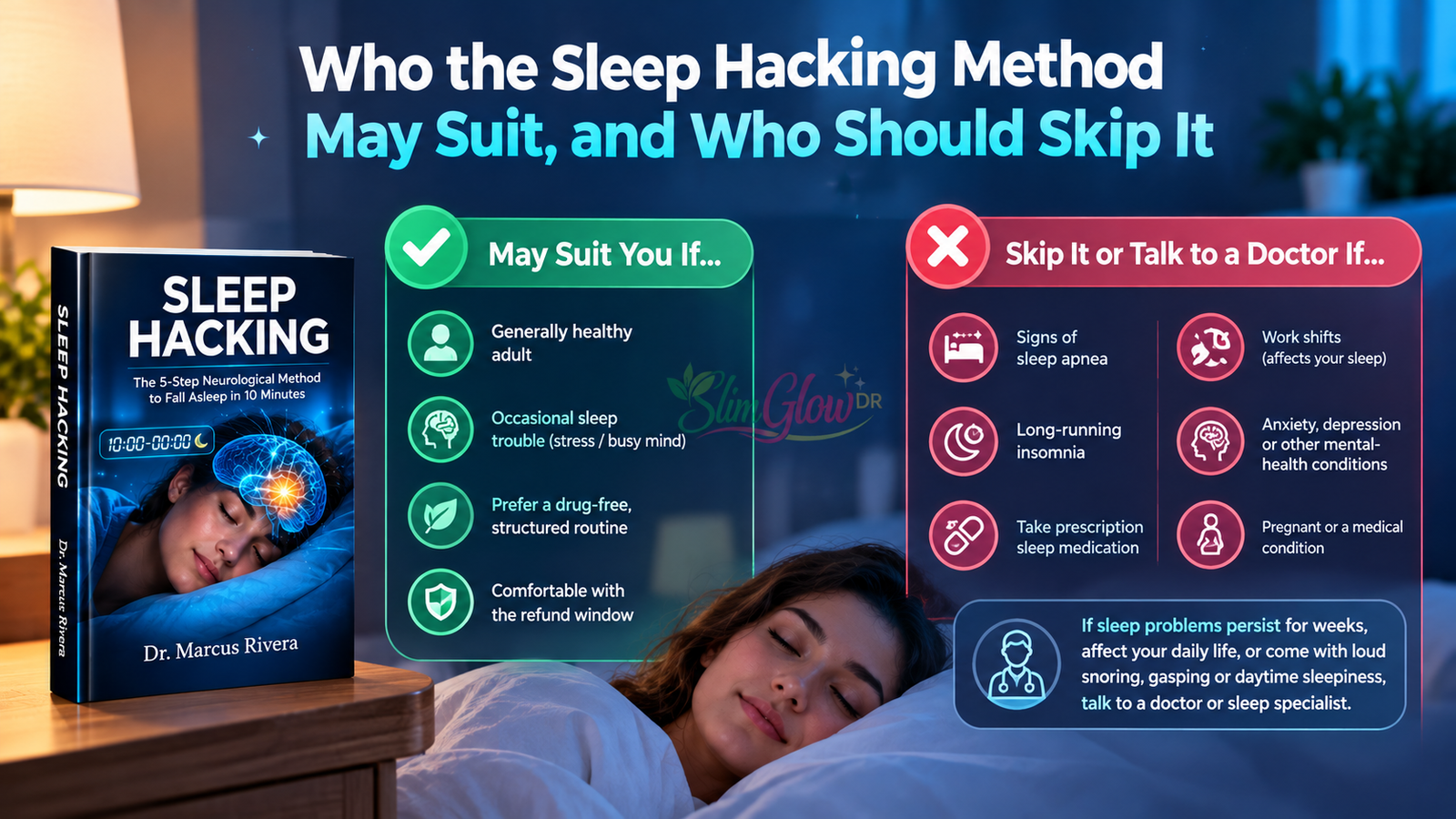
This section matters more than any other in the review, because the wrong self-help approach can delay the right care.
It May Suit You If...
You're a generally healthy adult with occasional trouble falling asleep, often linked to stress or a busy mind, and you want a structured, drug-free routine you can follow from a digital guide. You're also comfortable with the caveats above and willing to use the refund window if it doesn't help.
Skip It or Talk to a Doctor First If...
- You have signs of sleep apnea. The NHLBI lists signs of sleep apnea including loud snoring, breathing that starts and stops, gasping for air, and daytime sleepiness. It also lists insomnia as a possible symptom, which is a good reason to rule apnea out rather than self-treat. A sleep study may be needed for diagnosis.
- Your insomnia is long-running. According to the NHLBI, what counts as chronic insomnia is trouble falling or staying asleep at least three nights a week for three months or longer. CBT-I and a clinician's assessment are the appropriate starting points.
- You take prescription sleep medication. Don't stop or change it without talking to the doctor who prescribed it.
- You work shifts and suspect your schedule is causing ongoing sleep problems.
- You have anxiety, depression, or another mental-health condition that affects your sleep.
- You're pregnant, or have a medical condition where poor sleep may be a symptom.
As a general guide, talk to a doctor or sleep specialist if sleep problems persist for weeks, affect your daily life, or come with loud snoring, gasping, or heavy daytime sleepiness.
Final Verdict: Is the Sleep Hacking Method Legit?
Based on the public evidence, the Sleep Hacking Method appears to be a legitimate digital product sold through an established payment processor with a 60-day refund window. Its building blocks, including muscle relaxation, slow breathing, and bedtime routines, resemble techniques with genuine but modest research support, mostly for how well people feel they slept.
The weak points are the marketing. The 10-minute promise, the "Midnight Cortisol Spike," the 847-subject statistics, and the "Dr." attached to the program can't be verified, and cortisol is normally at its lowest around midnight rather than spiking. The bottom line of this sleep hacking method review: it may be a reasonable, low-cost way to get a structured routine if you're a healthy adult with occasional sleeplessness, but it doesn't treat insomnia disorder or any other sleep condition, and much of it is available free.
If you want a structured, drug-free bedtime routine and you're comfortable with those caveats, you can see the Sleep Hacking Method here. As a reminder, Slim Glow Dr earns a commission if you buy through this link. Check the final price and refund terms on the checkout page before you pay.
Not sure yet? Try one of the free techniques above tonight, such as progressive muscle relaxation or 4-7-8 breathing. If your sleep problems have lasted for weeks, or come with snoring, gasping, or daytime sleepiness, a doctor or sleep specialist is the better next step. For more of our honest product reviews, visit our Reviews section.
Frequently Asked Questions
Is the Sleep Hacking Method a scam?
We found no evidence that it's a scam. It's a real digital product sold through Digistore24, an established payment processor, with a 60-day refund window shown at checkout. The concerns lie elsewhere: the headline claims and creator credentials can't be verified (see The Big Claims), so buy with realistic expectations.
Is the Sleep Hacking Method a one-time payment or a subscription?
The Digistore24 order form we viewed on September 27, 2026 described it as a one-time purchase. We didn't complete the checkout, so we couldn't see whether any additional offers appear afterward. Read the order form carefully and confirm the final total before you pay.
Can I stop my sleep medication if I use the Sleep Hacking Method?
No. Don't stop or change prescribed sleep medication without talking to the doctor who prescribed it, whatever a sales page says. Some medications need a supervised taper. If you'd like to rely less on medication, ask your doctor about options such as CBT-I, which clinical guidelines recommend for chronic insomnia.
How long does it take to see results?
There's no reliable answer, because the vendor provides no published study and results vary from person to person. Some people find these techniques don't help at all. Tracking your sleep for a few weeks within the refund window gives you a fair test.
How is it different from the military method or 4-7-8 breathing?
Mainly in packaging. The military method and 4-7-8 breathing are free, single techniques focused on body relaxation or slow breathing. The Sleep Hacking Method combines similar kinds of techniques into a five-step sequence with written guides and bonuses. If you want structure, that may be worth paying for; if you only want a technique, the free options are a sensible first step. See the comparison table.
Does the Sleep Hacking Method work for chronic insomnia?
It isn't a treatment for chronic insomnia. Clinical guidelines from the ACP and AASM recommend CBT-I as the first-line treatment, and the AASM rates relaxation therapy alone only as a conditional option. If you've had trouble sleeping at least three nights a week for three months or more, talk to a doctor or sleep specialist.
How do I get a refund?
Request it through Digistore24, the seller of record, within the 60-day window shown on the order form. Use the help link in your order confirmation email or email Digistore24's help desk with your order ID. Digistore24 says it processes requests within 48 hours on weekdays, and payout timing depends on your payment method.
Does better sleep help with weight loss?
It may. Small studies link short sleep with higher hunger hormones, stronger cravings, and less fat loss during dieting. Sleep supports your efforts rather than replacing diet and activity. See why better sleep matters for weight loss.