

Written by Dr. Kaneez Fatima, Pharm-D
Published: October, 2026
How this guide was prepared: Dr. Kaneez Fatima holds a Pharm-D and writes health guides for moms. Because this guide explains a legal and developmental process, every procedural claim is tied to a primary source: the federal IDEA Part C regulations (34 CFR Part 303), the school-district evaluation rule (34 CFR 300.301), CDC early intervention guidance, the ECTA Center's state eligibility summary, and AAP developmental screening guidance.
Disclosure: This page may contain affiliate links. If you buy through one, I may earn a commission at no extra cost to you. That never changes what is written here, and no product on this page replaces an evaluation by early intervention professionals.
This guide is educational and does not diagnose or replace an evaluation by qualified professionals. If your child loses skills they once had, or you have an urgent concern, contact your pediatrician promptly.
Maybe your 20-month-old still isn't saying words. Maybe your baby isn't rolling over yet, or your toddler rarely looks up when you call their name. You've noticed something, you've probably done some late-night searching, and now you're wondering who you're actually supposed to call. If you're trying to figure out how to request an early intervention evaluation, here's the reassuring part: you can make the request yourself, today, without a doctor's referral or a diagnosis, and the evaluation is free.
Asking is not overreacting. The process is built for families who aren't sure yet. A concern is enough reason to ask.
This guide covers the US system under the Individuals with Disabilities Education Act (IDEA). Program names and some details differ by state and territory, but the core steps are the same. Below you'll find a step-by-step process, a phone script you can read from, a sample letter you can copy, a realistic timeline, a plain-language summary of your rights, and what to do if your child is 3 or older. If you live outside the US, your local child-health or public-health services are the best place to start.
Compliance · Freshness note. In June 2026 the U.S. Department of Education announced that its special education office (OSERS) is moving to the Department of Health and Human Services through interagency agreements. IDEA itself and the regulations cited in this guide are unchanged, and your first call is still your state's early intervention program. Check your state program's website for current contact details.’
Act fast. If your child loses skills they once had (for example, they stop using words they used to say), contact your pediatrician promptly, at any age.
Quick Answer
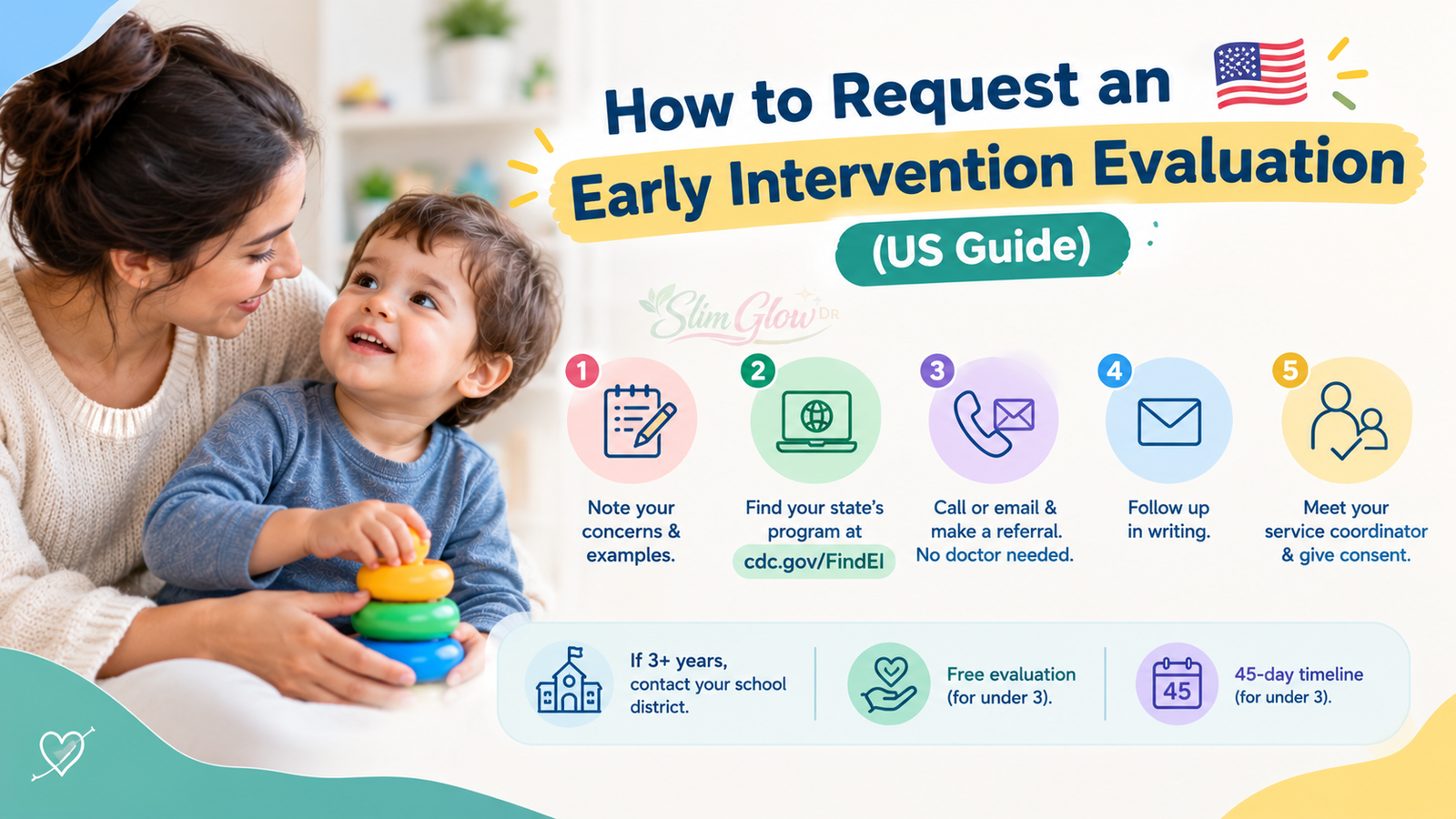
To request an early intervention evaluation in the US:
- Write down your concerns and examples.
- Find your state's early intervention program at cdc.gov/FindEI or by calling 1-800-CDC-INFO (800-232-4636).
- Call or email and say, "I'd like to refer my child for an early intervention evaluation." No doctor's referral is needed.
- Follow up in writing.
- Meet your service coordinator and give written consent.
If your child is 3 or older, contact your local public school district instead.
The evaluation is free, federal rules set a 45-day timeline for children under 3, and you can decline any service at any time.
Key Takeaways
- Any parent in the US can request an early intervention evaluation directly. No doctor's referral or diagnosis is needed.
- Under age 3: contact your state's IDEA Part C early intervention program (find it through CDC FindEI or 1-800-CDC-INFO).
- Age 3 and older: contact your local public school district and request a preschool special education evaluation in writing.
- The evaluation, service coordination, and development of your child's plan are at no cost to families. Some ongoing services may have state-specific cost rules.
- For children under 3, federal rules generally require the evaluation and first planning meeting within 45 days of the program receiving your referral.
- You give written consent before any screening, evaluation, or service begins, and you can decline services or disagree with decisions.
- If your child doesn't qualify, you can keep monitoring and request an evaluation again later.
What Is Early Intervention, and Who Can Request an Evaluation?
Early intervention (EI) is a set of services for babies and toddlers from birth to 36 months who have developmental delays or certain diagnosed conditions. It's created by Part C of IDEA, and each state or territory runs its own program through a designated "lead agency," which might be the health department, the education department, or another state office. That's why your state's program may go by its own name, and the words "early intervention" may not appear in it at all.
A few points matter most when you're getting started:
- Anyone can refer, including you. Federal regulations list moms as a "primary referral source," alongside physicians, hospitals, child care programs, and social service agencies (federal early intervention rules, 34 CFR 303.303). The CDC states plainly that you don't need a doctor's referral.
- No diagnosis is required. A child can qualify because of a measurable delay in one or more developmental areas. Some diagnosed conditions with a high probability of causing delay, such as certain genetic or chromosomal conditions or a sensory impairment, can make a child eligible on their own.
- Eligibility thresholds vary. Each state sets its own definition of "developmental delay." Some use a percentage delay, others use standard deviations below average, and some use more than one measure. The ECTA Center keeps a summary showing that eligibility rules differ by state, sometimes quite a bit; its summary (dated 2021, so check your state's current policy) lists eight states that also serve infants and toddlers considered "at risk" of delay.
Screening vs. Evaluation vs. Assessment: What's the Difference?
These three words get used interchangeably, but they mean different things, and knowing the difference helps you understand where you are in the process.
- Screening is a quick check that flags whether a child might need a closer look. Your pediatrician may usea questionnaire you fill out, such as the Ages and Stages Questionnaires (ASQ), or the M-CHAT-R/F for autism. Some EI programs also screen first, with your consent.
- Evaluation is the formal, multidisciplinary process that decides whether your child is eligible for EI. It draws on testing, observation, your input, and records.
- Assessment is the ongoing work that identifies your child's specific strengths and needs, and your family's priorities, so the team can plan services.
A common mistake is assuming a "passed" screening at a checkup settles the question. Screening tools are designed to flag likely concerns, not to rule everything out. If you're still worried after a normal screening, you can still request an evaluation.
Signs It May Be Time to Request an Evaluation
EI evaluations look at five broad areas of development, described here in everyday terms:
- Thinking and learning (cognitive development)
- Physical development: movement, vision, and hearing
- Communication, both understanding and using words, gestures, and sounds
- Social and emotional development, such as eye contact, interest in people, and play
- Self-help and daily living (adaptive skills), such as feeding, and dressing
If something in any of these areas worries you, that's a valid reason to call. You don't have to be certain first; the evaluation exists to answer the question you're asking.
To get a clearer picture, CDC's free milestone checklists cover ages 2 months to 5 years, and our guide to signs of developmental delay in toddlers, by age, walks through what to watch for from 12 to 36 months. Keep in mind that checklists help you notice and describe concerns, but they don't replace a standardized screening or evaluation.
How to Request an Early Intervention Evaluation (Under Age 3): Step by Step
These steps work in any US state. The order matters less than getting the referral made, so if you're ready to call right now, skip to Step 2 and come back to the rest.
Step 1: Write Down Your Concerns (and Gather Examples)
The people you talk to will ask what you've noticed, and it's surprisingly hard to remember specifics on the spot. Jot down concrete examples with rough dates, such as "Doesn't point to things she wants (noticed around 15 months)" or "Still not pulling to stand at 13 months." Specific, observable behaviors are more useful than general worries like "he seems behind."
A short phone video can help too. A 30-second clip of your child trying to communicate or move often shows more than a description.
[VISUAL PLACEHOLDER: "Before you call" checklist box. Items: child's full name and date of birth; insurance or Medicaid information (optional); list of concerns with specific examples and approximate dates; short videos; completed CDC milestone checklist; relevant medical history (premature birth, NICU stay, newborn hearing screen results); names and contact details of your pediatrician and child care provider; questions to ask; space to record who you spoke with, the date, and what they said. Alt text: Checklist of what to prepare before requesting an early intervention evaluation]
Before-you-call checklist (text version)
- Your child's full name and date of birth
- Insurance or Medicaid information (optional)
- A list of concerns with specific examples and approximate dates
- Short videos of what worries you
- A completed CDC milestone checklist
- Relevant medical history: premature birth, NICU stay, newborn hearing screen results
- Medicines your baby received in the hospital or NICU, and any pregnancy medicine or substance exposures you know of (see the pharmacist's note below)
- Names and contact details of your pediatrician and child care provider
- Your questions, plus space to note who you spoke with, the date, and what they said
Pharmacist's note: bring a medication and exposure history. Most checklists skip this. Write down any medicines your baby received in the hospital or NICU, and any medicines, alcohol, or other substances you were exposed to during pregnancy. Some NICU medicines, such as aminoglycoside antibiotics, can affect hearing in some babies, which is one reason a hearing test matters when speech is delayed. Some states also list prenatal exposure to certain substances among the conditions that can establish eligibility. This is history-taking, not blame. Share what you remember, and the team and your pediatrician can request records.
Step 2: Find Your State's Early Intervention Program
The fastest route is the CDC's directory: go to cdc.gov/FindEI and choose your state from the state-by-state contact list. If you'd rather talk to someone, call 1-800-CDC-INFO (800-232-4636) and ask for your state's early intervention contact.
Other routes that work:
- Your pediatrician's office. Front-desk staff and nurses often have the local intake number.
- Help Me Grow, where available. This network connects families with developmental services, but it doesn't operate in every state.
- Your county or local health department.
Don't be thrown off if your state's program has a name that doesn't include the words "early intervention." That's normal.
Step 3: Make the Referral Yourself (No Doctor's Referral Needed)
Call the intake line, send an email, or use the online referral form if your state has one. This is often called a self-referral, and it counts just as much as a referral from a doctor. Whichever route you choose, say the key words clearly: you are referring your child for an early intervention evaluation. Vague phrasing like "I have some questions about my son's speech" can get you general information instead of a formal referral.
Before you hang up or close the form, write down:
- The date and time
- The name of the person you spoke with
- Any reference number, and what they said will happen next
This matters because the federal 45-day clock (covered below) starts when the program receives your referral.
Step 4: Put Your Request in Writing
Even if your call went well, follow up with a short email or letter. A dated written request gives you a record of when the referral was made, puts your concerns in the program's file in your own words, and gives you something to point to if the process stalls. Use the sample letter below as a starting point.
Step 5: Loop In Your Pediatrician (and Ask About a Hearing Test)
Talking to your child's doctor runs alongside the EI referral. It doesn't replace it, and you don't need to wait for an appointment before calling EI.
At the visit, share your notes and videos and ask:
- For a standardized developmental screening. The American Academy of Pediatrics recommends developmental screenings at well-child visits at 9, 18, and 30 months, plus autism-specific screening at 18 and 24 months. A concern raised at any visit is also a reason to screen, so you don't have to wait for one of those ages.
- For a hearing evaluation if speech or language is delayed. Speech-language professionals typically check hearing early on, because hearing loss can contribute to language delays. ASHA's clinical guidance describes a hearing screening as a typical part of looking into late language, sometimes followed by a full audiology assessment (hearing test when speech is delayed).
It also helps to know that health providers who identify a possible delay are expected under federal rules to refer the child to EI as soon as possible, and no more than seven days after identifying the concern (34 CFR 303.303). If your doctor agrees there's a concern, you can ask whether they've sent a referral, and still make your own.
Step 6: Meet Your Service Coordinator and Give Written Consent
After your referral, the program will assign a service coordinator, who becomes your main point of contact. They explain the process, schedule the evaluation, gather records (with your permission), and help you understand your rights.
Nothing is evaluated without your informed, written consent. You'll be given information in your native language and asked to sign before any screening or evaluation. This is a good moment to ask questions. You can also ask whether the evaluation can happen at home or at your child's child care; many programs offer this, though options vary by state and program.
Ready to start? Find your state's early intervention program today and make the call. If your child is 3 or older, contact your local public school district instead (details below).
What to Say When You Call: A Sample Script
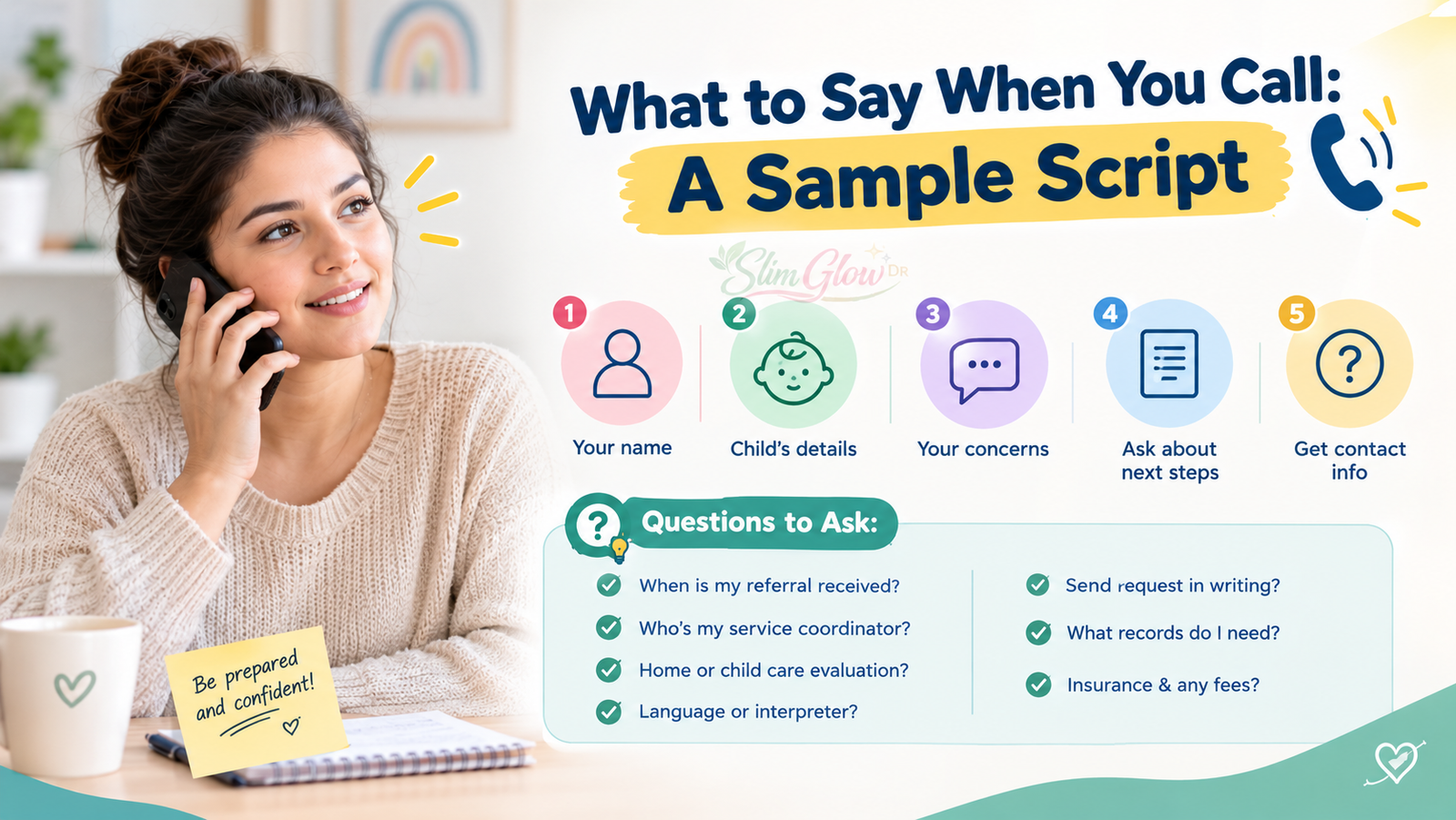
Many parents feel nervous making this call, especially if they've been told to wait. Reading from a script keeps you on track. Adjust the bracketed parts and keep it handy.
Hi, my name is [Your name]. I'm calling to refer my child for an early intervention evaluation.
My child's name is [Child's name], and their date of birth is [Date of birth]. We live in [City or county].
I'm concerned about [brief description, for example: "my son is 22 months old, says only two or three words, and doesn't point to show me things"]. Some background that may be relevant: [premature birth, NICU stay, hearing screen results, or "none"].
I am requesting an evaluation for early intervention in all areas of development. Can you tell me what the next steps are and about how long each step usually takes?
Could I have your name and a direct phone number or email? And who will be handling my child's referral?
Questions worth asking during the call:
- What date is my referral recorded as received?
- Who will my service coordinator be, and when should I expect to hear from them?
- Can the evaluation take place at home or at my child's child care?
- Can we do this in [your preferred language], or with an interpreter?
- Should I also send my request in writing? To what email or address?
- What records or information should I have ready?
- Will I be asked about insurance, and does my state charge for any services after the evaluation?
Sample Letter or Email to Request an Early Intervention Evaluation
A written request doesn't need to be formal or long. This template covers what matters: who your child is, what you're worried about, what you're asking for, and a request for confirmation.
Date: [Date]
To: [Name of your state or local early intervention program]
[Mailing address or email address]
Re: Request for an early intervention evaluation for [Child's name], date of birth [Date of birth]
Dear [Intake coordinator's name, or "Early Intervention Intake Team"],
I am the [parent / guardian / foster parent] of [Child's name], born [Date of birth]. I am writing to refer my child to early intervention and to request a comprehensive evaluation in all areas of development.
I am concerned about my child's development in the following areas (examples included):
- Communication: [e.g., "Says about three words at 21 months; doesn't follow simple directions like 'bring me your shoes.'"]
- Movement: [e.g., "Not yet walking independently at 17 months."]
- Social and emotional: [e.g., "Rarely makes eye contact or responds to name."]
- Thinking and learning: [example, or delete]
- Self-help (eating, dressing): [example, or delete]
Relevant history: [e.g., "Born at 32 weeks; 10 days in the NICU; passed newborn hearing screen."]
My child's pediatrician is [Doctor's name, practice, phone number]. [Optional: "I also called your office on [date] and spoke with [name]."]
Please confirm in writing that you have received this referral, including the date it was received, and let me know who our service coordinator will be and what the next steps are.
I can be reached at [phone number] or [email address]. The best times to reach me are [days/times]. Our preferred language is [language].
Thank you,
[Your name]
[Your address]
Tips for sending it:
- Keep a copy. Save the sent email, or photograph the letter before mailing it.
- Note the date and method. Email gives you an automatic timestamp, which is handy.
- Follow up if you hear nothing. As a practical rule of thumb, if you haven't heard back within about a week, call and mention the date you sent your request. This is advice, not a legal deadline, but it keeps your referral from slipping through the cracks.
- Use the online form too, if there is one. You can submit your state's form and still send this letter as a backup record.
Copy the sample letter above and send it today, then keep a copy for your records.
What Happens After You Request an Evaluation?
Knowing what's coming makes the wait easier. Here's what the federal rules require, and what the process typically looks like.
The 45-Day Timeline, Explained
Under federal rules (34 CFR 303.310), the program must complete the following within 45 days from the date it receives your referral:
- Screening, if your state uses it and you consent
- The initial evaluation
- The initial child and family assessments
- The initial IFSP meeting, if your child is eligible
There are documented exceptions. The clock can pause if your child or family is unavailable because of exceptional family circumstances documented in the child's records, or while the program is still seeking your consent after repeated, documented attempts. In those cases, the program must record why, finish as soon as possible afterward, and create an interim plan where appropriate.
What this means in practice: respond to the service coordinator's calls and paperwork quickly, because delays in getting consent can pause the timeline. And if 45 days are approaching with no meeting scheduled, it's reasonable to ask your coordinator where things stand.
[VISUAL PLACEHOLDER: Horizontal timeline graphic. Stages: concern noticed, then referral received by program (Day 0), then service coordinator contact and written consent, then screening (if used), evaluation, and assessments, then eligibility decision, then initial IFSP meeting (by Day 45). Footnote: "The clock can pause for documented family circumstances or while the program is still seeking your consent." Alt text: Timeline showing the steps from an early intervention referral to the first IFSP meeting within 45 days]
What Happens at the Evaluation
The evaluation is done by a multidisciplinary team, which might include professionals such as a speech-language pathologist (SLP), physical therapist (PT), occupational therapist (OT), developmental specialist, or early childhood educator, depending on your concerns and your state. Federal rules require that it be comprehensive, conducted in your family's native language when feasible, and not based on any single test.
In practice, evaluations are often play-based and often take place at home. The team typically:
- Asks about your child's history and what you've observed (your input is formally part of the evaluation)
- Uses an evaluation tool (often a standardized one) to look at all five developmental areas
- Watches your child play, move, and interact with you
- Reviews medical and other records you've agreed to share
Some children are found eligible based on medical records alone, for example with a qualifying diagnosis. Qualified professionals can also use "informed clinical opinion" to establish eligibility when test scores alone don't capture the full picture.
How to prepare: Schedule it for a time your child is usually rested and fed. Have favorite toys or a comfort item nearby. Bring your notes and videos, and write down your questions in advance. Don't worry if your child doesn't "perform" the way they do on a good day; tell the team what's typical and what's not, since they rely on your knowledge.
If Your Child Qualifies: The IFSP
If your child is eligible, the team works with you to write an Individualized Family Service Plan (IFSP). The IFSP is family-centered: it includes goals you care about, like "communicate what she wants at mealtimes" or "walk to the park with us," along with which services your child will receive, how often, and where.
Services are provided in "natural environments" whenever appropriate, meaning settings that are typical for children the same age, such as your home or community settings. Your service coordinator stays involved to help coordinate services and answer questions.
You're also in control of what's accepted. You can say yes to some services and no to others, and you can decline a service later without losing the rest.
Does an Early Intervention Evaluation Cost Anything?
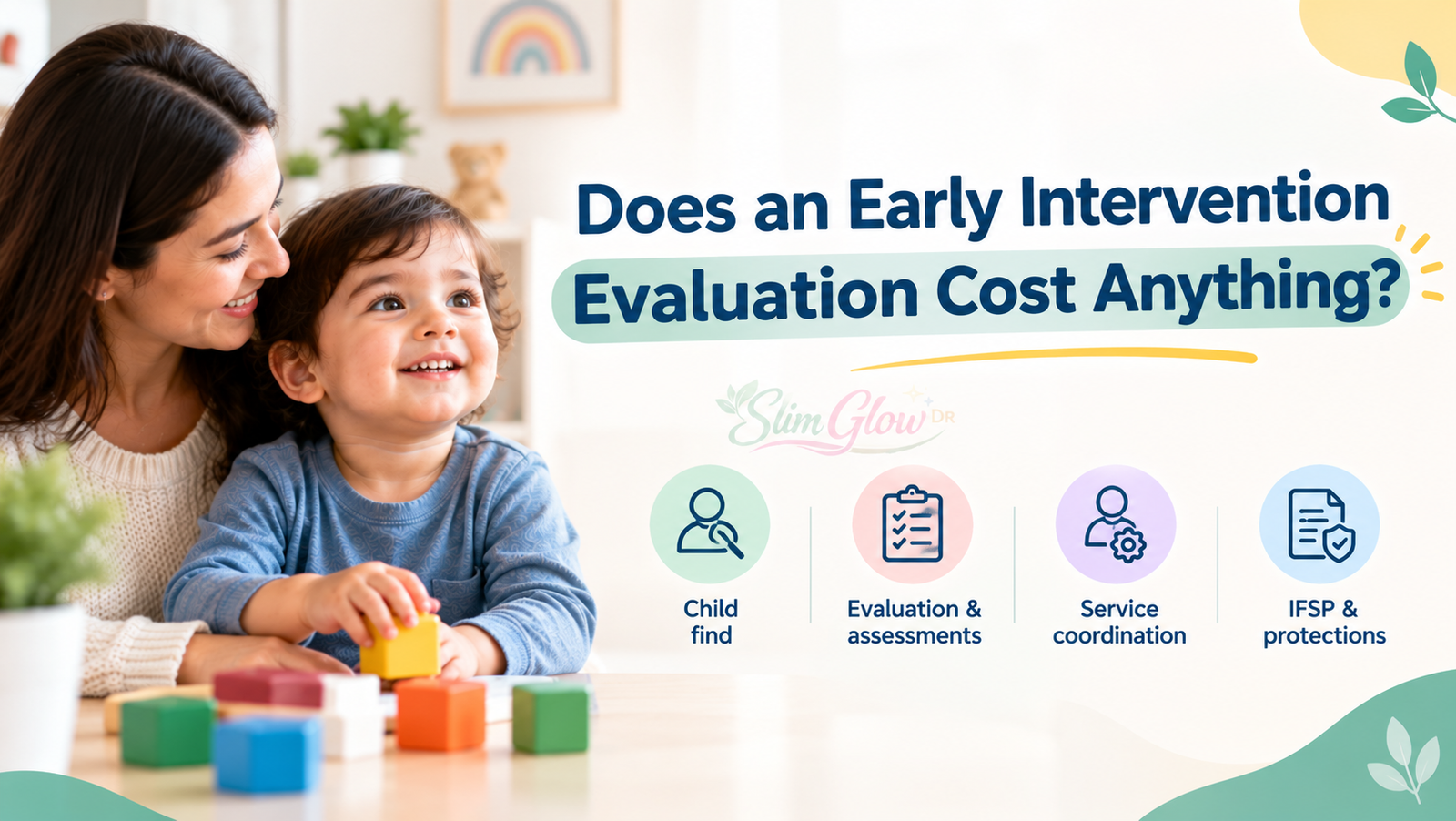
The evaluation itself is free. Under federal rules (34 CFR 303.521), states must provide these EI functions at no cost to families:
- Child find (identifying and referring children)
- Evaluation and assessments
- Service coordination
- Developing, reviewing, and evaluating the IFSP, and the procedural safeguards that protect your rights
Ongoing services are where states differ. Depending on where you live, some services may involve a sliding-scale family fee, billing to private insurance, or billing to Medicaid. If your state uses insurance or public benefits, consent rules apply, and you can ask exactly how it works before agreeing.
There are important protections either way:
- A family's inability to pay cannot delay or deny EI services. Families who meet the state's definition of unable to pay receive all Part C services at no cost.
- Families with insurance can't be charged disproportionately more than families without it.
- Families can't be charged more than the actual cost of a service.
If Your Child Is 3 or Older (or Turning 3 Soon)
Part C early intervention generally ends at age 3. After that, help comes through a different part of the same law, IDEA Part B (Section 619 for preschoolers), and through your local public school district. The good news is that you can still request an evaluation yourself, and the evaluation is still free.
Requesting a Preschool Special Education Evaluation From Your School District
Every school district has a legal duty, called Child Find, to identify and evaluate children who may need special education, including preschoolers who aren't enrolled anywhere yet.
Here's how to start:
- Contact your local public elementary school or the district's special education office. The CDC suggests calling any local public elementary school, even if your child won't attend there, and asking for an evaluation for preschool special education services.
- Ask for the special education director if staff seem unsure. Front-office staff may not handle preschool referrals often.
- Put your request in writing. You can adapt the sample letter above: address it to the district's special education office and request "an evaluation for preschool special education services."
- Sign consent promptly. Under the federal special education evaluation timeline (34 CFR 300.301), the evaluation must be completed within 60 days of the district receiving your consent, or within your state's own timeline if it has one. Note that this clock starts at consent, not at your initial request.
If the district decides not to evaluate, it must give you prior written notice explaining why, what it considered, and where you can get help. If you hear nothing at all, follow up in writing and escalate to the district's special education director. If your child is found eligible, the district develops an Individualized Education Program (IEP) instead of an IFSP.
If Your Child Is Close to Their Third Birthday
Timing gets tricky near age 3. Under federal rules (34 CFR 303.209), if a child is referred to early intervention fewer than 45 days (roughly six weeks) before their third birthday, the EI program isn't required to do the evaluation, assessment, or initial IFSP meeting. Instead, with your consent, it refers your child to the state education agency and local school district.
Some states have additional procedures, so the practical advice is simple: don't wait. If your child is approaching 3, contact both your state EI program and your school district and ask which one should start the process.
| Under 3 | 3 and Older | |
|---|---|---|
| Governing law | IDEA Part C | IDEA Part B, Section 619 |
| Who to contact | Your state's early intervention program | Your local public school district |
| How to find them | cdc.gov/FindEI or 1-800-CDC-INFO (800-232-4636) | Any local public elementary school, or the district special education office |
| How to request | Call, email, or online form; follow up in writing | Written request recommended |
| Evaluation timeline | Within 45 days of the program receiving the referral (evaluation through first IFSP meeting) | Within 60 days of your consent, or your state's timeline |
| Plan created | IFSP (Individualized Family Service Plan) | IEP (Individualized Education Program) |
| Where services happen | Natural environments, such as home or community settings | Preschool, school, or other settings; varies by district |
| Cost | Evaluation, service coordination, and IFSP development at no cost; some ongoing services may have state-specific fees or insurance billing | Provided at no cost to families as part of a free appropriate public education (FAPE) |
Alt text (if rendered as an image): Comparison table of early intervention for children under 3 and preschool special education for children 3 and older
What If Your Pediatrician Says "Wait and See"?
This is one of the most common reasons parents delay, and it's an understandable one. Children do develop at different paces, and your doctor may be weighing what they saw in a short visit. Still, a "wait and see" from a doctor doesn't stop you from referring your child to EI yourself. The evaluation is free, it doesn't commit you to services, and it gives everyone, including your pediatrician, more information.
You can keep the conversation collaborative:
- Share your notes and videos. A short visit may not show what you see every day.
- Ask for a standardized screening now. AAP guidance says a concern raised at any visit should be followed by a standardized screening or a referral, so you don't need to wait for the next scheduled screening age.
- Ask for a hearing test if speech or language is part of the concern.
- Ask what would change their mind. "What would you want to see, and by when, before we revisit this?" turns "wait" into a plan with a check-in date.
You might say: "I understand you'd like to give it more time. I'd still like to request an EI evaluation so we have more information. Would you support that?"
If you still have concerns, a second opinion or a referral to a developmental pediatrician is a reasonable step. Waiting for that appointment, which can take a while, is another reason to make the EI referral in parallel.
What If Your Child Doesn't Qualify?
Hearing "not eligible" can bring relief, frustration, or both. Either way, you have options.
First, you should receive written notice of the decision, explaining what was decided and why, along with your rights. You can:
- Ask how the decision was made and which results were used
- Request a copy of the evaluation report (you have the right to review your child's EI records)
- Use your state's dispute options if you disagree (see "Your Rights" below)
Remember that eligibility thresholds vary by state. A child who doesn't meet one state's definition might be close to it, and that's useful information in itself.
Next steps that many families find helpful:
- Keep tracking milestones with the CDC checklists and note any changes. Our guide to signs of developmental delay in toddlers shows what to watch for at each age.
- Refer again if concerns continue or new ones appear. A "no" today doesn't close the door.
- Ask your pediatrician about re-screening at upcoming well-child visits.
- Explore private evaluation or therapy, which may be covered by health insurance depending on your plan.
- Connect with community programs such as Help Me Grow, where available.
Your Rights as a Parent in the Early Intervention Process
You're a full partner in this process, and federal law backs that up. In plain language, your core rights under Part C include:
- Informed written consent. You must be fully informed, in your native language, and agree in writing before screening, evaluation, services, use of insurance or public benefits where required, or sharing of your child's personal information. Consent is voluntary, and you can revoke it at any time (though not retroactively).
- The right to decline. You can say no to an evaluation, or to any individual service, at any time, and declining one service doesn't cost you the others. The program can't use due process to override your refusal.
- Prior written notice. The program must notify you in writing, in plain language, before it proposes or refuses to start or change your child's identification, evaluation, placement, or services.
- Confidentiality and access to records. Your child's EI records are protected by federal privacy rules, and you can inspect and review them. One limited exception: EI programs share basic directory information (your child's name, date of birth, and your contact details) with education agencies so children who may need preschool services can be identified, and some states let moms opt out.
- Dispute options. Every state must offer mediation, a state complaint process, and due process hearings. During a due process hearing, your child generally continues receiving their current services.
Your state's procedural safeguards notice spells out these rights and how to use them, so ask your service coordinator for a copy. This section is general information about parent rights, not legal advice. For help with a specific situation, contact your state's Parent Training and Information Center (below).
Where to Get Help Navigating the Process (and Support for You)
You don't have to figure this out alone. A few places can help:
- Your service coordinator is there to explain the process and help you advocate for your child.
- Parent Training and Information Centers offer free guidance to families of children with disabilities. There are nearly 100 parent centers across the US and territories, and you can find your state's Parent Training and Information Center through the Center for Parent Information and Resources. PACER Center in Minnesota is one well-known example.
- Help Me Grow, where available, can connect you with local developmental resources.
- Mom support groups, often run through parent centers, hospitals, or community organizations, connect you with families who've been through the same steps.
It's also worth naming the feelings that often come with this. Many moms worry they missed something, or that asking will "label" their child. Requesting an evaluation is a caring, proactive thing to do, and you're far from the only family asking. Developmental differences are common: based on caregiver reports, about 8.6% of US children ages 3 to 17 (roughly 1 in 12) had been diagnosed with autism, intellectual disability, or another developmental delay as of 2021 (CDC/NCHS).
Finally, look after yourself. Appointments, paperwork, and worry add up. Accept help when it's offered, and lean on your partner, family, or friends.
Your Next Step
If you're worried about your baby or toddler's development, you already have what you need to act. You don't need a doctor's referral, a diagnosis, or certainty. You need a concern, a phone number, and a few minutes. The evaluation is free, federal rules set deadlines for each step, and you stay in charge of every decision along the way.
So pick one action for today. If your child is under 3, find your state's early intervention program and make the call, or dial 1-800-CDC-INFO (800-232-4636) for help finding it. If your child is 3 or older, contact your local public school district and ask for a preschool special education evaluation. Then send your written request and keep a copy.
Whatever the outcome, asking is a sign that you're paying close attention to your child. For more support along the way, browse more parenting guides in our Motherhood section.
Frequently Asked Questions
Can I request an early intervention evaluation without a doctor's referral?
Yes. moms can refer their own child directly to their state's early intervention program, and the CDC confirms a doctor's referral isn't necessary. Federal rules list moms as a primary referral source. It's still a good idea to tell your pediatrician, who can screen your child and arrange a hearing check, but you don't need their approval or paperwork to make the request.
How long does it take to get an early intervention evaluation?
For children under 3, federal rules require the evaluation, assessments, and first IFSP meeting within 45 days of the program receiving your referral. The clock can pause for documented family circumstances or while the program is seeking your consent. For children 3 and older, the school district must evaluate within 60 days of your consent, or your state's own timeline.
Is an early intervention evaluation free?
Yes. The evaluation and assessments, service coordination, and IFSP development are provided at no cost to families under federal law. Ongoing services may involve sliding-scale fees, insurance, or Medicaid billing depending on your state. However, a family's inability to pay can't delay or deny services, and families who meet the state's definition of unable to pay receive all Part C services at no cost.
Who qualifies for early intervention?
Children from birth to 36 months qualify if they have a developmental delay in one or more areas (thinking and learning, physical development including vision and hearing, communication, social-emotional, or self-help skills), or a diagnosed condition likely to cause a delay. Each state defines how much delay counts, so eligibility varies. A few states also serve infants and toddlers considered at risk.
Does early intervention come to my home or my child's daycare?
Often, yes. Federal rules call for services in "natural environments," meaning settings typical for children the same age, such as home or community settings, whenever appropriate. Whether services can happen at a particular child care center depends on your program and what your IFSP team decides. Many programs also offer evaluations at home, so ask when you call.
Do I have to accept services if my child qualifies?
No. Participation is voluntary. You can accept some services and decline others, and you can stop a service later without losing the rest of your child's EI services. The program can't override your decision through due process. Your consent is required in writing before services begin, and you can withdraw it at any time.
Will early intervention put a label on my child or go on their school record?
EI eligibility doesn't require a diagnosis, and EI records are confidential under federal privacy rules. They're generally shared only with your consent. The main exception is limited directory information (name, date of birth, and mom contact details) that EI programs share with education agencies to identify children who may need preschool services. Some states let moms opt out of this sharing.
My child just turned 3. Is it too late for early intervention?
It isn't too late to get help, but the route changes. Part C early intervention generally ends at age 3, although some states continue serving certain children longer. For a child who is 3 or older, contact your local public school district or any public elementary school and request a preschool special education evaluation in writing. The evaluation is free, and moms can request it directly.