

Last updated: October, 2026
Written By Dr. Kaneez Fatima, Pharm-D | Sources are linked throughout the article
Your child's 24-month checkup is coming up. A cousin the same age is already chatting in little sentences, while your toddler mostly points, grunts, and tugs your hand toward whatever they want. When your 2 year old is not talking much yet, it's easy to swing between "every child develops differently" and late-night searches about what it might mean.
Both reactions hold some truth. According to the American Academy of Pediatrics (AAP), delays in language are the most common type of developmental delay, and about one out of five children learn to talk or use words later than other children their age. Plenty of those children turn out to be late talkers who catch up. Still, a toddler not talking at 2 deserves a closer look now. An Early Intervention evaluation is free, and the NIDCD notes that there appear to be critical periods for speech and language development in young children.
This guide covers what's typical at 24 months (and why the major expert groups don't fully agree), how to tell a simple talking delay from signs that need prompt attention, and an ordered plan for what to do this week, including steps you can take without a doctor's referral.
Quick Answer
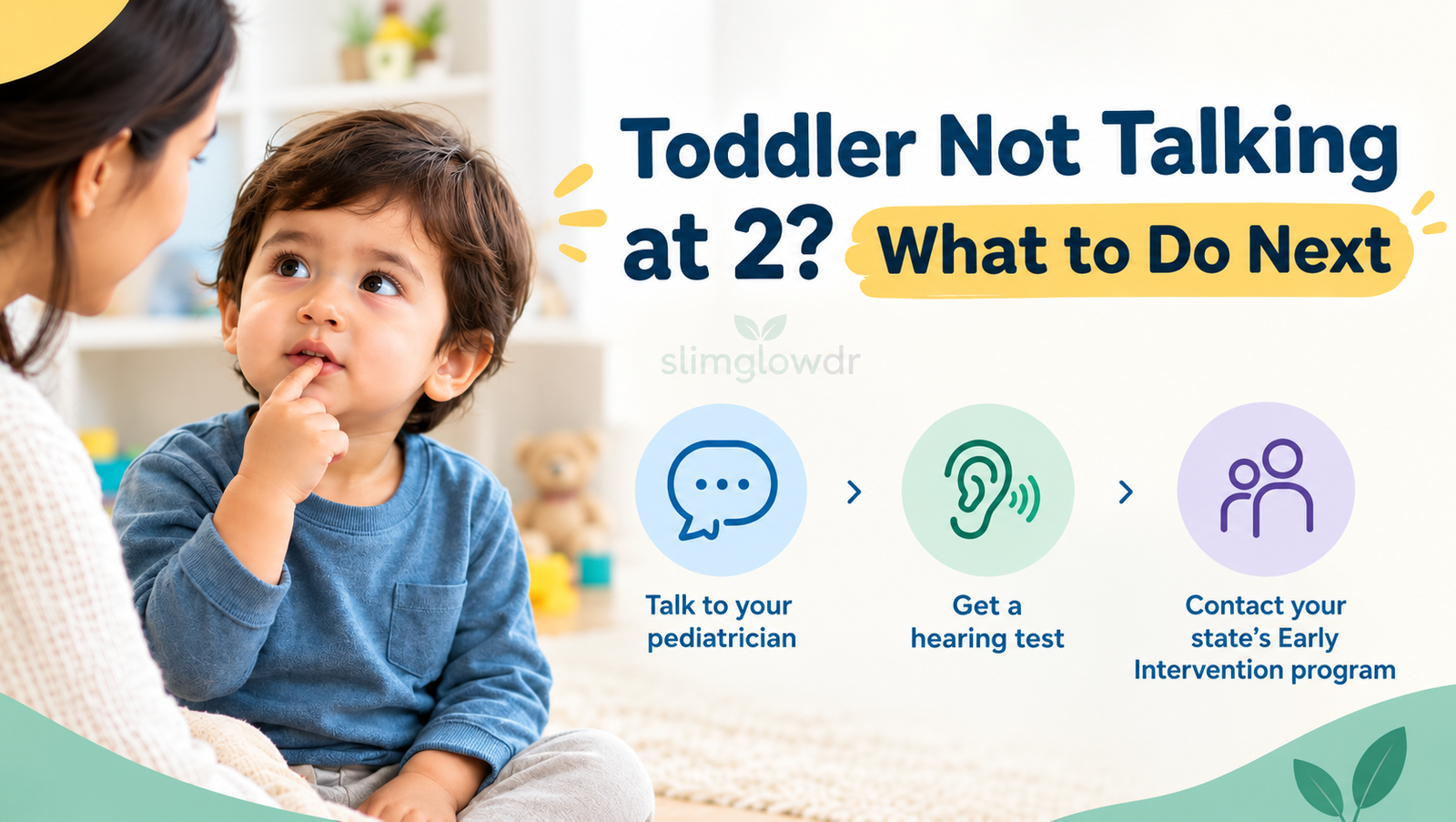
Many 2-year-olds who aren't talking much are late talkers, but waiting it out isn't the safest plan. If your child isn't using about 50 words or putting two words together ("more milk") by 24 months (missing either one is enough to act), tell your pediatrician, ask for a hearing test, and contact your state's Early Intervention program for a free evaluation. Treat any loss of skills, no pointing or gestures, or not understanding simple words as urgent.
Is It Normal for a 2 Year Old Not to Be Talking?
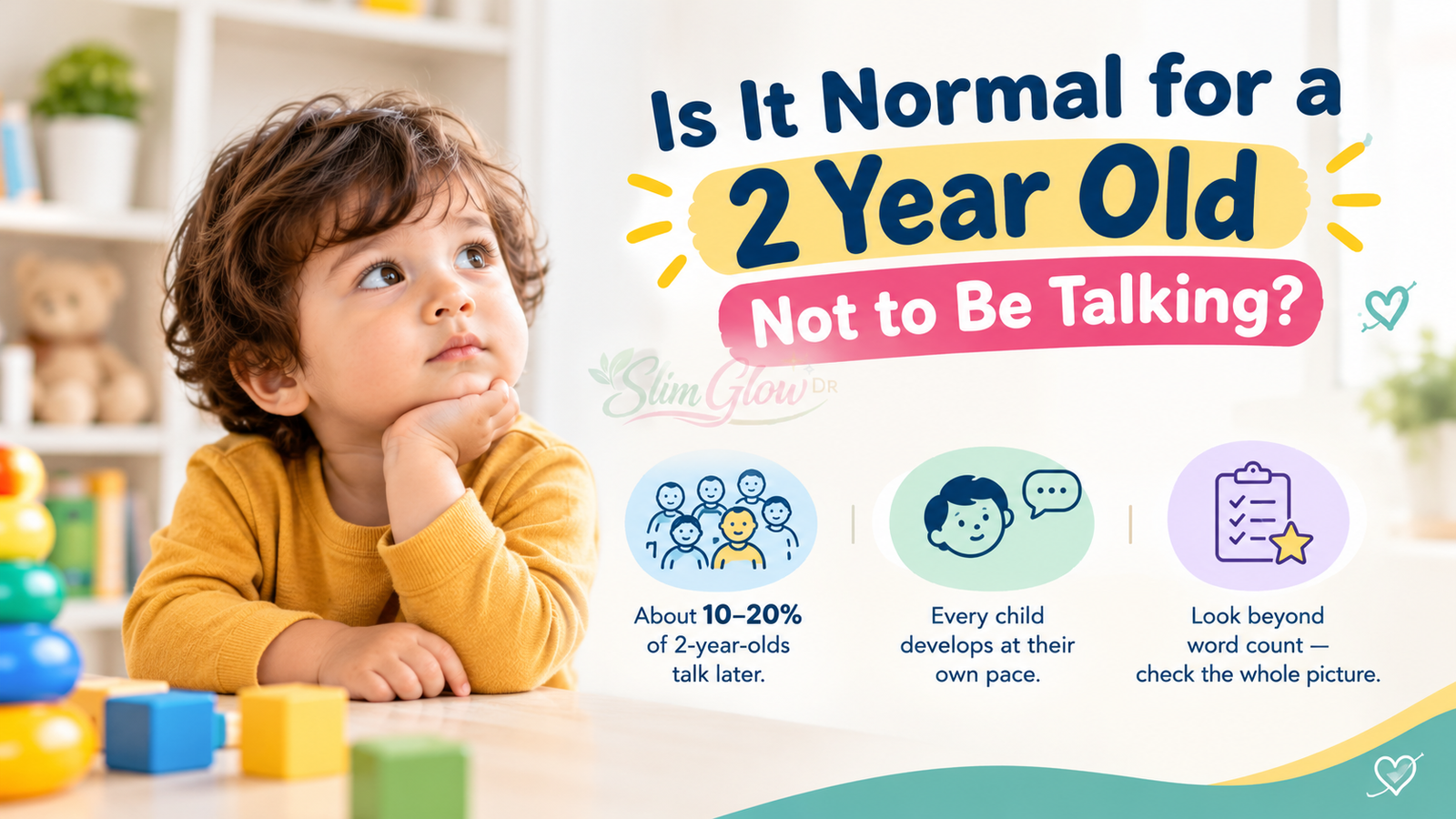
It's common, which is different from saying it's nothing to act on. According to ASHA's clinical summary on late language emergence, prevalence estimates for late talking in 2-year-olds mostly range between 10% and 20%. In a typical toddler room of ten children, one or two may be noticeably behind their peers in talking.
Language is also one of the most variable areas of early development. Some children say very little until a sudden "word explosion," while others add words steadily from their first birthday. That variation is exactly why it helps to know the specific benchmarks, and to look at more than word count alone.
How Many Words Should a 2-Year-Old Say?
By 24 months, most guidance puts a typical child at around 50 words or more, plus some two-word phrases like "more milk" or "daddy go." The AAP describes about 50 to 100 words at age 2. The CDC's checklist skips a word count at 24 months and instead looks for at least two words used together.
When you count, a practical approach is to include any word your child uses consistently for the same thing, even if it isn't pronounced perfectly. If your toddler always says "ba" for ball, that counts. If your family speaks more than one language, the AAP and ASHA advise counting words across all of them: 25 English words plus 25 Spanish words makes 50.
Writing the list down over two or three days usually gives a more accurate number than estimating from memory, and it's useful to bring to appointments.
Why the CDC, AAP and ASHA Give Different Benchmarks
If you've read that a 2-year-old should say 50 words and then found a CDC checklist that never mentions 50 words at that age, you haven't misread anything. The sources measure different things.
In February 2022, the CDC and AAP revised their milestone checklists. According to the CDC's explanation of the change, milestones were placed at ages by which at least 75% of children would be expected to show them. The goal was to make even one missed milestone more "actionable" and to reduce the "wait and see" approach. On the current checklists, "says about 50 words" appears on the 30-month checklist, and the 24-month language item is "says at least two words together."
Not everyone welcomed the change. ASHA has raised concerns that some of the changes "will slow and/or inhibit referrals for early intervention.
[VISUAL PLACEHOLDER: Comparison table of 24-month talking benchmarks from the CDC, AAP and ASHA. Alt text: Table comparing CDC, AAP and ASHA benchmarks for how many words a 2-year-old should say]
| Source | What it says about talking at 24 months | What it means for you |
|---|---|---|
| CDC/AAP 2022 checklist | "Says at least two words together, like 'More milk.'" (No word count at 24 months; "about 50 words" appears at 30 months.) | Set at what at least 75% of children do, so missing it is a clear signal to act |
| AAP HealthyChildren, "Language Delay" | "About 50 to 100 words" and "several 2-word phrases" | Describes what most toddlers do; fewer words is worth raising |
| ASHA late language emergence (clinical criterion) | "Fewer than 50 words and no two-word combinations by 24 months" | The research definition of a "late talker," not a target to wait for |
| ASHA 2023 milestones, 19 to 24 months | "At least 50 different words" and two or more words together | ASHA's own checklist for moms |
Note: The CDC says its checklists are not developmental guidelines or standards and should not be used as screening tools. Only a professional screening or evaluation can tell you whether your child has a delay.
The practical takeaway: if your child misses any of these benchmarks, raise it now. You don't need to wait until they miss the strictest one.
It's Not Just About Words: Other Skills to Look For at 24 Months
Word count gets the attention, but the 2 year old speech milestones professionals look at go well beyond it. Understanding, gestures, and social connection tell you a great deal about how a child's language is likely to develop. Drawing on CDC's milestones for 2-year-olds and the AAP, by around 24 months most children:
- Point to things in a book when you ask, like "Where is the bear?"
- Point to at least two body parts when asked
- Use more gestures than waving and pointing, such as blowing a kiss or nodding yes
- Follow simple one-step directions without you gesturing, like "Put your cup on the table" (AAP)
- Look at your face to see how to react in a new situation
- Play with more than one toy at once, such as putting toy food on a toy plate
- Are understood by others about half the time (AAP)
A child who says only a handful of words but points, follows directions, and brings you toys to share is showing a very different picture from a child who does none of those things. Speech is one piece of overall development; if you're also wondering about motor, play, or social skills, our guide to signs of developmental delay in toddlers covers the wider picture.
Before your child's next checkup, go through the CDC's 2-year milestone checklist (or the CDC's free Milestone Tracker app for iOS and Android) and note the words and gestures your child uses. Take it to the appointment.
2 Year Old Not Talking but Understands: Late Talker or Something More?
If your child seems to understand but isn't talking, that pattern is generally the more reassuring one. Even so, it still calls for an evaluation.
Receptive vs. Expressive Language, Explained Simply
Language has two sides. Receptive language is what your child understands. Expressive language is what your child can say or communicate. You may also hear professionals separate speech (producing sounds clearly) from language (understanding and using words to share meaning). A child can have difficulty with either one, or both.
A quick home check: without pointing or looking at the door, say "Go get your shoes." A child with good receptive language will usually head for the shoes, even if they can't say "shoes." Asking "Where's your nose?" or "Give me the spoon" works the same way.
This distinction matters because, according to ASHA, receptive language skills and expressive vocabulary size are among the best predictors of later language outcomes. ASHA also reports that late talkers who caught up tended to use more communicative gestures than those who stayed delayed. A 2 year old not talking but understanding well, gesturing, and engaging with people has several things working in their favor.
What Is a Late Talker?
"Late talker" is the everyday term for what clinicians call late language emergence (LLE). ASHA defines it as a delay in language onset with no other diagnosed disabilities, and the common research criterion is fewer than 50 words and no two-word combinations by 24 months.
The research on outcomes is encouraging, but mixed. ASHA reports that approximately 50% to 70% of children with LLE catch up to their peers. 20% of children with LLE had language impairment at age 7, compared with 11% of children with typical language histories. However, children who were late talkers also scored lower on average on some later language measures, including complex language at age 5 and vocabulary, grammar, and reading measures in adolescence.
So "most kids catch up" is true, but it isn't a reason to skip an evaluation. Some children don't catch up, and nobody can reliably tell which group your child is in just by waiting.
Why Is My 2 Year Old Not Talking? Possible Causes and Risk Factors
Often there's no single identifiable cause. Here are the main possibilities professionals consider. None of them can be confirmed at home.
- Hearing problems. According to the NIDCD's guide to speech and language milestones, a delay may be caused by hearing loss, which is why a hearing test is often part of a speech evaluation. Fluid in the middle ear (otitis media with effusion) is very common: an estimated 50% to 90% of children have it at some point by age 5. It can temporarily muffle hearing, and if it lingers, it can contribute to speech and language difficulties.
- An isolated expressive delay. The child understands well and develops typically otherwise, but talking is slow to start. This is the classic late talker.
- Speech sound disorders. Some children have trouble producing sounds. Childhood apraxia of speech, a motor planning disorder, is rare (ASHA estimates about 1 in 1,000 children aged 4 to 8) and is diagnosed by speech-language pathologists. At age 2, an SLP may watch for signs over time rather than diagnose it right away.
- Broader developmental differences, including autism. Not talking on its own doesn't point to autism, but it's one possibility professionals consider (see the next section).
ASHA also lists risk factors linked with a 2 year old speech delay: being a boy, delayed motor development, low birth weight, and a family history of late talking. These raise the odds; they don't explain any individual child.
Common Myths: Bilingualism, "Boys Talk Later," Screen Time, Tongue-Tie and Supplements
"Two languages confuse children and cause delays." False. Joint AAP and ASHA guidance on raising a bilingual child states that speech or language problems are not caused by learning multiple languages, and that mixing languages is normal. If a true language disorder exists, it shows up in every language a child uses. ASHA adds that dropping a language is not advised as a response to late talking. Keep speaking the language you're most comfortable in.
"Boys just talk later, so wait." Boys are at higher risk. ASHA cites research finding males are about 3 times more likely than females to be late talkers. That's a risk factor worth knowing, not a reassurance.
"Screens cause speech delay." The evidence is correlational. A 2020 meta-analysis of 42 studies on screen time and language development found a small but consistent link between more screen use and lower language skills, while educational programs and watching together with a mom were linked with better language. These studies can't prove screens cause delays. For 2- to 3-year-olds, the CDC suggests no more than 1 hour per day of quality programming.
"Clipping a tongue-tie will get them talking." A systematic review found that the evidence on tongue-tie and speech is limited: there isn't enough data to say whether clipping a tongue-tie improves speech. Separately, the AAP has noted that tongue-tie surgery for breastfeeding concerns may be overused. If tongue-tie comes up, ask for an SLP to assess speech before any procedure is considered for speech reasons.
"A supplement or natural remedy can help." There is no good evidence that any supplement, vitamin, or "natural remedy" treats speech delay in toddlers, and no major pediatric or speech-language guidance recommends one. We don't recommend any. Time and money are better spent on an evaluation and on the home strategies below.
Speech Delay vs Autism: How to Tell the Difference
Many moms searching about a quiet 2-year-old are privately worried about autism. A delay in talking on its own does not mean a child is autistic. When professionals weigh speech delay vs autism, they look less at how many words a child says and more at how the child connects and communicates without words.
The CDC's list of early autism signs focuses on social communication: avoiding or not keeping eye contact, not responding to their name, using few or no gestures, not showing you things they like, and not pointing to share something interesting (sharing attention like this is sometimes called joint attention). Delayed language is listed, but as one characteristic among others.
The AAP recommends autism screening at 18 and 24 months for all children, using a standardized autism screening tool during well-child visits. A screening is a brief check, and as the CDC notes, it doesn't provide a diagnosis. If a screening raises concerns, the next step is a full evaluation by a qualified specialist, such as a developmental-behavioral pediatrician.
Late Talker vs Autism: Signs Side by Side
[VISUAL PLACEHOLDER: Two-column table contrasting signs more typical of a late talker with signs to discuss promptly with a pediatrician. Alt text: Table comparing common signs of a late talker with signs that may point to autism in a 2-year-old]
| More typical of a late talker | Signs to discuss with your pediatrician promptly |
|---|---|
| Points to show you things and to ask for things | Rarely points or uses gestures |
| Responds to their name most of the time | Often doesn't respond to their name |
| Understands simple words and follows one-step directions | Seems not to understand simple words or directions |
| Enjoys back-and-forth play, shares smiles and looks | Limited eye contact or shared enjoyment |
| Uses gestures, sounds, or signs to make up for missing words | Little effort to communicate in other ways |
| Skills keep building, if slowly | Loses words or skills they used to have |
A table can't diagnose anything. Many children show a mix of these, and only a qualified professional can evaluate what's going on. If you're seeing items in the right-hand column, mention them specifically at your child's appointment.
Loss of words or skills needs prompt evaluation regardless of the cause, even if nothing else in the right-hand column applies.
When to Worry About Toddler Speech Delay: Red Flags That Need Prompt Action
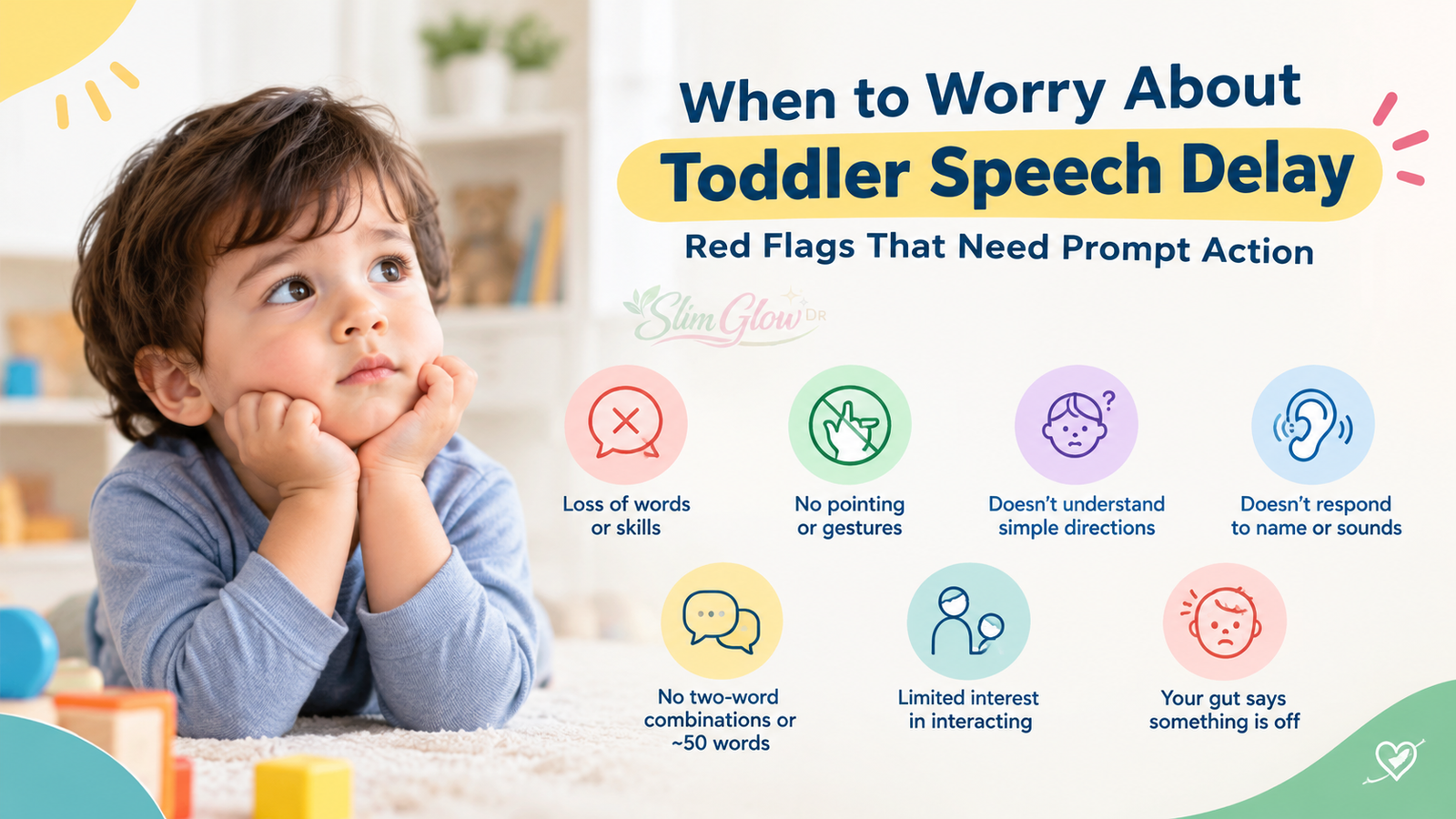
In most cases, speech delay in toddlers calls for a timely appointment, not panic. Some signs, though, mean you should contact your pediatrician soon:
- Loss of words or skills your child used to have. Act right away; don't wait for the next scheduled visit.
- No pointing or gestures by 24 months.
- Doesn't understand or follow simple one-step directions.
- Doesn't respond to their name or to sounds, which can signal a hearing problem.
- No two-word combinations, or fewer than about 50 words, at 24 months.
- Limited interest in interacting with you or other people.
- Your gut says something is off. The CDC's guidance is direct: "You know your child best. Don't wait." If your child is missing milestones, has lost skills, or you have other concerns, act early.
What to Do If Your Toddler Isn't Talking at 2: A Step-by-Step Plan
[VISUAL PLACEHOLDER: Numbered four-step flow graphic: 1. Pediatrician screening, 2. Hearing test, 3. Early Intervention self-referral (cdc.gov/FindEI), 4. SLP evaluation, with a side callout reading "Lost skills? Call now." Alt text: Four-step plan for what to do if your toddler is not talking at 2: pediatrician, hearing test, early intervention, speech therapy evaluation]
These steps are numbered for clarity, but you don't have to finish one before starting the next. You can call Early Intervention the same week you book the pediatrician visit, since each can take time to schedule.
Step 1: Tell Your Pediatrician and Ask for a Developmental Screening
Don't wait for a sibling's appointment or a passing comment at the end of a visit. Say it plainly when you book: "I'm concerned about my child's speech and would like a developmental screening." The AAP recommends general developmental screening at 9, 18, and 30 months and autism screening at 18 and 24 months, so your child should already be screened for autism at the 24-month visit. If you have concerns, the CDC's advice is to share them and ask about developmental screening rather than waiting for a scheduled one.
Bring:
- Your notes from the CDC milestone checklist or Milestone Tracker app
- A written list of words, signs, and word combinations your child uses
- A few short phone videos of your child communicating at home, since toddlers often behave differently in an unfamiliar exam room
- Any history of ear infections, and the result of the newborn hearing screen
Step 2: Get a Hearing Test
A hearing test for a toddler is one of the most useful early steps, because a hearing problem can affect speech and language development. The CDC's guidance on hearing loss in children advises looking out for signs of hearing loss even if a child passed a hearing screening before, lists delayed speech as one such sign, and says to ask your child's doctor for a hearing screening as soon as possible if you're concerned.
Ask your pediatrician for a referral to an audiologist, a hearing specialist who can test young children using play-based methods. ASHA's ProFind directory (see Step 4) also lists certified audiologists. If your child has had fluid in the middle ear, the AAO-HNS clinical guideline advises a hearing test when the fluid persists for three months or longer.
Step 3: Contact Early Intervention Directly (No Referral Needed)
Every US state runs an Early Intervention program for children under 3, funded under IDEA Part C and often called "Birth to Three." It's a route to early intervention for a speech delay that many moms don't realize they can start themselves.
- You can refer your child yourself. The CDC states that a doctor's referral is not necessary, and the AAP notes your child doesn't need a diagnosis to receive services.
- The evaluation is free. Under federal regulation, the evaluation, assessment, service coordination, and development of your child's plan come at no cost to families. Ongoing services are provided free or at reduced cost, depending on your state, and no family can be turned away for inability to pay.
- It moves on a set timeline. The evaluation and the first planning meeting generally happen within 45 days of referral.
- Eligibility rules differ by state. As the CDC notes, each state sets its own rules about eligibility, and federal regulation lets each state define the level of delay that qualifies. A child with a mild delay may qualify in one state but not another. If your child isn't found eligible, you can still pursue a private SLP evaluation (Step 4), ask what progress to look for and when to check again, and contact Early Intervention again if things change.
- If your child is eligible, you'll work with a service coordinator to create an Individualized Family Service Plan (IFSP) describing your child's goals and the services your family will receive.
- Around age 3, Early Intervention helps you transition to your school district's preschool special education services, with an Individualized Education Program (IEP), if your child is eligible.
To find your state's Early Intervention program, use the CDC's FindEI page (cdc.gov/FindEI), which links to contacts for every state and territory. When you call, a practical script is: "I'm concerned about my child's speech and would like to request an evaluation."
- If your child is close to 3: The 45-day timeline can run out close to the third birthday, so contact Early Intervention and your school district's special education office at the same time, and ask how the transition will work for your child. Rules and timing vary by state.
Step 4: Speech Therapy for a 2 Year Old (What an SLP Evaluation Looks Like)
A speech-language pathologist (SLP) evaluates how your child understands language, communicates with words and gestures, makes sounds, and plays and interacts. At this age, the evaluation usually looks like play, with the SLP also asking you detailed questions about what your child does at home.
If speech therapy for a 2 year old is recommended, expect it to be play-based and to involve you directly. Much of the work at this age involves coaching moms to use specific techniques during everyday routines. That approach has research behind it: a meta-analysis of parent-implemented language interventions found a significant positive effect on young children's receptive and expressive language.
There are two main routes to an SLP:
- Through Early Intervention, where an SLP is often part of the evaluation team and services follow your IFSP.
- Privately, through a referral from your pediatrician. Coverage varies by plan, so check with your insurer about speech therapy benefits. You can find a certified speech-language pathologist through ASHA's ProFind directory.
If You're Told to "Wait and See"
Sometimes a pediatrician suggests giving it a few more months. If you're still concerned, the AAP says it's OK to get a second opinion. You can also self-refer to Early Intervention at any point, without anyone's permission.
There is a real difference between a professional recommending monitoring with a plan after assessing your child, which ASHA describes for some isolated late talkers, and simply waiting on your own. If you're told to monitor, ask: When will we recheck? What specific progress should I see by then? What would change the plan?
Your next step this week: Worried about your 2-year-old's talking? Talk to your pediatrician, ask for a hearing test, and contact your state's Early Intervention program through cdc.gov/FindEI for a free evaluation. You can refer your child yourself.
Outside the US?
In the UK, the NHS advises talking to your GP or health visitor, and in many areas you can also refer your child to a speech and language therapist yourself; see the NHS guidance on helping your child learn to talk. Elsewhere, start with your local child-health service or family doctor.
How to Encourage Your Toddler to Talk at Home (Starting Today)
These strategies work alongside an evaluation, not instead of one. Several come straight from CDC guidance on building your toddler's language (expanding on words, daily reading, naming objects, songs). The others are techniques speech-language pathologists commonly coach moms to use.
[VISUAL PLACEHOLDER: Table of everyday strategies to encourage toddler talking, with what each looks like and an example phrase. Alt text: Everyday strategies to encourage a toddler to talk, with example phrases]
| Strategy | What it looks like | Example phrase |
|---|---|---|
| Talk through routines | Narrate what you and your child are doing (self-talk and parallel talk) | "You're washing your hands. The water's cold!" |
| Expand on their words | Repeat their word and add one or two more (CDC) | Child: "Car." You: "Big red car!" |
| Offer choices | Hold up two options so a word or point gets them what they want | "Milk or water?" |
| Use wait time | Pause expectantly and count to five in your head before helping | Hold the bubbles, look at your child, and wait |
| Read interactively | Point, name, and pause instead of reading every word (CDC) | "Where's the dog? Woof!" |
| Imitate and play face-to-face | Copy their sounds and actions at their eye level | Child bangs a drum; you bang yours and grin |
| Reduce pressure | Model words instead of demanding them | Say "Ball!" rather than "Say ball!" |
| Sing with pauses | Leave a gap for your child to fill (CDC suggests simple songs) | "Twinkle, twinkle, little..." (pause) |
Trying all eight at once can turn playtime into a drill. Pick two or three, build them into routines you already do (bath, meals, car rides), and keep it fun. If your child starts using words, signs, or gestures to ask for things, that's progress worth noticing.
Key Takeaways
- Benchmarks at 24 months differ: the CDC/AAP checklist looks for at least two words together, while ASHA's late-talker criterion is fewer than 50 words with no word combinations. Missing any of them is worth raising.
- Understanding, gestures, and social engagement matter as much as word count.
- Loss of words or skills means contact your pediatrician immediately.
- The plan: pediatrician, hearing test, Early Intervention self-referral (free evaluation), SLP evaluation.
- Many late talkers catch up, but not all, and no one can tell which group a child is in just by waiting.
- Home strategies help alongside professional support.
Conclusion
If your toddler is not talking at 2, asking for an evaluation isn't overreacting. The evaluation through Early Intervention is free, you can start it yourself, and if your child turns out to be a late talker who catches up on their own, you've lost very little. If they need support, they'll start getting it early, during the years the NIDCD describes as critical periods for speech and language development.
For more parenting and development topics, browse our parenting and motherhood guides.
Disclaimer: This article is for general education and isn't medical advice. Every child develops differently. If you have concerns about your child's speech, language, or hearing, talk to your child's pediatrician. In the US, you can also contact your state's Early Intervention program directly without a referral.
Frequently Asked Questions
Is it normal for a 2 year old not to talk?
It's common but worth checking. ASHA estimates that 10% to 20% of 2-year-olds are late talkers. A child who understands well, points, and engages socially often has a better outlook, but an evaluation is still the best way to know. See what a late talker is.
Why is my 2 year old not talking yet?
Often there's no single clear cause. Possibilities include an isolated expressive delay, hearing problems, speech sound difficulties, or broader developmental differences. Risk factors include being a boy and a family history of late talking. A hearing test and a professional evaluation help narrow it down.
Should I worry about my 2 year old not talking?
Act rather than worry. If your child isn't combining two words or has fewer than about 50 words, raise it with your pediatrician. Loss of skills, no pointing, or not responding to their name call for prompt attention. See the red flags list.
Do late talkers catch up on their own?
Many do, but not all. ASHA reports that about 50% to 70% of late talkers catch up to peers. Some don't, and as a group, former late talkers scored lower on average on some later language and reading measures. That uncertainty is why evaluation beats waiting.
Can I get early intervention without a doctor's referral, and is it free?
Yes, you can refer your child yourself, and no diagnosis is needed. The evaluation is free under federal law. Ongoing services are free or at reduced cost depending on your state, and inability to pay can't be used to deny services. Use the CDC's FindEI page to locate your program.
Does being bilingual cause speech delay?
No. The AAP and ASHA state that learning more than one language doesn't cause speech or language problems. Count words across all languages your child uses, and keep speaking your home language. Mixing languages in one sentence is normal.
Why is my 2.5 year old not talking?
By 30 months, the CDC checklist lists about 50 words and two-word phrases with an action word, like "Doggie run." If your child isn't there yet, contact Early Intervention soon. Early Intervention serves children under 3; after that, support usually moves to your school district's preschool special education program.
Can ear infections cause speech delay?
Ear infections can contribute to speech delay rather than directly cause it. Fluid behind the eardrum can temporarily muffle hearing, and if it lingers, it may affect speech and language. That's why a hearing test matters, especially after repeated ear infections or fluid lasting three months or more.