

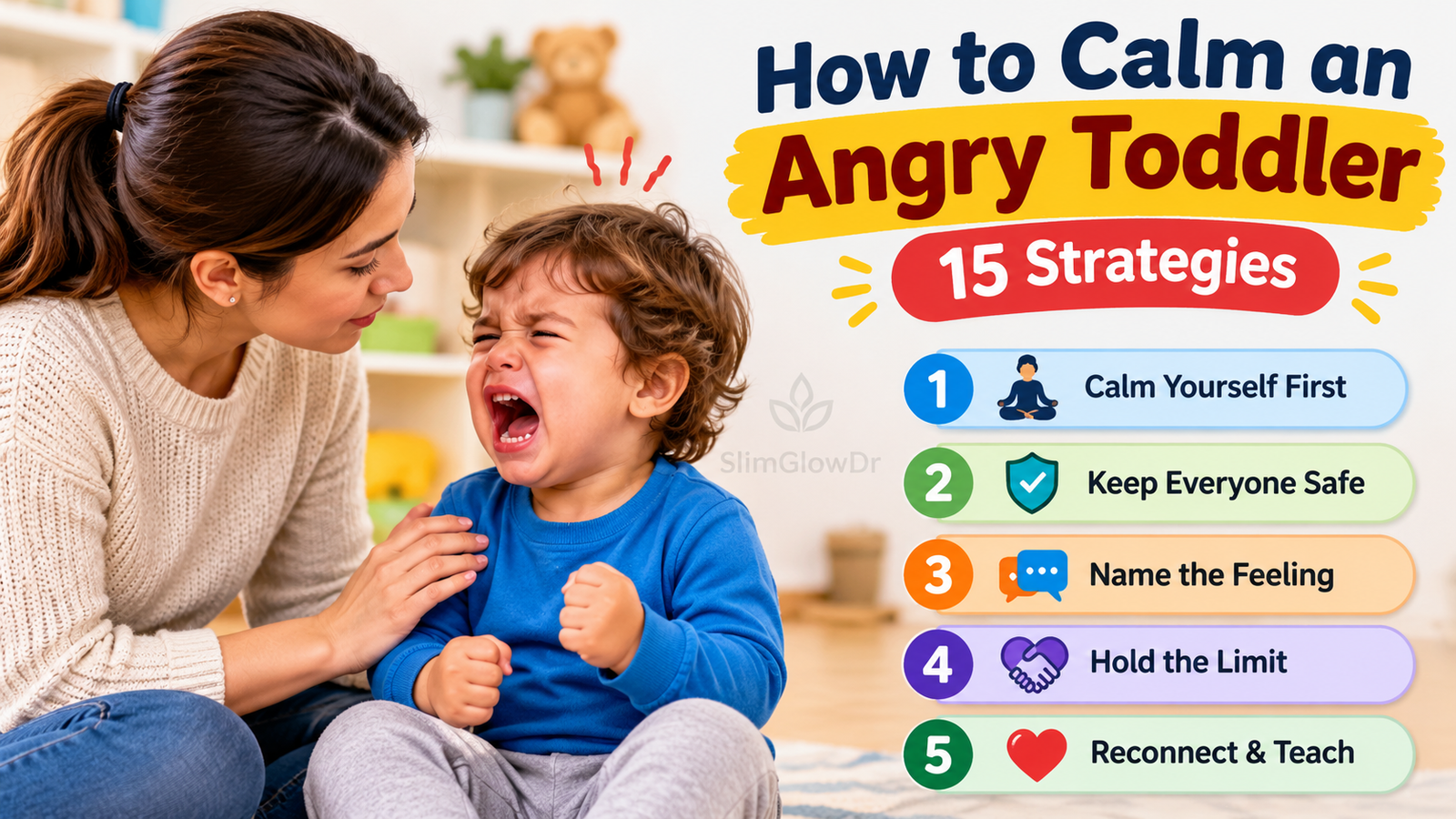
By Dr. Hafiza Kaneez Fatima, Pharm-D | Medically reviewed by [VERIFY: name and credentials of a qualified pediatrician, child psychologist, or developmental-behavioral specialist before publishing] | Published and last updated: November 16, 2026
It's 5:40 p.m. Dinner is almost ready, and your 2-year-old is face-down on the kitchen floor, screaming because you poured the milk into the blue cup instead of the green one. You can feel your own shoulders tightening. Part of you wants to hand over the green cup just to stop the noise, and part of you wants to yell.
If you're searching for how to calm an angry toddler, you're in very good company. The American Academy of Pediatrics (AAP) calls temper tantrums a normal part of toddler development, most common between ages 1 and 3. In one community study of nearly 1,500 preschoolers, 83.7% had tantrums at least sometimes (Wakschlag et al., 2012).
This guide covers what to do in the moment, the exact words to say, how to respond to hitting, screaming, and not listening, the habits that make calmer days more likely, and the specific signs that mean it's time to check in with your pediatrician. Each strategy draws on guidance from the AAP, the CDC, and the NHS, plus published research, rather than on a parenting trend.
Quick Answer: How to Calm an Angry Toddler
To calm an angry toddler, steady yourself first, keep everyone safe, and use very few words to name what your child feels. Accept the feeling while still holding the limit. Toddlers can't reliably settle themselves yet, so they borrow calm from the adult nearby. Once the storm passes, reconnect and practice the skill for next time.
- Calm yourself first. Your toddler borrows your calm.
- Keep everyone safe, then get low and close.
- Use few words and name the feeling ("You're so mad").
- Hold the limit kindly. Don't give in, and don't punish the feeling.
- Once they're calm, reconnect and teach the skill for next time.
[VISUAL PLACEHOLDER: Simple infographic listing all 15 strategies in three color-coded groups: In the moment (1–8), Hitting, screaming, and not listening (9–11), Between meltdowns (12–15). Use the exact strategy headings from this article as the labels; Alt text: Infographic of 15 gentle strategies to calm an angry toddler, grouped by in the moment, flashpoints, and between meltdowns]
Why Is My Toddler So Angry?
Toddlers get angry because their feelings arrive at full strength long before the brain skills and words needed to manage them. Add a missed nap, an empty stomach, or a sudden "time to leave," and a small disappointment can tip into a full meltdown. Understanding the cause won't stop every tantrum, but it changes how you respond.
Their brains are still building the "brakes"
The skills that help us pause, control impulses, and shift gears are called executive function, and they rely heavily on the prefrontal cortex. According to the Harvard Center on the Developing Child, nobody is born with these skills; they develop on an extended timetable that begins in early childhood and continues past adolescence.
Put simply, your toddler has a powerful accelerator for emotions and only the early beginnings of a brake. That's why reasoning ("It's just a cup!") rarely works mid-meltdown. Your toddler isn't choosing to be difficult. They need you to supply the regulation they can't yet produce, which is what the in-the-moment strategies below are designed to do.
Big feelings, few words
Toddler frustration and big emotions often come down to communication. KidsHealth notes that tantrums are common in the second year, when language is still developing, and tend to decrease as language skills improve. Imagine wanting something urgently and having no way to say it.
Research supports this link. A Northwestern University study of more than 2,000 toddlers found that late talkers were more likely to have frequent, severe tantrums, at about 1.96 times the rate of peers. This is an association, not proof that speech delay causes tantrums, and the researchers cautioned parents not to overreact to normal differences between children. If you're parenting a toddler who isn't talking yet at 2, though, it's worth knowing that frustration may be part of the picture.
Common triggers: tired, hungry, overstimulated, or facing a transition
Many meltdowns have a physical trigger. The AAP suggests bringing a snack if your child's tantrums peak when they're hungry, and the NHS describes tiredness and hunger as causes that can be "an easy fix." Overstimulation (busy stores, noisy parties) and transitions (leaving the park, turning off a show) are other common flashpoints.
There's also the drive for independence. A toddler who insists "Me do it!" and then can't get the shoe on is caught between wanting control and lacking the skill. The AAP adds that temperament plays a role, so some children simply feel things more intensely. Try jotting down when meltdowns happen for a few days; patterns around naps, meals, or transitions often become obvious.
Is It Normal? Toddler Anger by Age
For most families, yes. Tantrums commonly start in the second year, are very common at ages 2 and 3, and usually ease from about age 3 to 4. Research by Potegal and colleagues, cited in a 2008 study by Belden and colleagues, found that roughly 70% of 18- to 24-month-olds have tantrums. Sources differ slightly on exact timing: the NHS says tantrums usually begin around 18 months and are much less common by age 4, while the AAP says they tend to improve after age 3. The CDC's developmental milestones can help you see what's typical at each age.
Daily tantrums become less typical as children get older. In the community study of preschoolers (roughly ages 3 to 5) mentioned above, only 8.6% had tantrums every day, even though most had them at least sometimes.
| Age | What anger often looks like | Strategies that tend to fit best |
|---|---|---|
| 12–18 months | Crying, flopping, throwing, or arching away; few or no words to explain | Distraction and redirection, safety, comfort, naming the feeling for them |
| 2 years | Frequent, intense tantrums, often over limits, transitions, and "me do it" moments | Few words, naming feelings, holding limits kindly, simple two-option choices |
| 3 years | More words and more negotiating; arguing, defiance, and testing limits | Choices, feeling words, "when/then" statements, praise for calm moments, brief time-out for unsafe behavior if you use it |
12–18 months
Young toddlers can shift attention more easily, which is why redirection works so well at this age. Name the feeling for them even if they can't repeat it yet ("You're frustrated").
2-year-olds (the "terrible twos")
Two is often the peak of frustration-driven tantrums. If you're wondering how to calm an angry 2-year-old, focus on safety, fewer words, and staying close during the storm, then offer one or two simple choices once the peak passes. Expect the same limits to be tested many times; that repetition is how toddlers learn.
3-year-olds (the "threenager" stage)
More words often turn tantrums into arguments. To calm an angry 3-year-old, lean on simple feeling words, limited choices, and clear "when/then" statements. This is also a good age to practice calm-down tools when everyone is relaxed, because many 3-year-olds can start using them with support.
In the Moment: How to Calm an Angry Toddler During a Meltdown
Learning how to handle toddler tantrums as they happen comes down to three goals: stay steady, keep everyone safe, and help the feeling pass without rewarding the outburst. These eight strategies are roughly in the order you'll need them, though you won't use all eight every time.
1. Steady yourself first
The CDC's time-in guidance starts with one step for the parent: make sure you're calm first, then respond. This is the foundation of co-regulation, the idea that young children borrow an adult's calm to settle their own nervous system. It's also the starting point for toddler emotional regulation: before they can calm themselves, they need repeated experiences of being calmed by you. The NHS is blunt about the alternative: shouting back or losing your temper won't stop a tantrum.
Try a 10-second reset:
- Take one slow breath, longer on the exhale.
- Lower your shoulders and your voice.
- Tell yourself: "This is a hard moment, not an emergency."
Your stress is real, especially at the end of a long day. If you feel your anger rising, the AAP suggests taking a short break or handing off to another adult when that's possible and your child is safe.
2. Make it safe
Before anything else, check for danger. Move breakables, siblings, or the child to a safer spot. KidsHealth advises that a child at risk of hurting themselves or others should be taken to a quiet, safe place to calm down. The AAP is clear that you should step in right away if your child is in physical danger, such as near a street.
Some parents find that gently but firmly holding their child helps. The NHS notes this usually works best when a child is more upset than angry, and only when you feel calm enough to reassure them. Treat holding as an optional comfort and safety measure, never as restraint or punishment. If your child pulls away, let them go and stay close instead.
Script: "I'm moving you here so everyone stays safe. I'm right with you."
3. Get low, stay close, say less
Kneel or sit at your child's eye level, keep your body relaxed, and use as few words as possible. At the peak of a tantrum, most toddlers can't take in explanations.
This strategy is mostly based on pediatric guidance, plus some observational research. In a study of 2- and 3-year-olds' tantrums, researcher Michael Potegal and colleagues found that anger and sadness run together, with peaks of anger layered over underlying distress (Green, Whitney & Potegal, 2011). In interviews about the study, the researchers suggested that doing very little during the anger peak may help it pass fastest, and that asking questions may prolong it. Once the anger fades, sad toddlers often reach out for comfort, and that's your moment.
Script: "I'm here." Then wait.
4. Name the feeling
Put a simple word to what your child is feeling: "You're really angry the tower fell." The CDC's emotion coaching guidance for 2- to 4-year-olds includes labeling the emotion in simple words, and the NHS also recommends naming feelings to help toddlers understand them.
Why it helps: research in adults suggests that putting feelings into words can dampen the brain's alarm response (Lieberman et al., 2007). That study involved adults, not toddlers, so it doesn't prove the same effect in your child. More directly relevant, a randomized trial of an emotion-coaching program for parents of 18- to 36-month-olds, Tuning in to Toddlers, found improvements in parent-reported child behavior at 12 months. The authors describe this as preliminary support.
Script: "You wanted the green cup. You're so mad."
5. Accept the feeling, hold the limit
Validation doesn't mean giving in. You can fully accept your child's anger while still saying no to the behavior or the demand. The CDC models this exactly: "It's ok to feel angry, but it's not ok to throw our blocks."
Holding the limit matters because, as the CDC explains, if you give in during a tantrum, your child learns that crying loudly gets them what they want, making future tantrums more likely. The NHS adds that bribes, such as sweets, teach the same lesson.
That said, the AAP acknowledges that sometimes you have to give in a little to settle yourself, and that's OK. What matters most is the overall pattern. One rough afternoon doesn't undo your consistency.
Script: "You're allowed to be mad. I won't let you throw. The green cup is in the dishwasher."
6. Distract or redirect (especially for younger toddlers)
If you catch a tantrum early, redirection can stop it from building. The NHS gives a simple example: point and say, "Look! A cat." The AAP suggests moving to another room, offering a safer toy, or singing a song. It also cautions against turning distraction into bribery.
As a general rule of thumb, distraction works best with younger toddlers and before the anger peaks. Once a 3-year-old is in full meltdown, a sudden "Look, a bird!" often goes unnoticed.
Use redirection as one tool, not as a way to avoid every limit. If your child is upset because you said no to the scissors, redirect to something they can have rather than handing the scissors back.
Script: "Scissors are for grown-ups. Here's the crayon box. Which color first?"
7. Offer two simple choices
A lot of toddler anger is about control. The AAP recommends giving children control over little things by offering options rather than yes/no questions. KidsHealth gives the example "Do you want orange juice or apple juice?"
This is guidance-based advice; no trial has isolated choices as a stand-alone fix for tantrums. Two choices tend to work better than open-ended ones, and both choices should be fine with you. Offer them as the storm is passing, not at the peak, when your child can't process them.
Script: "Do you want to walk to the car or hop like a bunny?"
Script: "Should we stack the blocks again, or start a puzzle?"
8. Give space without leaving them alone
Sometimes the best move is to wait it out nearby. The AAP notes that many tantrums dissolve on their own. Stay within sight, keep your face calm, and let your child know you're available: "I'll be right here when you're ready for a hug."
Whether to pull back your attention depends on why the tantrum is happening. KidsHealth suggests that tantrums aimed at getting attention are best ignored, while the CDC recommends staying close and offering comfort (time-in) for real emotional meltdowns or distress. At home, the NHS says you can step out of the room briefly as long as your child is safe. Never ignore hitting or danger. We cover this debate in more detail in the discipline section below.
Hitting, Screaming, and Not Listening: What to Do
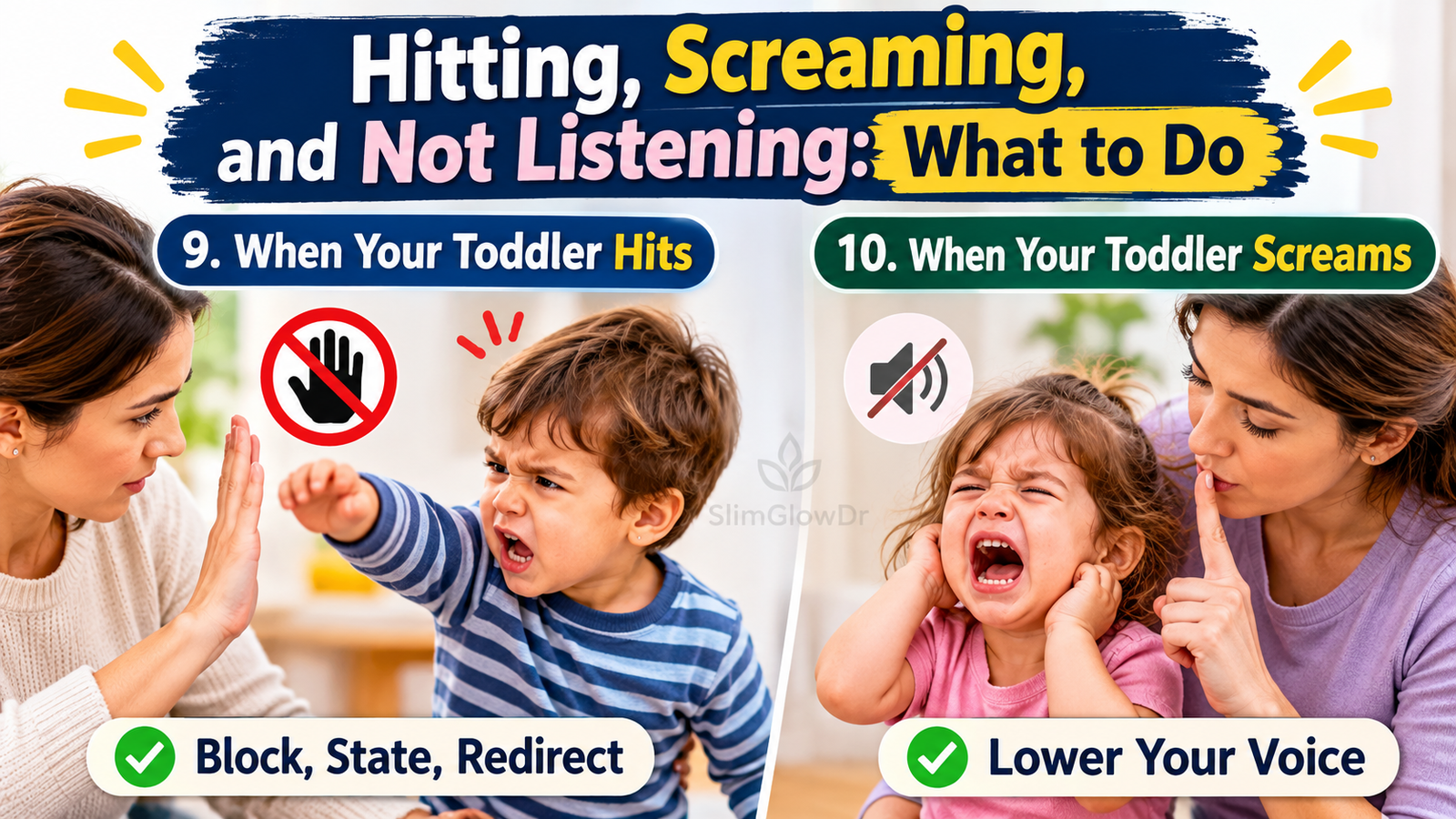
These three behaviors come up again and again in parents' questions about toddlers. Each one has a specific, calm response.
9. When your toddler hits: block, state the limit, redirect
How to respond when a toddler hits comes down to five calm steps:
- Block or move away calmly. Gently catch the hand or step back.
- State the limit in a few words: "I won't let you hit."
- Name the feeling: "You're angry I took the toy."
- Show an alternative: stomp your feet, squeeze a pillow, or say "I'm mad!"
- Check on the person who got hurt, so your child sees the effect.
The AAP's guidance on aggressive behavior in young children explains that toddlers have limited self-control and need adults to teach them not to kick, hit, or bite when angry. It recommends short phrases like "We don't hurt each other" and separating children until they calm down. You can use the same steps for biting, kicking, and throwing.
Never hit or bite back. The NHS warns this can teach your child that hurting is acceptable. Many young children hit or bite occasionally, and the NHS notes it doesn't mean they'll be aggressive later. It also suggests giving your child safe ways to let off steam, such as running around or shouting in the park.
10. When your toddler screams: lower your voice, don't match it
How to stop toddler screaming starts with your own voice. Answer screaming with a quieter, slower tone. Matching the volume tends to escalate things, and as Strategy 1 notes, shouting back won't stop a tantrum.
The evidence here is thin. Research on 2- and 3-year-olds found that screaming reflects the highest-intensity anger in a tantrum, with sadness running underneath (Green, Whitney & Potegal, 2011). Beyond that, there's no authoritative screaming-specific guidance, so the tips below are practitioner recommendations based on general calm-modeling advice:
- Tell distress screaming apart from play or testing. Distress screaming needs comfort and few words. Playful screaming can get a cheerful, calm "Inside voice, please" and a quieter game.
- Teach "inside voice" when calm, by practicing loud and soft voices as a game.
- In public, move to a quieter spot if you can and focus on your child, not onlookers.
Script (whispering): "That was a big scream. You're really upset. I'm listening."
11. When your toddler refuses to listen: connect, keep it short, follow through
What to do when a toddler refuses to listen often starts before you speak. The CDC's tips on how to give clear, one-step directions include making sure your child hears and pays attention, using statements instead of questions (questions give your child the option to refuse), giving one direction at a time, and being specific.
How that looks at home:
- Get close and get eye contact first.
- Say what to do, not what to stop: "Feet on the floor" instead of "Stop climbing."
- Use a "when/then" statement: "When your shoes are on, then we go outside." (This is a positively framed variation on the CDC's "if/then" approach.)
- Follow through calmly every time, and only warn about consequences you'll actually carry out.
- Praise cooperation right away.
Keep expectations realistic. A 2-year-old who ignores "Clean up your room" may manage "Put the blocks in the bin."
Between Meltdowns: Teaching Your Toddler to Manage Big Emotions
Much of the real work happens between tantrums, not during them. Toddler emotional regulation grows slowly, through hundreds of small, calm repetitions. At this age, toddler anger management is mostly the adult's job: building routines and practicing skills when everyone is calm, which is how to teach toddlers to manage emotions over time.
12. Head off triggers with routines and warnings
A predictable rhythm, such as the same short sequence before naps and dinner, means fewer surprises. The AAP notes that staying consistent from day to day can help reduce how often and how intensely tantrums happen.
Protect sleep: expert guidance endorsed by the AAP recommends 11 to 14 hours per 24 hours (including naps) for ages 1 to 2, and 10 to 13 hours for ages 3 to 5. A large Norwegian cohort study of more than 32,000 children linked short or frequently interrupted sleep at 18 months to more emotional and behavioral problems at age 5, though it couldn't prove cause and effect.
Other everyday habits:
- Keep regular meals, and pack a snack for outings that run close to mealtimes.
- Give transition warnings: "Two more slides, then shoes." (This is common practitioner advice; we didn't find a study testing it specifically.)
- Plan high-risk outings. The NHS suggests keeping shopping trips short and letting your child help.
13. Teach feeling words and calm-down tools when everyone is calm
The Harvard Center on the Developing Child notes that executive-function skills develop through practice. The CDC recommends noticing and naming emotions ideally when they're mild, not only during big meltdowns.
Ideas to try:
- Read picture books about feelings and name the characters' emotions.
- Narrate feelings in play: "Teddy is sad his tower fell."
- Name your own feelings: "I'm frustrated the bus is late. I'm taking a deep breath."
You may also want to try simple breathing ("Smell the flower, blow out the candle") or an optional calm-down corner with soft pillows and a feelings book. These are practitioner ideas, not research-tested tools for toddlers. Many children under 2 can't follow breathing instructions yet, so treat these as playful practice for older toddlers. If you use a calm-down space, keep it a place of comfort you go to together, never a punishment.
14. Notice and praise calm moments
Toddlers tend to repeat what gets a reaction, good or bad. The CDC recommends positive attention, such as praise, hugs, and high-fives, as much as possible, and suggests labeled praise that names exactly what you liked.
Script: "You told me you were mad instead of throwing. That was hard, and you did it!"
This principle sits at the heart of evidence-based parenting programs. A 2017 meta-analysis of 23 studies found that Parent-Child Interaction Therapy (PCIT) reduced children's disruptive behavior compared with control groups. A large 2014 meta-analysis of Triple P also found improvements in children's social, emotional, and behavioral outcomes, although critics have pointed out that most Triple P studies involved the program's developers. These are structured programs, often clinician-led, so using their principles at home isn't the same as completing one. Still, they suggest that consistent praise and clear limits can make a real difference.
15. Reconnect and repair after the storm
When the tantrum is over, reconnect. KidsHealth suggests a hug and reassurance that your child is loved no matter what, and praising your child for regaining control. The CDC's time-in steps end with reassurance through words and actions, then emotion coaching once your child is calm.
Keep the recap short: "You were so mad. You threw the cup. Next time you can stomp and say 'I'm mad!'"
Repair matters for parents too. If you yelled, many parenting practitioners recommend a brief, honest apology. This is practitioner guidance rather than a research-tested technique, but it models the accountability you want your child to learn.
Script: "I yelled. I'm sorry. I'm working on staying calm too."
You don't have to get this right every time. What helps is coming back, again and again.
How to Discipline a Toddler Without Yelling
If you're wondering how to discipline a toddler without yelling, the 15 strategies above are the answer, used consistently. Discipline at this age means teaching. The positive parenting techniques that pediatric groups recommend share a common thread: calm limits, warm connection, and predictable follow-through.
Time-out, time-in, or ignoring: what the evidence says
Major health authorities don't fully agree here, so it's worth seeing each position:
- CDC: Uses both, matched to the behavior. Time-in (staying close, comforting, supporting) is for emotional meltdowns and distress. Time-out, for children 2 to 4, is for unsafe or harmful behavior like hitting or biting, or ignoring a direction after a warning, at about one minute per year of age.
- AAP: Time-out is acceptable at about one minute per year of age, though its aggressive-behavior guidance calls time-outs "a last resort." Ignoring minor misbehavior can work when the child isn't in danger and gets plenty of positive attention, but hitting should never be ignored.
- NHS Best Start in Life: Questions ignoring or time-outs for toddlers who are angry or sad, and recommends helping them manage those big feelings instead.
One way to reconcile these views: when your child is distressed, stay close and support them. When behavior is purely attention-seeking, such as whining for a cookie, ignore the behavior, not the child, and stay nearby. When there's danger or aggression, always act. A brief, calm time-out is one option for children 2 and older if you choose to use it.
Why spanking and harsh yelling backfire
The American Academy of Pediatrics advises against spanking and harsh verbal discipline. Its 2018 policy statement says that corporal punishment increases aggression in young children over time, doesn't teach responsibility or self-control, and may affect normal brain development. The AAP also notes that yelling at or shaming children can elevate stress hormones and doesn't improve behavior over the long term.
Research on teenagers has linked harsh verbal discipline (shouting, cursing, insults) to later behavior problems (Wang & Kenny, 2014), though that's a different age group and a different thing from occasionally raising your voice. If you've spanked or yelled in the past, you're not alone, and today is a fine day to try something different.
Consistency across caregivers
Limits tend to stick better when the rules don't change depending on who's in charge. The AAP recommends setting expectations in advance and staying consistent in enforcing limits.
Start by agreeing on three things with your partner, grandparents, and childcare providers: the main limits (no hitting, car seat stays buckled), the words you'll use ("I won't let you hit"), and the follow-through. Even a five-minute conversation can help keep the rules the same at Grandma's house.
What to Say (and What to Avoid) When Your Toddler Is Angry
Save or screenshot this table for the next hard moment.
| Moment | Instead of… | Try… |
|---|---|---|
| Meltdown peak | "Stop crying right now!" | "You're really upset. I'm right here." |
| Meltdown peak | "Why are you acting like this?" | (Stay close, say little.) "I'm here." |
| Saying no | "Fine, take it, just stop screaming." | "You're allowed to be mad. The answer is still no." |
| Hitting | "Do you want me to hit you back?" | "I won't let you hit. You can stomp your feet." |
| Throwing | "You're so naughty!" | "You're angry. I won't let you throw. Throw this soft ball instead." |
| Screaming | "STOP SCREAMING!" | (Quietly) "That was a big scream. I'm listening." |
| Not listening | "Can you put your shoes on?" | "Shoes on, please. When your shoes are on, then we go outside." |
| Transitions | "We're leaving NOW." | "Two more slides, then shoes." |
| Choices | "What do you want?" | "Do you want to walk or hop like a bunny?" |
| Public tantrum | "Everyone is looking at you!" | "Let's go somewhere quiet. I'll stay with you." |
| After the storm | "Are you done now?" | "That was hard. Want a hug? Next time you can say 'I'm mad.'" |
| After you yell | (Saying nothing) | "I yelled. I'm sorry. I'm working on staying calm too." |
[VISUAL PLACEHOLDER: Optional downloadable graphic version of the table above, reproducing the same 12 rows and three columns (Moment, Instead of, Try) with no added content; Alt text: Table of calm phrases to say to an angry toddler instead of common reactions like yelling]
When to Talk to Your Pediatrician About Toddler Anger
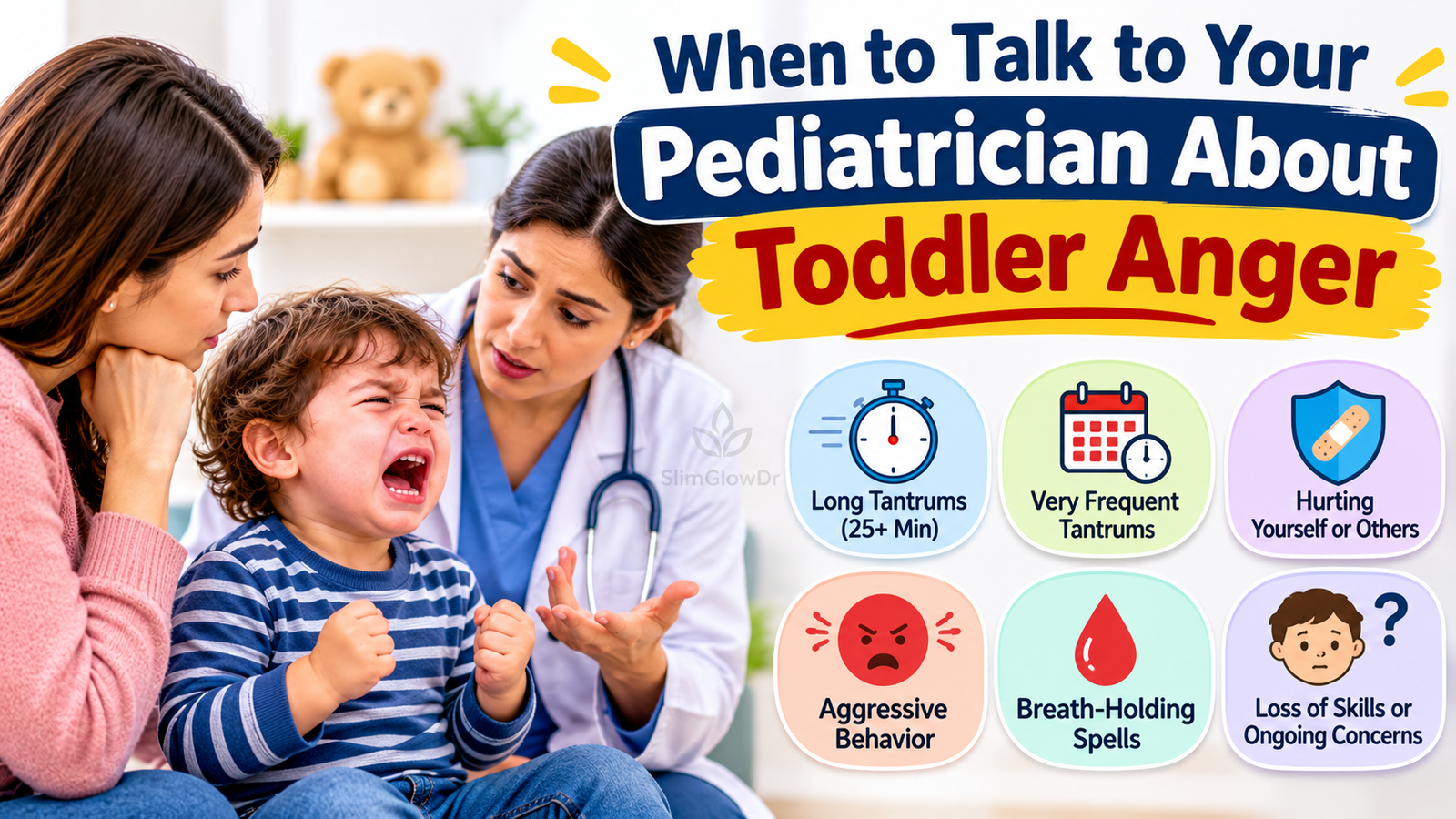
Most toddler anger is normal. Needing your help to calm down is expected at this age and isn't a warning sign on its own. Still, some patterns are worth discussing with your pediatrician:
- Tantrums that regularly last longer than about 25 minutes. Research on preschoolers (ages 3 to 5) suggested this as a possible marker of concern; healthy children in that study averaged about 12 minutes (Belden et al., 2008).
- Very frequent tantrums, or tantrums that happen more often, become more intense, or last longer over time. The same preschool research flagged 10 to 20 tantrums on separate days within a month at home, or more than five a day on several days outside the home.
- Your child often hurts themselves during tantrums, or regularly hurts others, attacks adults, or is being sent home from childcare.
- Unusually aggressive behavior lasting longer than a few weeks, as the AAP describes it.
- Breath-holding spells with fainting. Seattle Children's notes these breath-holding spells usually start between 6 months and 2 years and go away by age 6; they're frightening but generally harmless. Get medical advice after a first spell. Call 911 if breathing has stopped for more than one minute and hasn't returned. A doctor may check for underlying causes.
- Tantrums that persist or get worse after about age 4, when they're usually much less common.
- Losing skills your child used to have, such as words or social skills. This is a general developmental red flag, not specific to tantrums.
- Concerns about speech, social interaction, play, or sleep alongside frequent outbursts.
Belden and colleagues note that clinical use of their thresholds hasn't been formally established, and up to 30% of healthy children in their study showed some of these behaviors. No single sign means something is wrong.
Frequent, intense outbursts alongside concerns about speech, social interaction, or play are worth a closer look. Reading about the signs of developmental delay in toddlers and the CDC's "Learn the Signs. Act Early." guidance can help you prepare for that conversation. For children under 3 in the US, you can also learn how to request an early intervention evaluation yourself, without waiting for a referral.
If your toddler's outbursts match any of these signs, or you're worried about speech or development, talk to your pediatrician.
Your wellbeing counts too. KidsHealth suggests talking to a doctor if you often feel angry or out of control when responding, if you keep giving in, or if tantrums are causing a lot of conflict at home. If you ever feel overwhelmed or afraid you might lose control, put your child somewhere safe, step away for a moment, and reach out. Talk to your pediatrician or your own doctor, or call the free, 24/7 National Parent & Youth Helpline at 1-855-427-2736.
Outside the US?
In the UK, talk to your health visitor or GP; the NHS advice on toddler tantrums also lists the free Family Lives helpline (0808 800 2222). In Australia, the government-funded Raising Children Network has guidance on toddler tantrums, and your GP is a good first contact.
Key Takeaways
- Toddler anger and tantrums are developmentally normal and usually ease from about age 3 to 4.
- Toddlers calm down by borrowing an adult's calm, so steady yourself first.
- Name the feeling, accept it, and still hold the limit. Don't give in as a pattern, and don't punish the feeling.
- Hitting, screaming, and not listening each have a specific, calm response.
- Toddler anger management mostly happens between meltdowns: routines, feeling words, praise, and repair.
- Talk to your pediatrician about tantrums that are very long or frequent, involve self-injury or regular aggression, come with breath-holding and fainting, worsen after age 4, or appear alongside speech, social, or developmental concerns.
Conclusion
Toddler anger can feel relentless, but it's a normal stage, and calm is a skill that both toddlers and parents can learn. Knowing how to calm an angry toddler comes down to three phases: steady yourself and keep everyone safe in the moment, have a plan for flashpoints like hitting, screaming, and not listening, and build skills between meltdowns.
These strategies are drawn from pediatric guidance and from approaches that have been tested in research, and they help many families. No single strategy works every time for every child, though, and that's not a sign you're doing it wrong.
Your next step: pick one in-the-moment strategy (Strategy 1, steadying yourself, is a strong place to start) and one between-meltdowns strategy to practice this week. Save the "What to Say Instead" table so it's on hand for the next hard moment. You can also subscribe to the Slim Glow Dr newsletter.
This article is for general information and isn't a substitute for individual advice from your child's pediatrician or another qualified health professional. If you're worried about your child's behavior, development, or safety, contact your pediatrician. This article contains no product recommendations.
Frequently Asked Questions
Should I ignore my toddler's tantrum?
Sometimes, but only for attention-seeking behavior, not distress or danger. KidsHealth suggests tantrums aimed at getting attention are best ignored, and the AAP says ignoring minor misbehavior can work when your child is safe and gets plenty of positive attention otherwise. If your toddler is truly upset, the CDC recommends staying close and offering comfort instead. Never ignore hitting, biting, or unsafe behavior, and when ignoring, ignore the behavior while staying nearby.
Do time-outs work for toddlers, and at what age?
Time-outs can work for some children from about age 2, used briefly and calmly. The CDC and AAP suggest about one minute per year of age, mainly for unsafe behavior such as hitting or biting. The AAP calls time-out a last resort for aggression, and the NHS questions using it with angry or sad toddlers. Whatever you choose, follow up by praising the next good thing your child does.
How long is too long for a toddler tantrum?
Most tantrums are short. In one research sample of children 18 to 60 months (Potegal and Davidson, as cited by Belden and colleagues), the median tantrum lasted about 3 minutes, and three-quarters lasted 1.5 to 5 minutes. Research in preschoolers suggests discussing it with your pediatrician if tantrums regularly last longer than about 25 minutes on average, especially alongside self-injury or frequent aggression.
At what age do tantrums usually stop?
Tantrums usually ease from about age 3 to 4, though they rarely disappear overnight. The AAP says they tend to get better after age 3, and the NHS says they're much less common by age 4. Occasional outbursts can continue into the preschool years. Tantrums that intensify rather than fade after about age 4 are worth raising with your pediatrician.
How do I handle a toddler tantrum in public?
Focus on your child, not the audience. Move to a quieter spot if you can, such as the car or a store corner, and use the same calm steps you'd use at home: few words, name the feeling, hold the limit. The CDC also suggests asking permission before physical touch as your child calms. Keeping errands short and planning around naps and snacks helps prevent public meltdowns.
Can speech delay cause tantrums?
Speech delay is linked to more frequent tantrums, but research hasn't shown it directly causes them. A Northwestern study found late talkers had severe or frequent tantrums at about twice the rate of peers. Toddlers who can't express their needs often get frustrated. If your child has fewer than 50 words or isn't combining words by age 2, ask your pediatrician about a speech and language check. Our guide to a toddler not talking at 2 explains the next steps.
Are frequent tantrums a sign of autism or ADHD?
Tantrums alone aren't a sign of autism or ADHD, and most frequent tantrums are part of typical development. AAP guidelines on diagnosing ADHD start at age 4. If frequent, intense outbursts come with concerns about speech, social interaction, or play, talk to your pediatrician, who can assess development and refer you to early intervention if needed. Our overview of developmental delay signs in toddlers can help you prepare.
What should I do if I yell at my toddler?
Pause, calm down, and repair. Once you're both settled, get down to your child's level and offer a short apology: "I yelled. I'm sorry. I'm working on staying calm too." This is practitioner advice. One moment of yelling doesn't define your parenting; what matters is the overall pattern of warmth and coming back to reconnect.